The results are starting to show. According to PIB data from March 2026, cumulative investment under PLI has crossed ₹2.16 lakh crore, with over 14.39 lakh jobs created and production exceeding ₹20 lakh crore.
This article covers what the PLI Scheme is, how the incentive mechanism works, all 14 sectors with their key figures, eligibility requirements, and what the scheme has actually delivered — including where it has fallen short.
Key Takeaways
- ₹1.97 lakh crore committed across 14 sectors; actual investment has surpassed ₹2.16 lakh crore
- Incentives are performance-based — calculated on incremental sales above an FY 2019–20 baseline
- Electronics dominates: LSEM alone exceeded production targets by 136% and made India the world's 2nd largest mobile manufacturer
- Food processing created 3.39 lakh jobs on ₹9,207 crore investment, among the highest employment returns of any PLI sector
- Solar PV has disbursed zero funds despite a ₹24,000 crore outlay, due to a structural design mismatch in incentive thresholds
What Is the PLI Scheme?
The Production-Linked Incentive Scheme is a performance-based government programme that pays eligible manufacturers a financial incentive — ranging from roughly 4% to 18% depending on the sector — on incremental sales above a defined base year. The incentive is tied entirely to output, not to upfront inputs.
India historically ran large trade deficits in electronics, pharmaceuticals, and capital goods due to structural import dependence. PLI was designed to reverse this by making domestic manufacturing financially attractive enough to compete globally — and by tying every rupee of government support to verified production output, not promises.
A Brief History
- March 2020: Scheme launched for three sectors — mobile manufacturing, pharmaceutical APIs/KSMs, and medical devices
- November 2020: Expanded to 10 additional sectors, bringing the total to 14
- FY 2021–22 onwards: Full implementation begins with ₹1.97 lakh crore committed over five years
How the Incentive Actually Works
The mechanism works like a performance bonus: a manufacturer earns a percentage of every additional rupee in sales above their baseline. The government co-invests in production growth rather than subsidising inputs upfront.
Practical example:
- Base year sales: ₹500 crore
- Year 2 actual sales: ₹800 crore
- Incremental sales: ₹300 crore
- Incentive at 5%: ₹15 crore — disbursed after submission and verification of audited sales data
How PLI Differs from Related Schemes
PLI is often grouped with Make in India and Startup India, but the three serve distinct roles:
- PLI — cash incentive tied directly to incremental sales; disbursed after audited verification
- Make in India — creates the manufacturing environment through FDI policy, ease of doing business, and infrastructure
- Startup India — targets early-stage innovation through tax exemptions, funding access, and regulatory simplification
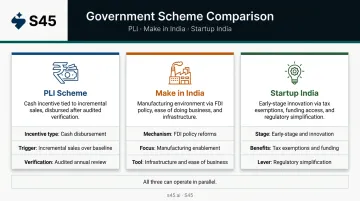
All three can operate in parallel. PLI is the only one where the government's contribution is conditional on what a manufacturer actually ships.
PLI Sectors: All 14 Covered
The 14 sectors fall into five broad clusters. Here is the complete picture:
Electronics and Technology
| Sector | Outlay (₹ Crore) | Incentive Rate |
|---|---|---|
| Large Scale Electronics Manufacturing (LSEM) | 40,951 | 4–6% |
| Telecom & Networking Products | 12,195 | 6–7% |
| IT Hardware | 5,000 | 2–4% |
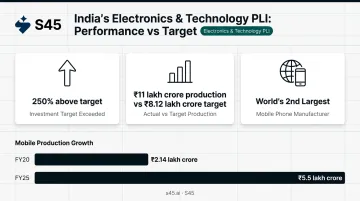
This cluster was prioritised because India was a net importer of smartphones and telecom equipment. The results from LSEM have been striking: investment exceeded the scheme target by 250%, production hit ₹11 lakh crore against a target of ₹8.12 lakh crore, and India is now the world's 2nd largest mobile phone manufacturer. Mobile production grew from ₹2.14 lakh crore in FY 2019–20 to ₹5.5 lakh crore in FY 2024–25.
Healthcare and Life Sciences
| Sector | Outlay (₹ Crore) | Key Outcome |
|---|---|---|
| Pharmaceuticals | 15,000 | ₹2.66 lakh crore cumulative sales |
| Bulk Drugs (APIs/KSMs) | 6,940 | India flipped from net importer to net exporter |
| Medical Devices | 3,420 | Device exports grew from $2.5B to $4B (FY21–FY25) |
The bulk drugs programme has been particularly significant for supply chain security. India went from being a net importer of ₹1,930 crore in bulk drugs (FY22) to a net exporter of ₹2,280 crore, with 38 commissioned projects and ₹3,591 crore in import avoidance.
Pharmaceuticals PLI has also channelled 40% of its ₹37,306 crore investment into R&D — an unusually high proportion for a manufacturing incentive scheme.
Mobility and Clean Energy
| Sector | Outlay (₹ Crore) | Key Outcome |
|---|---|---|
| Automobiles & Auto Components | 57,042 | ₹29,576 crore investment; 44,987 jobs |
| Advanced Chemistry Cell Batteries | 18,100 | Capacity build-out underway |
The automobile sector carries the largest single PLI outlay (₹57,042 crore), with a strategic focus on EVs and advanced components. That focus is translating into activity: by March 2025, the scheme had attracted ₹29,576 crore in investment and created nearly 45,000 jobs, with disbursals at ₹2,377 crore so far.
Sustainability and Green Technology
| Sector | Outlay (₹ Crore) | Status |
|---|---|---|
| Solar PV Modules | 24,000 | Zero disbursals as of February 2026 |
| Drones & Drone Components | 120 | Turnover growth driven by MSMEs/startups |
Solar PV deserves a frank note: despite 48,337 MW of awarded manufacturing capacity and approximately 30 GW of module capacity commissioned, no funds have been released as of February 2026.
The scheme requires one year of post-commissioning operations before disbursement triggers. This is a design feature, not a programme failure, but it has created genuine cash flow uncertainty for manufacturers.
Core Industry and Exports
| Sector | Outlay (₹ Crore) | Key Outcome |
|---|---|---|
| Food Processing | 10,900 | 3.39 lakh jobs; ₹9,207 crore invested |
| Textiles (MMF & Technical) | 10,683 | MMF exports: $6B; Technical: $3.3B (FY25) |
| Specialty Steel | 6,322 | Data limited |
| White Goods (ACs & LEDs) | 6,238 | 154 total beneficiaries |
Food processing stands out for employment intensity: ₹0.27 crore per job created, compared to ₹0.66 crore per job in automotive. With 69 MSME beneficiaries and 165 total approved applications, it is also among the most accessible PLI sectors for smaller manufacturers.
How the PLI Scheme Works
The Base Year Mechanism
FY 2019–20 is the standard base year for most sectors launched in 2020. Each year, a company's current sales are measured against that baseline — only the incremental portion qualifies for the incentive. For sectors launched later (such as bulk drugs, with a tenure from FY 2022–23 to FY 2028–29), the base year aligns with the scheme's launch date.
What Counts Toward Investment Thresholds
Investment threshold eligibility breaks down as follows:
- ✅ Counts: Plant and machinery, manufacturing equipment, R&D infrastructure
- ❌ Does not count: Working capital, land costs, pre-existing capacity
The Claim and Disbursement Process
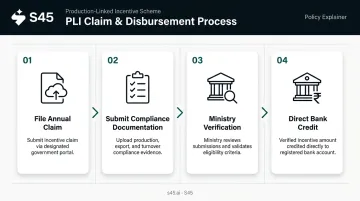
- File annual claim through the designated government portal with certified sales data
- Submit compliance documentation — audited financials, investment proofs, production records
- Ministry verification — the concerned nodal ministry reviews submissions
- Direct credit to company's bank account upon approval
The incentive period runs four to six years depending on the sector (bulk drugs runs seven years). Electronics disbursals account for over 54% of the ₹28,748 crore total disbursed across all 14 sectors as of December 2025, driven by both the sector's scheme design and its early operational readiness relative to other verticals.
PLI Eligibility and Objectives
Who Can Apply
General eligibility requirements across most sectors:
- Must be a company registered in India under the Companies Act 2013 (Indian subsidiaries of foreign companies are eligible)
- Must meet sector-specific minimum investment thresholds — ranging from ₹5 crore in medical devices to ₹200 crore or more in mobile manufacturing
- Must demonstrate capacity for year-on-year incremental sales above the base year benchmark
- Sectors like bulk drugs, medical devices, drones, food processing, and telecom deliberately set lower thresholds — 176 MSMEs are among approved PLI beneficiaries as a result
These criteria vary by sector, but the underlying logic is consistent: the scheme is structured to pull in a wide range of manufacturers, not just large conglomerates.
The Five Core Objectives
| Objective | Government's Intent |
|---|---|
| Reduce import dependence | Replace critical imports with domestic production |
| Attract investment | Both domestic and FDI into manufacturing |
| Boost export competitiveness | Integrate India into global supply chains |
| Create employment | Large-scale direct and indirect job creation |
| Supply chain integration | Position India as an alternative to China in high-value sectors |
PLI Scheme Achievements and Challenges
The Headline Numbers
As of December 2025:
- ₹2.16 lakh crore cumulative investment (exceeds the ₹1.97 lakh crore incentive outlay)
- ₹20.41 lakh crore in production/sales
- ₹8.3 lakh crore+ in exports
- 14.39 lakh direct and indirect jobs created
- 836 approved applications across all sectors
Sector-Specific Highlights
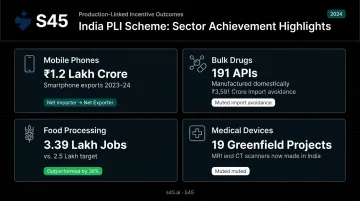
- Mobile phones: India went from net importer to net exporter; smartphone exports have crossed ₹1.2 lakh crore
- Bulk drugs: 191 APIs/KSMs manufactured domestically for the first time; ₹3,591 crore import avoidance
- Food processing: 3.39 lakh jobs created against a target of 2.5 lakh — outperformed by 36%
- Medical devices: 19 greenfield projects commissioned producing MRI machines and CT scanners that were previously imported entirely
The headline wins are real — but the scheme has also exposed structural gaps that policy planners and beneficiaries are still working through.
Where the Scheme Has Fallen Short
- Solar PV: Zero disbursals despite massive capacity build-out — post-commissioning period requirements have delayed any cash flows to manufacturers
- Specialty Steel and Telecom: Limited publicly available outcome data; disbursal progress has been slower than electronics
- Capital intensity critique: The National Council of Applied Economic Research (NCAER) has noted that over half of approved incentives flow to highly automated sectors — rewarding capital deployment while generating fewer jobs per crore of incentive than labour-intensive industries
- Compliance burden: Annual claim filing, documentation requirements, and verification timelines create working capital planning challenges for mid-sized beneficiaries
What PLI Growth Means for Manufacturers Eyeing Public Markets
PLI participation can mark a structural inflection point in a manufacturer's growth story. Companies that have scaled production under the scheme tend to share a specific profile: demonstrated incremental sales growth over multiple years, audited financials with government-validated revenue, reduced import dependence, and growing export contribution. That combination builds the clean, credible equity narrative institutional investors look for in IPO candidates.
As PLI-backed companies in sectors like electronics, pharmaceuticals, automotive components, and food processing reach scale, many are beginning to explore public markets as the logical next step for capital formation. Listed PLI beneficiaries — including Dixon Technologies, Amber Enterprises, and Aurobindo Pharma — have demonstrated that the market values manufacturing scale stories backed by government-validated compliance and production data.
For manufacturers on this path, S45 — India's first AI-native investment bank — works with growth-stage manufacturers across PLI-eligible sectors including healthcare, automotive, industrial goods, food processing, and technology. Two services are particularly relevant for companies 12–24 months from a potential listing:
- IPO Readiness Scan: Identifies compliance gaps early (board independence issues, related-party transaction disclosures, statutory dues) before they become SEBI observations.
- Demand Thesis: Maps cohort-level institutional investor appetite for manufacturing and industrialisation-themed IPOs, giving founders a clear read on market demand before committing to a Lead Manager mandate.
Frequently Asked Questions
What is the PLI Scheme?
The Production-Linked Incentive Scheme is a government programme that provides financial incentives of 4% to 18% on incremental sales above a base year to eligible manufacturers across 14 priority sectors. It is designed to boost domestic production, reduce import dependence, and increase exports.
What sectors are covered under the PLI Scheme?
All 14 sectors span electronics (mobile manufacturing, IT hardware, telecom), healthcare (pharmaceuticals, bulk drugs, medical devices), mobility (automobiles, ACC batteries), sustainability (solar PV, drones), and core industries (specialty steel, textiles, white goods, food processing).
Who is eligible to apply for the PLI Scheme?
Indian-registered companies — including subsidiaries of foreign firms — that meet sector-specific minimum investment thresholds and can demonstrate incremental sales growth above the FY 2019–20 base year are eligible. MSMEs qualify in several sectors with lower investment thresholds.
How much incentive can a company earn under PLI?
Incentive rates vary by sector: from around 3% in food processing and textiles to 18% in automotive for EVs. The incentive is applied annually on incremental sales above the base year for four to seven years.
How has PLI impacted India's exports?
PLI-linked exports have surpassed ₹8.3 lakh crore as of December 2025, with significant contributions from electronics, pharmaceuticals, and food processing. Smartphone exports alone have crossed ₹1.2 lakh crore, and India is now the world's 2nd largest mobile phone manufacturer.
Can MSMEs participate in the PLI Scheme?
Yes. 176 MSMEs are among approved PLI beneficiaries, with sectors like bulk drugs, medical devices, drones, food processing, and telecom setting lower investment thresholds for smaller manufacturers.