
Introduction
Getting listed on a stock exchange marks one of the most significant milestones a company can achieve. It signals the transition from a privately held business to one that is publicly owned, regulated, and traded on platforms like BSE or NSE in India.
India's IPO market has demonstrated extraordinary momentum. In calendar year 2025, 370 IPOs raised a record ₹1,87,331 crore — comprising 103 Main Board offerings (₹1,75,901 crore) and 267 SME issues (₹11,430 crore).
An all-time high of 249 companies filed offer documents with SEBI in 2025, up from 145 in 2024, signalling that more Indian businesses are seriously considering going public.
That momentum doesn't make the path straightforward. Getting listed involves regulatory approvals, financial disclosures, banker coordination, and a defined sequence of steps — most founders underestimate the preparation required, and that's where the process breaks down.
Key Takeaways
- Listing means selling shares to the public through an Initial Public Offering (IPO), after which shares trade freely on BSE or NSE
- Companies must meet SEBI's eligibility across financials, governance, and minimum public shareholding before filing
- The process moves through readiness, intermediary appointments, DRHP filing, roadshows, pricing, and listing — Main Board listings typically take 6–12 months; SME listings run 2–3 months
- India offers Main Board (larger firms) and SME routes (smaller businesses), each with different thresholds and timelines
- Preparation and advisor selection are the biggest variables in execution speed and quality
What Does Getting Listed on a Stock Exchange Mean?
Listing is the formal admission of a company's shares to trade on a recognised stock exchange — BSE or NSE in India — following a public offering where shares are sold to investors for the first time. It is the end outcome of the IPO process, not a standalone event.
Under the Securities Contracts (Regulation) Act, 1956, Section 21 requires listed companies to comply with the listing agreement conditions of the exchange.
Why companies pursue a listing
- Raises large-scale funding from public investors to fuel growth, expansion, or working capital
- Gives founders, promoters, and PE investors a clear exit route through share sales
- Builds brand visibility, attracts stronger talent, and lets companies negotiate from a stronger position with suppliers and customers
- Creates a currency for acquisitions and employee stock incentive programs
The trade-off is real, though. Listing brings ongoing obligations — quarterly disclosures, public scrutiny, and adherence to corporate governance standards under LODR (Listing Obligations and Disclosure Requirements) Regulations.
Listing is also distinct from registering a company or raising private equity. It requires filing a draft prospectus, conducting a public offer, receiving regulatory approval, and complying with both SEBI's ICDR Regulations and the exchange's listing agreement — each step with its own timeline and documentation burden.
What Are the Requirements to Get Listed on BSE or NSE in India?
Eligibility requirements are governed by SEBI's Issue of Capital and Disclosure Requirements (ICDR) Regulations. Missing any one threshold — financial, governance, or shareholding — can delay or block a listing. Here's what SEBI and the exchanges require.
Financial Eligibility for Main Board IPOs
Profitability Route (Regulation 6(1)):
- Net tangible assets of at least ₹3 crore in each of the preceding 3 full years (max 50% in monetary assets unless firm commitments exist)
- Average pre-tax operating profit of at least ₹15 crore during the preceding 3 years, with operating profit in each of those years
- Net worth of at least ₹1 crore in each of the preceding 3 years
- If name changed within last 1 year, at least 50% of revenue must come from the activity indicated by the new name
QIB Route (Alternative – Regulation 6(2)):
For companies not meeting profitability criteria: issue must be made through 100% book-building with at least 75% of the net offer allocated to Qualified Institutional Buyers (QIBs). SEBI mandates a full refund if QIB subscription falls below 75%.
Exchange-Level Requirements:
| Criterion | Threshold |
|---|---|
| Post-issue paid-up equity capital | ₹10 crore minimum |
| Post-issue market capitalisation | ₹25 crore minimum |
| Track record | 3 years (company, promoters, or promoting entity) |
| Net worth | Positive (unless issue size exceeds ₹500 crore) |
Financial Eligibility for SME IPOs
SME platforms (BSE SME / NSE Emerge) have lower thresholds:
- Post-issue paid-up capital: ₹3 crore minimum, ₹25 crore maximum (hard ceiling separating SME from Main Board)
- Operating profit: At least ₹1 crore in any 2 of the preceding 3 financial years
- Track record: 3 years
- Minimum promoter holding post-issue: 20%
- Offer for Sale (OFS) cap: 20% of total issue size
Corporate Governance Requirements
SEBI requires these governance structures to be in place before the DRHP is filed:
- At least one-third of the board must be independent directors (or half, if the chairperson is executive or related to a promoter)
- Audit Committee must have a minimum of 3 directors — at least two-thirds independent, all financially literate, with an independent chairperson
- 3 years of audited financial statements covering the prescribed period
Getting governance right early avoids last-minute restructuring that delays the DRHP filing.
Minimum Public Shareholding (MPS) and Lock-in
MPS Norm:
SEBI LODR Regulation 38 requires minimum public shareholding of 25% post-listing. Promoters cannot hold more than 75% of the company.
Promoter Lock-in Periods (amended May 2024):
| Shareholding Category | Lock-in Period |
|---|---|
| Minimum promoter contribution (20% of post-issue capital) | 18 months from allotment |
| Excess promoter holding (above 20%) | 6 months from allotment |
| Pre-IPO non-promoter shareholders | 6 months (with exemptions for VCFs, AIFs, FVCIs held ≥1 year) |
For founders planning liquidity, the lock-in structure determines when and how much they can exit — making it a factor worth modelling early in IPO planning.
How Does the Stock Exchange Listing Process Work?
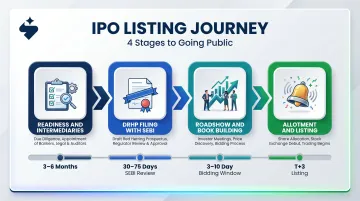
The path from private company to listed entity follows a defined sequence. Skipping or rushing any stage — particularly documentation and regulatory review — is a common reason IPOs get delayed or rejected.
Stage 1: Readiness Assessment and Appointing Intermediaries
Readiness Assessment (3–6 months):
Before filing anything, companies must assess IPO readiness:
- Restate financial accounts to SEBI standards (Ind-AS compliance)
- Strengthen governance structures (board composition, audit committee)
- Resolve legal or compliance gaps (pending litigation, IP issues, land titles)
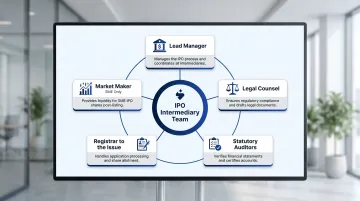
Appointing Key Intermediaries:
| Role | Function |
|---|---|
| Lead Manager (Merchant Banker) | Primary coordinator; SEBI-registered investment bank |
| Legal Counsel | Draft agreements, conduct due diligence |
| Statutory Auditors | Audit financials, issue certificates |
| Registrar to the Issue | Manage applications, allotment, refunds |
| Market Maker (SME only) | Provide liquidity post-listing |
Choosing the right lead manager has an outsized effect on execution speed and quality. S45, for instance, moves from first call to signed mandate in approximately 7 days and delivers a DRHP-ready draft in 30–45 days — compressing a stage that traditionally stretches for months. The firm pairs sector bankers with proprietary AI analytics for readiness scans, evidence-linked drafting, and real-time book management, and has executed 26 IPOs since July 2023 with a 168x average subscription.
Stage 2: Filing the DRHP with SEBI
The Draft Red Herring Prospectus (DRHP) is the primary disclosure document. It details:
- Company business and operations
- Audited financials for required periods
- Risk factors (industry, business, operational, regulatory)
- Use of proceeds
- Management and promoter background
The DRHP is filed with SEBI for review. SEBI issues observations (comments) that the company must address before the final prospectus is approved. SEBI's review typically takes 30–75 days. The DRHP is made public during this period, meaning competitors and media can scrutinise the filing.

Stage 3: Roadshow and Book Building
Roadshow:
A structured marketing exercise where management and the lead manager present to institutional investors — QIBs (mutual funds, insurance companies) and NIIs (high net worth individuals, corporates). The goal: gauge demand and build a credible valuation range.
Book-Building Process:
- Investors submit bids within a price band (floor to cap price)
- Bidding window: 3 working days minimum, 10 maximum
- Price band: cap cannot exceed 20% above floor
Oversubscription — bids exceeding shares available — signals strong investor confidence. In 2025, Main Board IPOs averaged approximately 34x oversubscription; SME IPOs averaged approximately 60x.
Stage 4: Allotment and Listing
Post-bidding:
Shares are allotted to investors based on SEBI's allotment norms:
| Investor Category | Reservation (Profitability Route) |
|---|---|
| Qualified Institutional Buyers (QIB) | Up to 50% |
| Non-Institutional Investors (NII) | At least 15% |
| Retail Individual Investors (RII) | At least 35% |
Listing Day:
The company lists on the exchange and trading begins. The listing price is determined by market supply and demand, not by the company. The gap between issue price and listing price is the listing pop (or listing loss if negative) — it reflects pricing accuracy and demand strength during book-building.
SEBI mandates listing within T+3 working days from the issue closing date.
Main Board vs. SME Listing: Which Route Is Right for You?
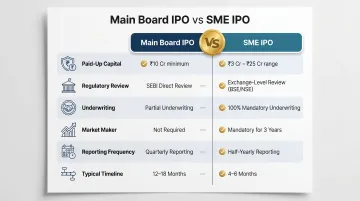
The right listing route depends on where your company stands today — not just in revenue, but in capital size, reporting capacity, and investor appetite. India's two primary pathways each serve a distinct stage:
Key Structural Differences
The table below maps the structural differences that affect your preparation timeline, compliance obligations, and investor base:
| Feature | Main Board IPO | SME IPO |
|---|---|---|
| Post-issue paid-up capital | ₹10 crore minimum; no upper limit | ₹3 crore minimum; ₹25 crore maximum |
| Offer document review | SEBI reviews DRHP | Stock exchange reviews; SEBI does not vet |
| Minimum application size | ₹14,000–15,000 (1 lot) | ₹1,00,000 (1 lot); investors apply for minimum 2 lots |
| Underwriting | Not mandatory | 100% mandatory |
| Market maker | Not required | Mandatory for at least 3 years post-listing |
| Financial reporting | Quarterly | Half-yearly |
| Minimum allottees | 1,000 | 50 |
SME IPO Activity in India
SME IPOs have grown significantly:
| Year | SME IPOs | Capital Raised |
|---|---|---|
| CY 2024 | 236 | ₹8,761 crore |
| CY 2025 | 267 | ₹11,430 crore |
Average SME issue size rose from ₹13 crore in 2021 to ₹43 crore in 2025 — a 3x increase that signals maturing deal quality, not just deal volume. For growth-stage companies not yet ready for Main Board scale, the SME platform has become a legitimate and well-capitalized first step toward public markets. Companies that execute well on this route have a clear path forward: migration to the Main Board once they meet the criteria.
Migration from SME to Main Board
SME companies that meet Main Board criteria can migrate without a separate IPO. NSE criteria include:
- Listed on SME platform for at least 3 years
- Post-issue paid-up capital of at least ₹10 crore
- Market capitalisation of at least ₹25 crore
- Net worth of at least ₹75 crore
- Positive EBITDA in each of the 3 preceding years
Conclusion
Getting listed on a stock exchange is a staged, multi-month process — and companies that treat it as one continuous sprint rather than a sequence of distinct phases tend to hit the most friction. Those that invest early in documentation discipline, regulatory preparation, and the right advisory team move faster and with far fewer surprises.
Understanding each stage — from SEBI eligibility through DRHP filing, bookbuilding, and listing day — lets founders plan timelines realistically and avoid last-minute scrambles. The process is demanding, but it is also predictable. Main Board mandates typically run 6–12 months from engagement to listing; SME listings can close in 2–3 months. Knowing which phase you're in, and what comes next, is half the battle.
Frequently Asked Questions
How does a company get listed on the stock market?
A company gets listed by completing an IPO: filing the DRHP with SEBI, receiving regulatory approval, conducting a public offer to investors, and having its shares admitted to trading on BSE or NSE on the listing date.
What are the requirements for a company to be listed on BSE or NSE?
Companies must satisfy three categories of requirements. Financial eligibility covers profitability or net worth track record under SEBI ICDR. Corporate governance standards require independent directors, audited financials, and an audit committee. Finally, a minimum public shareholding of 25% must be achieved post-listing.
Can a company get listed without an IPO?
Yes. Companies can list through a direct listing (without a fresh public offer) or migrate from SME to Main Board once they meet Main Board criteria. SEBI also allows listing on the Institutional Trading Platform (ITP) without a traditional IPO for startups.
Can a company be listed on both BSE and NSE?
Yes. Dual listing is permitted and common among large Indian companies. Each exchange has separate listing requirements and fees, but the payoff is broader investor access and higher trading liquidity.
What types of IPO structures exist in India?
IPOs in India fall into four structural types:
- Fixed Price Issue — offer price set upfront before the subscription window
- Book Building Issue — price discovered through investor bids within a declared band
- Fresh Issue — new shares issued to raise capital for the company
- Offer for Sale (OFS) — existing promoter or investor shares sold; no new capital enters the company
How long does it take to list on the Main Board versus an SME exchange?
Main Board listings typically require a 6–12 month engagement from readiness assessment to trading day. SME listings on NSE Emerge or BSE SME can move faster — often 2–3 months — given lighter regulatory thresholds, though SEBI compliance requirements still apply throughout.