
Introduction
Yes, you can sell SME IPO shares on listing day — but the mechanics work differently from mainboard IPOs. SME listings operate under distinct rules: mandatory lot sizes, dedicated exchange platforms (BSE SME or NSE Emerge), and market maker obligations that shape how, when, and at what price you can actually exit.
Nearly 65% of 2024 SME listings were trading below their issue price by early 2026, despite 90% delivering positive opening-day gains. That gap between the opening pop and post-listing erosion is exactly why knowing your exit options before listing day matters.
This article covers:
- Whether lock-in periods apply to retail allottees on listing day
- How lot-size requirements and market maker liquidity affect your ability to sell
- What to watch for on listing day to time your exit effectively
Key Takeaways
- Retail investors can sell SME IPO shares on listing day once trading begins—no lock-in period applies
- Sales must occur on dedicated SME platforms (BSE SME or NSE Emerge) in fixed lot sizes, not individual shares
- Allotted shares credit to your demat by T+2; listing follows on T+3 per SEBI's August 2023 circular on T+3 listing
- Promoters face 3-year lock-in on minimum promoter contribution; anchor investors have 30- and 90-day restrictions
- Low liquidity and volatile price discovery favour limit orders over market orders on listing day
Can You Sell SME IPO Shares on Listing Day?
Yes, retail investors can sell allotted SME IPO shares on listing day. Under SEBI ICDR Regulations, there is no mandatory holding period for retail applicants, HNIs, or non-anchor QIB investors.
That said, you can only trade once shares are credited to your demat account and the stock is officially listed. Under SEBI Circular SEBI/HO/CFD/TPD1/CIR/P/2023/140 (August 9, 2023), all public issues opening on or after December 1, 2023 follow a T+3 listing timeline:
- T+2: Shares credited to demat accounts (typically by 6 PM)
- T+3: Listing and trading commence
Investor category distinctions:
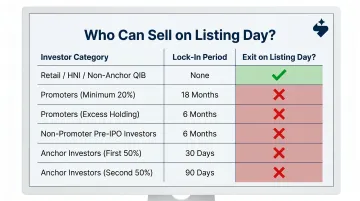
| Category | Lock-in Period | Can Sell on Listing Day? |
|---|---|---|
| Retail, HNI, Non-anchor QIB | None | Yes |
| Promoters (20% minimum contribution) | 3 years from allotment | No |
| Promoters (excess above 20%) | 1 year from allotment | No |
| Non-promoter pre-IPO shareholders | 6 months from allotment | No |
| Anchor investors (first 50%) | 30 days from allotment | No |
| Anchor investors (second 50%) | 90 days from allotment | No |
Key Rules for Selling SME IPO Shares
Lot Size Is Mandatory
Unlike mainboard stocks where you can sell a single share, SME IPOs require trades in fixed lot sizes specified in the IPO prospectus. If the lot size is 1,200 shares, you must sell in exact multiples of 1,200—not 600, not 1,800 individual shares.
SEBI raised the minimum application size from ₹1 lakh to ₹2 lakh for DRHPs filed on or after April 1, 2025. Lot sizes are set by merchant bankers to ensure each lot exceeds this minimum value at the issue price.
Recent SME IPO lot size examples:
- Rajesh Power Services: 400 shares (₹335 issue price)
- Agarwal Toughened Glass: 1,200 shares (₹108 issue price)
- Mangal Compusolution: 3,000 shares (₹45 issue price)
This constraint significantly increases capital exposure per trade and complicates partial exits. If liquidity is thin and you hold two lots worth ₹4 lakh, you cannot sell half—you sell both lots or none.
Odd-lot provision: If you hold less than one full lot, you may sell your entire holding to the market maker, who is obligated to purchase odd lots under NSE Emerge market maker rules.
Trading Only on SME Platforms
SME IPO shares are not listed on the main NSE or BSE boards. They trade exclusively on:
- NSE Emerge (for NSE-listed SME stocks)
- BSE SME (for BSE-listed SME stocks)
Before attempting to sell, confirm your broker and trading account support these SME exchange segments. Major brokers like Zerodha, Angel One, and Groww provide access, but not all platforms seamlessly support pre-open or intraday SME trading.
The Pre-Open Session and Regular Trading Window
Special pre-open session for SME IPO listings:
| Phase | Timing | Activity |
|---|---|---|
| Order Entry Period | 9:00 AM - 9:35 AM | Place, modify, or cancel limit orders only |
| Random Closure Window | 9:35 AM - 9:45 AM | System randomly closes; limit orders only |
| Order Matching & Price Discovery | 9:45 AM - 9:55 AM | Call auction determines opening price; no new orders |
| Buffer Period | 9:55 AM - 10:00 AM | System preparation; no orders |
| Regular Trading | 10:00 AM - 3:30 PM | Normal trading with standard order types |
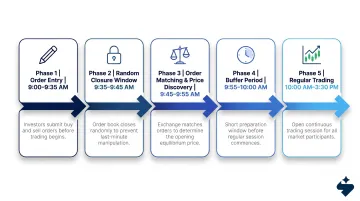
During the pre-open session, only limit orders are accepted—market orders are not permitted. Orders placed during 9:00-9:45 AM participate in price discovery at 9:45 AM, but execution happens when regular trading opens at 10:00 AM.
No standard circuit limits apply on listing day. Instead, dummy circuit filters set initial operating ranges between 25% and 75%, flexed in 10% increments as needed. Unmatched limit orders from pre-open carry forward into regular trading.
The Market Maker Role
Thin retail volumes are a real risk in SME trading—which is why SEBI mandates every SME IPO appoint a SEBI-registered market maker under Regulation 261 of SEBI ICDR 2018. This ensures baseline liquidity is available from day one.
Market maker obligations:
- Duration: Minimum 3 years from listing date
- Two-way quotes: Provide buy and sell quotes for at least 75% of trading time each day
- Minimum quote depth: ₹1,00,000 per quote
- Minimum inventory: 5% of issue size
- Odd-lot purchase: Must buy entire holdings below minimum tradable lot size
The market maker must quote on both sides for at least 75% of the trading day, so you can typically find a buyer even when retail volumes are thin. The trade-off: the price may be below your target, since you're transacting at the market maker's quoted bid rather than open-market competition.
How to Sell SME IPO Shares on Listing Day: Step-by-Step
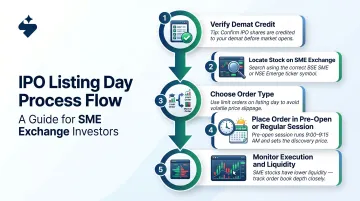
Step 1 — Verify demat credit Log into your trading app the night before listing day and confirm the allotted shares appear in your holdings or portfolio section. Shares are typically credited by 6 PM on T+2. If shares are not visible, contact your broker immediately.
Step 2 — Locate the stock on the correct SME exchange Search for the stock specifically under the NSE Emerge or BSE SME segment in your trading platform—not the main board. Some platforms have separate sections for SME stocks; ensure you are viewing the right segment.
Step 3 — Choose your order type Decide between a limit order and a market order before you act:
- Limit order (recommended for listing day): Sets a minimum sell price, protecting against sudden dips or execution at unfavourable prices.
- Market order (use with caution): Executes at the prevailing price. In low-liquidity, high-volatility conditions, it can fill well below expectations, especially in the first minutes of trading.
Step 4 — Place the sell order during pre-open or regular session To target the opening price, place a limit sell order during the pre-open window (9:00–9:45 AM). Unmatched orders carry over automatically, or you can re-place them when regular trading opens at 10:00 AM.
Set your limit price based on observed bid-ask spreads and your exit target before placing.
Step 5 — Monitor execution and track liquidity Check the order book for market depth before placing the order. If the bid-ask spread is wide or volumes are very low, you have three practical adjustments:
- Adjust your limit price slightly lower to match available demand
- Wait for volumes to build in the first 30–60 minutes of regular trading
- Hold until the afternoon session if morning volatility makes execution unpredictable
Liquidity Realities and Pitfalls to Avoid
SME stocks face structural liquidity challenges that make listing-day exits harder than mainboard IPOs. Trading volumes are significantly lower, meaning large sell orders relative to daily volume can move the price against you or go partially unexecuted.
SME IPO market growth and performance:
| Year | Number of SME IPOs | Amount Raised (₹ Cr) |
|---|---|---|
| 2021 | 59 | 746.14 |
| 2022 | 109 | 1,874.85 |
| 2023 | 182 | 4,686.11 |
| 2024 | 240 | 8,760.89 |
In 2024, 223 of 247 SME IPOs (90%) delivered positive listing-day gains. Yet NISM reports that nearly 65% of 2024 SME listings were trading below their issue price by early 2026. That gap between listing-day gains and six-month performance is where most retail exits go wrong. Three mistakes account for the majority of avoidable losses:
Use limit orders, not market orders. In a low-liquidity environment, a market order can execute well below your target—especially in the first few minutes of a volatile open. Set a floor price and stick to it.
Sell in exact lot multiples. Attempting to sell a partial quantity (say, 400 shares from a 1,200-share lot) will result in an order rejection. Sell in complete lots, or offload your entire odd-lot holding to the market maker.
Check order book depth before placing. A wide bid-ask spread or thin buy-side depth means your order may fill at a steep discount or not at all. Watch volumes build before committing, or adjust your limit price accordingly.
The quality of the original pricing also determines how much room you have on listing day. SME IPOs priced with genuine demand signals and institutional discipline tend to open predictably and hold gains longer than overpriced or thinly-subscribed issues. Across 26 IPOs since July 2023, S45 has averaged a 43% listing pop — a figure that reflects disciplined bookbuilding rather than speculative froth, which means investors entering at issue price start from a more defensible position.
Should You Sell on Listing Day or Hold?
The right call depends on your entry thesis, tax position, and risk tolerance. Here's how to think through it.
The case for selling on listing day:
- You applied purely for listing gains and the stock opens at a significant premium (30%+)
- Liquidity constraints may make exiting later at the same price harder
- Short-term capital gains tax is 20%, but locking in a 40-50% gain still delivers strong net returns
- Historical data shows 65% of 2024 SME listings fell below issue price post-listing
The case for holding:
- The company has strong fundamentals and the listing pop is modest (under 20%), suggesting the stock isn't overpriced
- You have conviction in the business and believe in long-term value creation
- Holding beyond 12 months qualifies for long-term capital gains tax at 12.5% (versus 20% short-term), with ₹1.25 lakh annual exemption
- You can tolerate volatility and illiquidity in the SME segment
Whichever path you choose, the tax treatment is the same regardless of when you decide — your holding period starts from the allotment date, not the listing date.
Tax implications (effective July 23, 2024):
| Holding Period | Tax Rate | Section | Exemption |
|---|---|---|---|
| Within 12 months (STCG) | 20% | 111A | None |
| Beyond 12 months (LTCG) | 12.5% | 112A | ₹1.25 lakh/year |
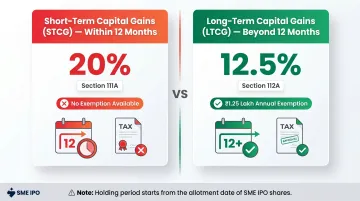
Since allotment and listing typically fall within days of each other, selling on listing day always triggers STCG at 20%.
Frequently Asked Questions
Can I sell SME IPO shares immediately?
Yes, retail investors can sell on listing day once shares are credited (by T+2) and trading begins (T+3). The earliest opportunity is the pre-open session (9:00-9:45 AM) on listing day, but execution happens when regular trading starts at 10:00 AM.
What are the rules for SME IPO sale?
Three core rules apply:
- Trades must occur on dedicated SME platforms (BSE SME or NSE Emerge)
- Sales must be in fixed lot sizes—not individual shares—as specified in the IPO prospectus
- Trading begins only after official listing on T+3
Can we withdraw SME IPO?
You can withdraw or modify your SME IPO application before the subscription window closes (typically by 5 PM on the final bidding day). Once allotment is done and shares are credited, withdrawal is no longer possible. The only exit at that point is selling on the exchange after listing.
Can we easily sell SME IPO shares?
No, selling SME shares is harder than mainboard exits due to lower liquidity, mandatory lot sizes, and fewer market participants. The mandatory market maker does provide baseline liquidity—offering two-way quotes with ₹1 lakh minimum depth for at least 3 years post-listing—but this is a floor, not a guarantee of easy exits.
Where to sell SME shares?
SME shares can only be sold on dedicated SME platforms—NSE Emerge for NSE-listed SME stocks or BSE SME for BSE-listed ones—via a broker that has access to these platforms. Confirm your broker supports SME segment trading before placing any orders.