
Yet most founders understand "going public" only in the abstract. They know the term. They've heard the outcomes. What they often lack is a clear-eyed view of what listing actually delivers — operationally, financially, and strategically — and whether those benefits apply to their business right now.
This article breaks down the concrete advantages of stock exchange listing in India, from capital access and credibility to founder liquidity and M&A optionality. No abstract promises — just the mechanisms that matter and when they matter most.
Key Takeaways
- Public markets give companies access to capital at a scale that private funding rarely matches — India's SME IPOs alone raised ₹6,100 crore in FY2025
- Listing confers regulatory credibility that improves credit terms, enterprise relationships, and talent acquisition
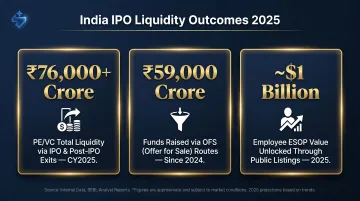
- PE/VC-backed listings generated ₹76,000+ crore in exits in CY2025, giving founders and early investors a structured, transparent way out
- Listed companies can use publicly priced stock as acquisition currency, which cuts cash outflows when buying other businesses
- These benefits compound over time, but only when the IPO is executed with pricing discipline and clean disclosures
What Is Stock Exchange Listing?
A stock exchange listing is the process by which a private company offers shares to the public for the first time through an IPO, and gets those shares traded on a regulated exchange — BSE or NSE in India.
Two distinct pathways exist:
| Platform | Best For | Post-Issue Paid-Up Capital |
|---|---|---|
| Main Board (NSE/BSE) | Established companies | Minimum ₹10 crore |
| SME (NSE Emerge / BSE SME) | Growth-stage companies | ₹1–25 crore |
Each pathway carries its own eligibility bar. Main Board requires an average operating profit of at least ₹15 crore over three preceding years and minimum net worth of ₹1 crore per year.
SME platforms set a lower threshold: positive cash accruals (EBDT) for at least two of the preceding financial years and a minimum three-year operating track record.
The SME pathway is not a consolation prize. Nearly one-third of BSE SME-listed companies eventually graduate to the Main Board — making the SME listing a legitimate stepping stone for companies not yet ready for the larger exchange.
Listing is a capital market tool — one that delivers real strategic advantages, but only for companies that arrive genuinely prepared.
Key Benefits of Listing on a Stock Exchange
Benefit 1: Access to Growth Capital at Scale
The most fundamental reason companies list is capital. An IPO lets a company raise funds from a broad base of public investors — QIBs, NIIs, and retail — in a single structured event, at a scale that private funding rounds rarely match.
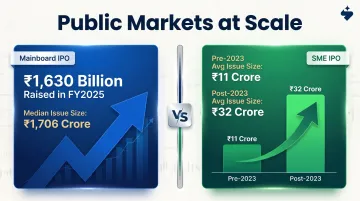
The numbers illustrate this. India's mainboard IPOs raised ₹1,630 billion in FY2025, with a median issue size of ₹1,706 crore. On the SME side, average issue size has grown from ₹11 crore (pre-2023) to ₹32 crore since January 2023 — a near-tripling that reflects genuine institutional appetite for growth-stage companies.
How the capital works in practice:
- Proceeds can be deployed toward capacity expansion, R&D, acquisitions, or debt repayment
- Listed companies can return to public markets via rights issues without the complexity of private negotiations
- Public market capital typically comes without the governance control trade-offs common in late-stage PE rounds
A concrete example: Anlon Healthcare raised ₹121 crore in its July 2023 IPO. By March 2026, the company had deployed ₹105.90 crore — ₹30.72 crore toward manufacturing expansion and ₹9.20 crore toward acquiring stakes in two companies. That capital trajectory — IPO proceeds funding both organic and inorganic growth — is the template many listed companies follow.
KPIs that typically shift after listing:
- Debt-to-equity ratio
- Capital expenditure coverage
- Revenue growth rate
- Return on capital employed (ROCE)
This matters most at inflection points — when organic growth has plateaued and private lenders won't fund the next phase alone. Manufacturing, healthcare, and infrastructure companies hit this ceiling regularly; listing is often what moves them past it.
Benefit 2: Enhanced Credibility, Brand Visibility, and Institutional Trust
A listing is a form of public validation. The SEBI scrutiny, mandatory disclosures, and prospectus filings signal to customers, suppliers, banks, and partners that the company operates at a measurably higher standard of governance and transparency.
This credibility creates downstream effects that are harder to quantify but real in impact:
- Banks offer better credit terms to listed companies with audited, publicly filed financials
- Enterprise customers are more willing to enter long-term contracts with counterparties that carry regulatory oversight
- Media coverage of a successful IPO reaches audiences that private companies rarely access
- Employee offer acceptance rates improve when candidates can verify the company's financial health independently
The SME platform data supports this directionally. Industry sources consistently note that after listing, SME companies are more trusted in negotiations with clients, suppliers, and lenders. The one-third graduation rate from BSE SME to Main Board is itself a credibility signal — it means listed SMEs attract the institutional attention needed to grow into larger companies.
When this benefit is highest: companies expanding into new geographies, moving upmarket in customer segments, or entering regulated industries where counterparty trust is a prerequisite. In B2B sectors like EPC, healthcare, or financial services, listing status can directly influence whether a company wins or loses a major contract.
Benefit 3: Liquidity for Founders and Early Investors, Plus M&A Currency
Listing unlocks two related advantages that private markets cannot replicate cleanly.
Founder and investor liquidity: An IPO gives founders, early employees, and pre-IPO investors a transparent, regulated mechanism to realise value — partially, not entirely. Founders can sell a portion of their stake through the OFS component while remaining in control of the business. For institutional investors like PEs and VCs, a listed exit is often preferable to a trade sale: it is more transparent, typically better priced, and allows phased divestment.
The scale of this activity in India is substantial. PE/VC-backed companies generated ₹76,000+ crore in total liquidity through IPO and post-IPO exits in CY2025 alone. Since 2024, investors have sold approximately ₹59,000 crore through OFS routes. These are not marginal numbers.
ESOP value at listing: Indian startup employees collectively unlocked approximately $1 billion through ESOPs via public listings in 2025. In Q1 2025 alone, employees across nearly 50 companies acquired shares worth ₹284 crore through ESOP exercises. Listing converts paper equity into real wealth — a retention and recruitment signal that private companies cannot match.
Stock as acquisition currency: Beyond personal liquidity, listing opens a corporate-level option: using publicly priced shares to fund acquisitions without large cash outflows. The HDFC–HDFC Bank merger — where HDFC shareholders received 42 HDFC Bank shares for every 25 HDFC shares — is the most prominent Indian example, creating the world's fourth-largest bank by market cap at completion.
KPIs that shift in this dimension: founder net worth realisation, investor IRR, share-based M&A deal value, and employee ESOP value at vesting. For companies in fragmented industries, the ability to consolidate through stock-funded deals is often what separates market leaders from also-rans.
What Happens When Companies Delay or Avoid Listing
Delaying a listing is not inherently wrong. But deferring without a plan has compounding costs.
Three costs compound for companies that wait without a clear plan:
- Market timing shifts fast. Mainboard listing-day gains dropped from 28% in FY2025 to 8% in FY2026. SME listing gains fell from ~80% in CY2024 to ~20% in CY2025. Companies that were ready in FY2025 but delayed captured more listing premium than those that waited.
- DRHP validity expires in 12 months. Miss that window and you refile — incurring additional compliance, legal, and merchant banker costs with no guarantee of better conditions.
- Late-stage private rounds get expensive. As a company grows, VC and PE investors demand larger governance concessions alongside capital. Public markets offer capital without those structural trade-offs.
For companies that attempt an IPO without clean disclosures or solid governance, the outcome is often worse than a delayed listing. SEBI issues an average of approximately 100 observations per DRHP filing, with 46% focused on risk factors disclosure. Companies that file underprepared face extended timelines, damaged credibility, and weaker subscription quality — outcomes that take years to recover from.
Remaining private is a legitimate choice for some businesses. But for companies with strong fundamentals and growth ambitions, avoiding public markets indefinitely means forgoing benefits that build steadily over the 3–5 years after listing.
How to Get the Most Value from a Stock Exchange Listing
A listing delivers its full value only when the company enters the market at the right time, with the right pricing, and with clean, well-documented books.
Pre-IPO preparation is where value is created or destroyed:
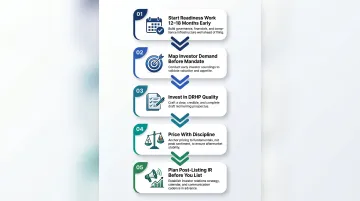
- Start readiness work 12–18 months before filing — governance gaps, Ind-AS restatements, cap table cleanup, and board composition issues take time to resolve properly
- Map investor demand before signing a mandate — knowing expected QIB–NII–retail subscription patterns and geographic demand strength before committing to pricing prevents costly mistakes later
- Invest in DRHP quality — with SEBI averaging 100 observations per filing, companies that front-load risk factor disclosure and financial transparency face fewer iterations and shorter time-to-listing
- Price with discipline — the shift from 28% to 8% average listing gains reflects a market that now rewards fair pricing over aggressive valuations; overpriced IPOs face poor subscription and prolonged price recovery
- Plan the post-listing phase before you list — investor relations, quarterly disclosure quality, earnings call preparation, and consistent earnings communication determine whether the stock sustains listing-day gains or erodes them; they also determine whether the company can return to public markets and whether ESOP value compounds for employees
S45 builds its engagement to cover each of these steps directly. The 30-minute AI-powered Readiness Scan surfaces eligibility gaps early; the Demand Thesis maps cohort-level investor demand before mandate signing; and post-listing IR keeps the relationship active well past listing day — addressing the pattern where traditional bankers disappear once the issue closes.
Across 26 IPOs executed since July 2023, the S45 team has delivered ₹1,180+ crore in capital raised, 168x average subscription, and a 43% average listing pop.
Conclusion
Listing on a stock exchange reshapes how a company is perceived, financed, and valued — across every stakeholder relationship, not just the balance sheet.
The advantages — capital access, credibility, liquidity, and valuation visibility — are measurable. But they compound only when the IPO is executed with discipline and the post-listing investor relations is managed with consistency. The companies that extract the most from going public are the ones that start with a clean readiness foundation — governance structured, disclosures tightened, demand mapped — well before the DRHP is filed. That preparation is where the long-term value of listing is actually built.
Frequently Asked Questions
What makes a company eligible for an IPO?
For India's Main Board, SEBI requires a minimum average operating profit of ₹15 crore over three years, net worth of at least ₹1 crore per year, and post-issue paid-up capital of ₹10 crore. SME platforms (NSE Emerge / BSE SME) have lower thresholds — minimum ₹1 crore post-issue capital, a three-year operating track record, and positive cash accruals for at least two preceding years. An alternate QIB route exists for Main Board applicants who don't meet the profitability criteria.
What role do investment banks play in an IPO?
Investment banks acting as Book Running Lead Managers manage the end-to-end IPO process — from DRHP drafting and SEBI filings to bookbuilding, pricing, and post-listing investor relations. In S45's model, Narnolia serves as the Category-I SEBI-Registered Merchant Banker (the regulated Lead Manager), while S45 runs the AI-led readiness, demand mapping, pricing support, and aftermarket IR layer.
Can a company get listed on a stock exchange without an IPO?
Direct listings and reverse mergers are alternatives to a traditional IPO, but they involve different regulatory processes and do not raise fresh capital from the public. In India, the IPO route remains the standard pathway for most companies seeking public market access.
Does an IPO mean listing on a stock exchange?
These terms are related but distinct. An IPO (initial public offering) is the mechanism through which a company offers shares to the public for the first time. Listing on the exchange is the outcome — shares begin trading on BSE or NSE after the IPO process completes. The IPO is the process; the listing is the result.
Why do companies opt for an IPO?
The primary drivers are raising growth capital, providing liquidity for founders and early investors, building brand credibility, and enabling stock-based M&A. Capital access tends to drive manufacturing and infrastructure companies; liquidity drives founder-led consumer businesses and PE-backed exits.
What happens to stocks after an IPO listing?
Once listed, shares trade freely on the exchange at prices set by supply and demand — the company receives no proceeds from secondary trading. Stock price performance does matter, though: it shapes the company's ability to raise future capital, the value of employee ESOPs at vesting, and the strength of stock as M&A currency.