IPO costs in India vary enormously depending on whether you're pursuing an SME or Main Board listing, your offer size, how prepared your financials are, and which intermediaries you engage. Most founders underestimate the total bill — sometimes by a factor of two or more.
This article breaks down realistic cost ranges for both SME and Main Board listings, the specific components that drive them, and the budget mistakes that create mid-process surprises.
Key Takeaways
- SME IPOs typically cost ₹1–3 crore all-in; mid-to-large Main Board IPOs range from ₹10–30+ crore
- BRLM fees are the largest single line item — but legal, audit, registrar, and exchange fees combined often match or exceed them
- SEBI filing fees follow a published formula — 0.1% of issue size for offers between ₹10–5,000 crore
- Post-listing compliance is a recurring annual cost — and most first-time issuers fail to budget for it before signing mandates
- Most issuers who face mid-process cost surprises had no itemized fee schedule when they signed their first mandate
How Much Does It Cost to Take a Company Public in India?
There is no fixed price tag. Total IPO costs in India depend on listing type, offer size, company complexity, and the scope of intermediaries engaged.
What goes wrong when founders misunderstand costs: they anchor to one line item — usually the merchant banker's quoted percentage — and underbudget everything else. Mid-process delays, renegotiations, and compliance gaps then add legal and audit expense at the worst possible time.
SME IPO (BSE SME / NSE Emerge)
For an SME IPO with an issue size of ₹10–100 crore, total all-in costs typically range from ₹50 lakh to a few crore, or roughly 5–15% of issue size. This range covers:
- Merchant banker fee (retainer + success commission)
- SEBI and exchange filing fees
- Registrar to the Issue (RTI)
- Legal and audit fees
- Statutory advertising and printing
- Mandatory market-maker commitment (3-year obligation)
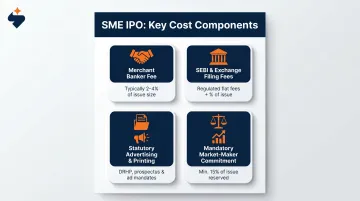
SME IPOs are structurally simpler and faster, typically completing in 2–3 months from mandate to listing. One SME-specific cost that doesn't apply to Main Board listings: the mandatory market-maker requirement, which adds ₹5–15 lakh in obligations over three years.
Mid-Size Main Board IPO
For a Main Board IPO raising ₹100–500 crore, total transaction costs typically fall in the ₹5–15 crore range, covering BRLM fees, legal and audit, SEBI fees, exchange listing, roadshow, and printing/advertising.
What this range excludes matters just as much. Costs that sit outside this figure include:
- Pre-IPO restructuring and entity clean-up
- IndAS conversion (if not already compliant)
- Internal compliance build-out
- Ongoing public company operating costs post-listing
Large Main Board IPO
At scale (₹500 crore+), absolute costs rise but the percentage drops sharply. LIC's ₹20,557 crore IPO had total issue expenses of ₹119.56 crore — roughly 0.58% of proceeds. Mid-market issuers will see a higher percentage — typically 3–7% of proceeds.
One cost that large IPOs must account for but rarely discuss upfront: underpricing. When the listing price significantly exceeds the offer price, that gap is value transferred from the issuer to investors. Average Main Board listing gains were ~30% in 2024 and ~10% in 2025. In a strong market, underpricing can dwarf explicit fees.
Understanding the full cost picture — explicit fees, excluded costs, and underpricing — is what separates a well-planned IPO budget from one that unravels mid-process.
Detailed Cost Breakdown of an IPO in India
Beyond the headline percentage, an Indian IPO is the sum of multiple distinct components — each with different pricing logic and different negotiation levers.
Merchant Banker / BRLM Fee
The Book Running Lead Manager fee is the largest single direct cost. It's structured as a percentage of issue proceeds and covers DRHP drafting coordination, SEBI filing management, bookbuilding, and investor outreach.
- SME IPOs: Typically 2–5% of issue size as a success component, within an all-in cost structure of 5–15%
- Main Board IPOs: Wider dispersion by size; LIC's BRLM line was ₹11.80 crore on a ₹20,557 crore issue — well under 0.1% at scale; mid-market deals see meaningfully higher percentages
S45 operates with 0% upfront fees: a retainer for readiness and filing work, plus milestone-linked fees tied to issue execution. All terms are documented in the engagement letter before mandate signing.
SEBI and Exchange Filing Fees
These are formula-driven and non-negotiable:
| Issue Size | SEBI Filing Fee |
|---|---|
| Up to ₹10 crore | ₹1,00,000 flat |
| ₹10 crore – ₹5,000 crore | 0.1% of issue size |
| Above ₹5,000 crore | ₹5 crore + 0.025% of excess |
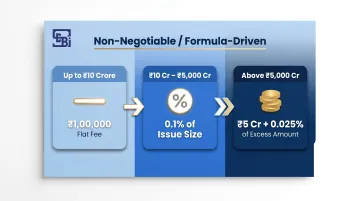
For NSE listings: initial listing fee is ₹50,000 for both Main Board and Emerge. Annual fees start at ₹3,00,000 for Main Board (tiered by paid-up capital) and ₹25,000 or 0.01% of full market cap (whichever is higher) for NSE Emerge.
These are formula-driven and fully predictable — build them into your cash plan from day one.
Legal Fees
Legal costs cover DRHP drafting support, company counsel and underwriter counsel, SEBI observation responses, and shareholder agreements. For Indian IPOs, legal fees typically range from ₹50 lakh to ₹3 crore+ depending on deal size and complexity. LIC's legal counsel fees were ₹4.26 crore on a deal of that scale.
Complex restructuring, litigation disclosures, or IP matters push this figure considerably higher.
Auditor and Reporting Accountant Fees
Auditors prepare restated financial statements, issue comfort letters to the BRLM, and review DRHP disclosures. Typical audit fees for Indian IPOs range from ₹25 lakh to ₹2 crore, depending on the complexity of financials and the number of years requiring restatement.
Companies with three or more years of unaudited or non-IndAS financials face higher costs due to restatement requirements. S45's readiness process flags this early: IndAS conversion, segment reporting, and internal financial controls implementation are all part of the 12–18 month pre-filing preparation window.
Registrar, Advertising, and Other Transaction Costs
- Registrar to the Issue (RTI): Fixed or volume-based fee, typically ₹5–25 lakh depending on issue size and number of applications
- Statutory advertising and printing: ₹10–50 lakh for SME; can reach ₹1–2 crore for larger Main Board issues
- Roadshow and investor outreach: Variable; S45 uses a 50,000+ pre-mapped investor network scored by mandate fit and ticket bands — replacing cold-call roadshows with precision targeting, which reduces outreach costs without sacrificing subscription quality
LIC's advertising and marketing alone was ₹16.98 crore — scale context matters when estimating your own outreach budget.
Post-IPO One-Time Costs
Transaction costs cover the listing event itself. What often gets missed is the one-time build-out phase that begins after your stock starts trading:
- Independent director recruitment and onboarding
- ESOP plan structuring
- Investor relations setup (IR toolkit, analyst presentation, earnings model templates)
- Internal systems upgrades for quarterly SEBI LODR filings
- Compliance calendar setup for LODR Regulation 30 events
Budget ₹25–75 lakh for this one-time build-out, depending on how much governance infrastructure already exists. S45's post-listing IR program covers the IR toolkit, compliance calendar, and institutional targeting plan as part of the engagement.
SME IPO vs. Main Board IPO: How Costs Differ
| Dimension | SME IPO (BSE SME / NSE Emerge) | Main Board IPO (NSE / BSE) |
|---|---|---|
| Minimum issue size | Generally ₹10 crore+ | Generally ₹50–100 crore+ |
| Post-issue paid-up capital | Must not exceed ₹25 crore (NSE Emerge) | No upper cap |
| DRHP prep timeline | 2–4 weeks (lighter disclosures) | 6–12 weeks (extensive SEBI filings) |
| Mandatory market maker | Yes — 3-year obligation | No |
| BRLM fee range | 2–5% of issue (within 5–15% all-in) | Sub-1% to 3%+ depending on size |
| SEBI + exchange fees | Lower absolute; higher as % of issue | Higher absolute; lower as % |
| Post-listing compliance | LODR applies; lighter board requirements | Full LODR; stricter independence norms |
| Typical total transaction cost | ₹1–3 crore | ₹5–30+ crore |
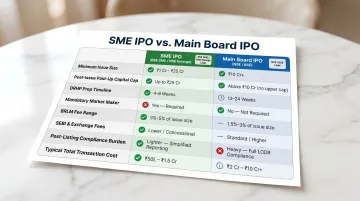
SME IPOs are often the right first step for companies raising under ₹100 crore. However, if you plan to migrate to the Main Board within 2–3 years, factor in the cost of uplisting — another DRHP, another SEBI review, another round of legal and audit fees.
That uplisting risk makes early-stage execution quality matter more than most founders expect. A SEBI observation letter requiring DRHP resubmission, a financial restatement discovered mid-process, or a delayed allotment causes delays and budget overruns regardless of which exchange you're listing on — and those same errors compound if you're planning a second filing within a few years. The SME route costs less upfront, but sloppy preparation on either track closes the gap fast.
What Most Founders Get Wrong About IPO Costs
Focusing Only on the BRLM Fee
The merchant banker's quoted percentage is only one line item. Legal, audit, registrar, exchange, and advertising costs can together equal or exceed the BRLM fee — particularly for SME IPOs where the absolute deal size is small and fixed costs hit harder as a percentage.
A founder raising ₹30 crore on the SME platform might budget 3% for the banker and be shocked when total costs land at 10–12%.
Ignoring Pre-IPO Readiness Costs
Financial restatements, governance restructuring, IndAS conversion, and internal audit build-out are real costs — but they almost never appear in any cost estimate shared by intermediaries at the start of the process.
S45's AI-powered Readiness Scan surfaces these gaps early — ESOP dilution not reflected in the cap table, inconsistent revenue recognition, audit committee composition issues, undisclosed contingent liabilities. Identifying them 12–18 months before filing lets you remediate on your own timeline, not SEBI's.
Finding the same issues during DRHP drafting means rush premiums and potential listing delays.
Underestimating Post-Listing Recurring Costs
SEBI's LODR regulations mandate quarterly financial results, annual report publication, secretarial audit, stock exchange disclosures, and ongoing board independence maintenance. Budget ₹30–75 lakh annually for this compliance run-rate, covering finance, secretarial, IR, statutory audit, and exchange fees.
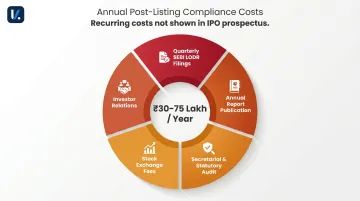
These costs don't show up in the transaction expense table in your prospectus. They show up in your P&L every quarter for as long as you remain listed.
Frequently Asked Questions
Can I take my company public?
Eligibility depends on the listing route. For the SME platform, post-issue paid-up capital must not exceed ₹25 crore on NSE Emerge. For Main Board, SEBI's profitability route requires a multi-year track record of profits and net tangible assets; the QIB route allows listing without a profitability track record. Running an eligibility check before engaging any intermediary saves time and surfaces gaps early.
What is the cost of an IPO in India?
Total costs range from approximately ₹1–3 crore for SME IPOs to ₹10–30+ crore for mid-to-large Main Board listings, depending on issue size, company complexity, and intermediary selection. This covers transaction costs only — pre-IPO readiness and ongoing post-listing compliance are additional.
What is the difference in cost between an SME IPO and a Main Board IPO?
SME IPOs carry lower absolute costs but a higher cost-to-proceeds ratio, because fixed regulatory and intermediary fees hit smaller issue sizes disproportionately — and mandatory market-maker fees add a layer absent on the Main Board. Main Board IPOs run higher on every line item but benefit from scale economies as issue size grows.
What are the ongoing compliance costs after listing?
Post-listing costs cover quarterly SEBI filings, annual reports, secretarial and statutory audits, stock exchange fees, and investor relations. Budget ₹30–75 lakh annually as a baseline compliance run-rate for newly listed companies.
What percentage of IPO proceeds goes toward transaction costs?
Transaction costs as a percentage of proceeds typically range from 3–7% for larger Main Board IPOs and can reach 10–15% or more for smaller SME IPOs, where the fixed-cost floor on regulatory and intermediary fees compresses the ratio.
Who pays for IPO costs — the company or the promoters?
Costs directly attributable to the offering — BRLM fee, SEBI fees, legal, audit, registrar, printing — are typically netted against IPO proceeds. Pre-IPO readiness and post-listing compliance costs sit outside the issue and are funded from the company's operating budget.