This guide is for founders, promoters, and CFOs evaluating whether their company qualifies, and what specific financial and compliance benchmarks they must meet before approaching any exchange or intermediary.
Key Takeaways
- BSE Main Board sets minimum thresholds: ₹3 crore net tangible assets, ₹1 crore net worth, ₹15 crore average operating profit (3-year), and ₹25 crore post-issue market cap
- BSE SME caps post-issue paid-up capital at ₹25 crore and requires ₹1 crore net worth (2 years) plus positive EBITDA in 2 of the last 3 financial years
- Companies with SEBI debarment, wilful default status, or outstanding convertible securities are ineligible to list
- Before filing, verify financials, promoter disclosures, and regulatory clearances — gaps caught late can delay listing by months
BSE Main Board Eligibility Criteria
BSE Main Board listing is governed by SEBI ICDR Regulations and BSE's own listing norms. Companies must satisfy financial thresholds on a restated and consolidated basis for the three preceding full financial years. Whether a company "satisfies" or "does not satisfy" eligibility criteria also determines QIB/retail investor allocation ratios.
Financial Requirements
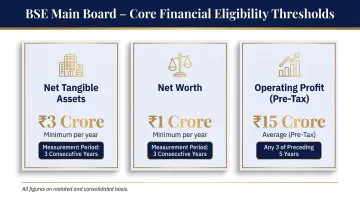
The table below summarises the three core financial thresholds. Each is calculated on a restated and consolidated basis.
| Criterion | Threshold | Measurement Period |
|---|---|---|
| Net Tangible Assets | Minimum ₹3 crore per year | Each of the last 3 financial years |
| Net Worth | Minimum ₹1 crore per year | Each of the last 3 financial years |
| Operating Profit (pre-tax) | Minimum ₹15 crore average | Any 3 of the preceding 5 financial years |
Net Tangible Assets
One restriction applies beyond the ₹3 crore floor: no more than 50% of net tangible assets can sit in monetary assets (cash or cash equivalents). The exception is when the excess is demonstrably committed to a specific business use, or when the IPO is structured as a pure Offer for Sale (OFS).
Net Worth
Companies must maintain a minimum net worth of ₹1 crore in each of the preceding 3 full financial years, on a restated and consolidated basis. Net worth is calculated as paid-up capital plus free reserves (from profits and securities premium), minus accumulated losses, deferred expenditure, and miscellaneous expenditure not written off.
Operating Profit
Companies must achieve a minimum average pre-tax operating profit of ₹15 crore across any 3 of the immediately preceding 5 financial years. Note that this metric is distinct from EBITDA — and the profit must be positive in each of the 3 qualifying years, not just on average. Restated financials apply here, so pre-restatement figures cannot be used.
Post-Issue Market Capitalisation and Capital
- Minimum post-issue market capitalisation: ₹25 crore (calculated as post-issue paid-up shares × issue price)
- Minimum post-issue paid-up capital: ₹10 crore
- IPO size cannot exceed 5 times the pre-issue net worth
- Name-change rule: If the company changed its name in the last year, at least 50% of revenue must come from the activity reflected in the new name
Non-Financial Requirements
Public Float and Shareholder Spread
Main Board IPOs require a minimum 25% public float post-issue, more than 1,000 public shareholders at listing, and compliance with SEBI's prescribed allocation norms:
- QIBs (Qualified Institutional Buyers): Up to 50%
- NIIs (Non-Institutional Investors): Minimum 15%
- Retail investors: Minimum 35%
Operating History and Compliance
Companies must demonstrate:
- 3-year operating history with audited financial statements
- Financials prepared under Ind AS (additional reconciliation disclosures required if using US GAAP or IFRS)
- Management continuity and clear ownership structure
- No pending winding-up petitions admitted by NCLT
- No proceedings admitted under the Insolvency and Bankruptcy Code (IBC)
BSE SME Platform Eligibility Criteria
BSE SME is a dedicated platform for smaller companies with lighter but still structured eligibility norms. SEBI ICDR Regulation 229 establishes the framework: post-issue paid-up capital of ₹10 crore or less qualifies firmly as an SME IPO; between ₹10 crore and ₹25 crore, listing can still happen on the SME platform subject to compliance. Companies exceeding ₹25 crore post-issue capital must list on the Main Board.
Capital, Net Worth, and Profitability
Post-Issue Paid-Up Capital Ceiling
The ₹25 crore post-issue paid-up capital ceiling is the defining boundary for BSE SME eligibility:
- ≤₹10 crore: Firmly qualifies for SME IPO under Regulation 229(1)
- ₹10–25 crore: May list on SME platform subject to Chapter IX compliance under Regulation 229(2)
- >₹25 crore: Must list on Main Board
Net Worth and Track Record
BSE SME requires:
- Minimum net worth of ₹1 crore in each of the two immediately preceding consecutive financial years
- At least 3-year track record for the company or its promoters
Converted entities (from proprietorship, partnership, or LLP) can count prior operational track records, provided the entity existed as a company for at least 1 full financial year before filing the draft offer document. Prior operational history requires ICAI peer-reviewed auditor certification.
Operating Profitability
The EBITDA profitability requirement sets a minimum operating profit of ₹1 crore from operations in at least 2 of the last 3 financial years. This satisfies both SEBI ICDR and BSE SME exchange requirements.
NSE Emerge takes a different approach: it requires positive Free Cash Flow to Equity (FCFE) for at least 2 of 3 years. BSE SME does not mandate FCFE.
Compliance and Structural Requirements
Leverage, Promoter Contribution, and Demat
- Maximum debt-to-equity ratio: 3:1
- Minimum promoter contribution: 20% of post-issue capital (locked in for 3 years)
- 100% dematerialisation of promoter shareholding mandatory
- No pending defaults or IBC proceedings
OFS Restrictions and Use of Proceeds
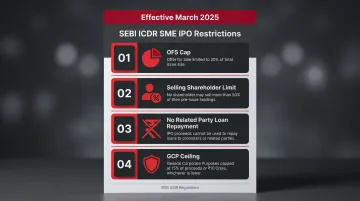
SEBI ICDR amendments effective March 2025 introduced strict controls on how proceeds can be structured and used:
- OFS cannot exceed 20% of total issue size
- Each selling shareholder cannot offload more than 50% of their pre-issue holding
- IPO proceeds cannot be used to repay loans from promoters, promoter group, or related parties
- General Corporate Purposes (GCP) capped at 15% or ₹10 crore, whichever is lower
Who Cannot List on BSE: Disqualification Rules Under SEBI ICDR
SEBI Capital Market Debarment
If the issuer, its promoters, promoter group members, directors, or any selling shareholder has been debarred from accessing the capital market by SEBI, the company cannot file for an IPO on either BSE Main Board or BSE SME. The restriction extends to cases where a director or promoter of the issuer holds the same role at another SEBI-debarred company.
The debarment block lifts automatically if the debarment period has expired by the date of DRHP filing.
Wilful Defaulters, Fraudulent Borrowers, and Fugitive Economic Offenders
Any issuer, promoter, or director classified as a wilful defaulter or fraudulent borrower by a bank or financial institution renders the company ineligible. Similarly, anyone declared a fugitive economic offender under the Fugitive Economic Offenders Act, 2018 disqualifies the company. SEBI and the exchanges verify these classifications at the DRHP stage — prior to filing, issuers should confirm clean status across all promoters and directors.
Outstanding Convertible Securities
Issuers with outstanding convertible securities, rights, or instruments that entitle any party to subscribe to equity shares prior to listing are ineligible. Exceptions include:
- ESOPs — outstanding employee stock options are explicitly permitted
- Fully converted securities — instruments converted on or before the RHP filing date are excluded, provided the conversion is disclosed in the RHP
Step-by-Step BSE Listing Process
Phase 1 – Eligibility Assessment and Intermediary Appointment
Every BSE listing begins with an IPO readiness assessment—reviewing financials, compliance status, corporate structure, and promoter credentials against BSE eligibility norms. Once confirmed eligible, the company appoints:
- SEBI-registered Merchant Banker (lead manager)
- Underwriters
- Registrar
- Market makers (for SME)
- Bankers
- Legal counsel
S45's AI-powered readiness assessment flags eligibility gaps before they become delays — moving companies from first call to signed mandate in as few as 7 days.
Phase 2 – DRHP Preparation and Exchange Filing
With intermediaries appointed, the Merchant Banker conducts full due diligence and prepares the Draft Red Herring Prospectus (DRHP), which must contain:
- Restated and consolidated financials
- Business overview and competitive positioning
- Risk factors and regulatory disclosures
- Use of proceeds
- Management discussion and analysis
The DRHP is filed with BSE (and SEBI, for Main Board). For SME IPOs, the DRHP requires a 21-day public review period, a newspaper advertisement within 2 days of filing, and a QR code for investor access. S45 targets a DRHP-ready draft in 30–45 days, depending on issuer readiness and data room completeness.
Phase 3 – Regulatory Approvals and In-Principle Listing Approval
BSE's review process involves several sequential steps before trading can proceed:
- BSE examines the DRHP and conducts a site inspection
- Promoters appear before the Listing Advisory Committee
- BSE issues in-principle approval upon satisfactory review
- Final Red Herring Prospectus (with issue dates and price band) is filed with BSE and the Registrar of Companies (ROC)
Phase 4 – Public Issue, Allotment, and Commencement of Trading
The IPO opens for public subscription per the disclosed timeline. Post-closure, BSE and the registrar finalise the basis of allotment. Key regulatory timelines:
- Allotment must be completed within 15 days of subscription closure (for book-building issues)
- Trading must commence within 3 working days of issue closure (T+3 framework), as mandated by SEBI Circular dated August 9, 2023
BSE Main Board vs BSE SME: Key Differences at a Glance
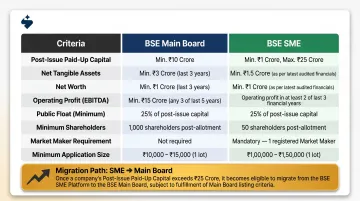
| Criteria | BSE Main Board | BSE SME |
|---|---|---|
| Post-Issue Paid-Up Capital | Minimum ₹10 crore | Maximum ₹25 crore |
| Net Tangible Assets | Minimum ₹3 crore (3 years) | Not specified |
| Net Worth | Minimum ₹1 crore (3 years) | Minimum ₹1 crore (2 years) |
| Operating Profit | ₹15 crore average (3 of 5 years) | ₹1 crore EBITDA (2 of 3 years) |
| Public Float | 25% minimum | 25% minimum |
| Minimum Shareholders | More than 1,000 | 200 minimum (as of March 2025 amendments) |
| Market Maker | Not required | Mandatory |
| Minimum Application Size | Varies by pricing | ₹2 lakh (minimum 2 lots) |
When to Choose SME vs Main Board:
The decision comes down to three factors:
- Capital size: Post-issue paid-up capital below ₹25 crore qualifies for the SME route; above that, Main Board is required
- Timeline: SME listings typically close in 2-3 months; Main Board engagements run 6-12 months
- Growth path: Migration to Main Board is possible once paid-up capital crosses ₹25 crore, making the SME route a viable first step for companies scaling toward larger raises
Frequently Asked Questions
What are the eligibility criteria for listing on BSE?
BSE eligibility depends on the listing route. Main Board requires net tangible assets of ₹3 crore, net worth of ₹1 crore, and average operating profit of ₹15 crore over 3 years. BSE SME sets a lower bar: post-issue paid-up capital below ₹25 crore, net worth of ₹1 crore maintained for 2 years, and EBITDA of ₹1 crore in at least 2 of the last 3 fiscal years.
What is the minimum turnover required for listing on BSE?
BSE and SEBI ICDR do not prescribe a minimum turnover figure. The key financial thresholds are net tangible assets, net worth, and operating profit. The closest turnover-linked condition is the name-change revenue rule (requiring 50% of revenue from the new business activity) applicable to Main Board eligibility.
What is the IPO process for a Main Board listing on BSE?
The process follows four phases:
- Eligibility assessment and intermediary appointment
- DRHP preparation and filing with SEBI
- BSE in-principle approval
- Public issue, allotment, and trading commencement under the T+3 framework
How long does it take for a Main Board IPO to list on BSE?
The end-to-end process from DRHP preparation to listing typically takes 6-12 months. Post-subscription, SEBI mandates allotment within 15 days for book-building issues, and the T+3 listing framework means trading begins 3 days after issue closure.
What is the difference between BSE Main Board and BSE SME listing requirements?
SME is capped at ₹25 crore post-issue paid-up capital with lighter financial thresholds (₹1 crore EBITDA vs ₹15 crore operating profit). Main Board requires 3 years of operating profit, higher net tangible assets, 25% public float, and more than 1,000 public shareholders.
Can a BSE SME-listed company migrate to the BSE Main Board?
Yes, migration is possible once the company meets Main Board eligibility norms, including minimum paid-up capital of ₹10 crore and either average market capitalisation of ₹100 crore or revenue of ₹100 crore for 3 consecutive years, subject to BSE's migration guidelines.