Introduction
Getting listed on BSE is only the beginning. Companies must navigate two distinct compliance layers: the eligibility and documentation requirements needed to secure a BSE listing, and the ongoing regulatory obligations under SEBI LODR that continue long after listing day.
The cost of gaps in this process is steep. Delayed listings burn runway and miss market windows. Regulatory penalties compound daily once triggered. Investor confidence erodes when quarterly filings are late.
Trading suspensions can follow within two quarters of non-compliance. For founders and compliance teams, a structured checklist isn't optional — it's existential.
What follows covers BSE Main Board vs. SME eligibility criteria, pre-listing documentation, quarterly and annual LODR filings, corporate governance mandates, and penalty implications — structured so you can use it whether you're planning your IPO or managing the obligations that come after listing day.
TLDR: Key BSE Listing Compliance Requirements at a Glance
- Main Board eligibility requires ₹3 crore net tangible assets and ₹15 crore average operating profit over three years
- SME eligibility caps post-issue paid-up capital at ₹25 crore with ₹1 crore EBITDA in at least 2 of the last 3 years
- Pre-listing requires a SEBI-approved DRHP, intermediary appointments (merchant banker, RTA, auditor), and all statutory clearances before filing
- Quarterly filings include shareholding patterns (21 days), financial results (45 days), corporate governance reports (30 days)—missing deadlines triggers ₹2,000–₹5,000 per-day fines
- Annual compliance spans secretarial audit, BRSR for top 1,000 entities, AGM-related filings (AOC-4, MGT-7, MGT-15), and SEBI LODR Regulation 34 annual reports
- Non-compliance escalates from promoter shareholding freeze to Z-category trading suspension within two quarters, and compulsory delisting after six months
BSE Listing Eligibility Requirements: Main Board vs. SME
BSE operates two listing platforms: the Main Board for established companies meeting higher financial thresholds, and BSE SME for smaller companies with separate eligibility criteria tailored to their stage of growth. The platform you choose determines your compliance roadmap, investor base, and migration obligations.
Main Board Eligibility Criteria
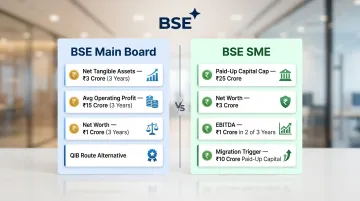
The Main Board follows SEBI ICDR Regulation 6(1) profitability route:
| Criterion | Threshold | Period |
|---|---|---|
| Net tangible assets | At least ₹3 crore | Each of preceding 3 years |
| Average operating profit | At least ₹15 crore | Average over preceding 3 years |
| Net worth | At least ₹1 crore | Each of preceding 3 years |
If your company doesn't meet these thresholds, Regulation 6(2) permits the QIB route: 75% of net offer must be allotted to Qualified Institutional Buyers through book building. Failure to achieve this subscription level requires full refund of application money.
For companies already listed on another exchange, BSE's direct listing norms add further requirements:
- ₹10 crore minimum paid-up capital
- ₹200 crore net worth
- ₹15 crore net profit before tax in each of the preceding 3 years
- Dividend paid in the last 3 financial years
- At least 500 public shareholders
BSE SME Eligibility Criteria
The SME platform serves smaller growth-stage companies:
| Criterion | Requirement |
|---|---|
| Post-issue paid-up capital | Must not exceed ₹25 crore |
| Net worth | At least ₹3 crore (excluding revaluation reserves) |
| Net tangible assets | At least ₹3 crore |
| Operating profit (EBITDA) | At least ₹1 crore in 2 of preceding 3 years |
| Track record | Minimum 3 years of operations |
Once paid-up capital exceeds ₹10 crore, migration to the Main Board becomes mandatory. BSE's January 2024 guidelines set the following conditions for migration eligibility:
- ₹15 crore net worth for the preceding 2 years
- ₹25 crore market capitalisation
- Minimum 3-year SME listing period
- Positive operating profit in 2 of the preceding 3 years
- Positive PAT in the immediate financial year before application
Promoter and Shareholding Requirements
Promoters must contribute at least 20% of post-issue capital. Lock-in periods tightened significantly under SEBI's March 2025 amendments:
- Minimum promoter contribution (20%): 3 years (restored from 18 months)
- Excess promoter holdings: 50% for 2 years, 50% for 1 year (staggered structure)
- Non-promoter pre-IPO shareholders: 6 months (unchanged)
Promoter shareholdings must be fully dematerialized before listing approval. Pledged shares beyond SEBI-specified limits are not permitted. BSE also conducts fit-and-proper due diligence on promoter backgrounds, covering track records, related-party transactions, and compliance history. Incomplete documentation at this stage is one of the most common causes of in-principle approval delays.
Pre-Listing Documentation Checklist
BSE requires a comprehensive set of documents before granting in-principle approval. Missing or incorrect documentation is the most common cause of listing delays—early preparation is critical.
DRHP: The Central Pre-Listing Document
The Draft Red Herring Prospectus (DRHP) is your core disclosure document. It must contain:
- Business overview with operating history and competitive positioning
- Risk factors specific to your business, industry, and regulatory environment
- Audited financial statements for three years (Ind-AS compliant)
- Management discussion and analysis (MD&A)
- Related party disclosures
- Use of proceeds with detailed breakdowns
- Basis of offer price and pricing methodology
SEBI typically issues observations within 30 days of receiving a complete DRHP filing. Those observations remain valid for 12 months—your IPO must open within that window or the process restarts.
Intermediary Appointment Documents
You must appoint and document:
- Book Running Lead Manager (BRLM): SEBI-registered merchant banker
- Registrar and Transfer Agent (RTA): Handles allotment and share transfers
- Statutory auditor: Provides audited financials and certificates
- Legal counsel: Issues due diligence certificates
- Banker to the issue: Manages escrow accounts and refunds
Each appointment requires formal letters and due diligence certificates. S45 coordinates these appointments directly, working alongside Narnolia as Category-I Merchant Banker to keep all intermediary documentation moving on a single timeline.
Statutory and Regulatory Certificates
BSE requires:
- Auditor certificate on financial statements
- Certificate of incorporation
- Memorandum and articles of association
- Board resolutions approving the IPO
- Shareholder resolutions for capital increase
- No-objection certificates from lenders (if applicable)
- Environmental clearances and sector-specific compliance certificates
S45's AI-Led Readiness Assessment
S45's AI-led readiness assessment delivers a DRHP-ready draft in 30–45 days (issuer-dependent). The scan catches documentation gaps before they reach the exchange, including:
- Missing board independence requirements
- Incomplete audited financials or Ind-AS compliance gaps
- Missing legal opinions on title and facility compliance
- Inadequate disclosure of related-party transactions and promoter details
- Incomplete contracts, IP licenses, and vendor agreements
- Litigation and statutory dues not properly disclosed
The result is a structured data room—governance, financials, legal diligence, and sector compliance organised before the exchange ever sees the filing.
Post-Filing Requirements
After DRHP filing:
- Respond to SEBI/BSE observations with documentation and clarifications
- File final prospectus (RHP) incorporating SEBI feedback
- Announce price band
- Secure BSE in-principle listing approval
- Complete T+3 listing process (mandatory from December 1, 2023)
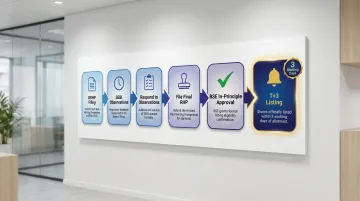
The T+3 mandate gives you just 3 working days from allotment to listing. That timeline leaves no room for documentation errors or coordination gaps—which is why registrar, exchange, and depository alignment must be locked in well before the IPO opens.
Post-Listing LODR Compliance: Quarterly, Half-Yearly, and Annual Obligations
SEBI's Listing Obligations and Disclosure Requirements (LODR) Regulations, 2015 impose recurring calendar-driven obligations on all BSE-listed entities. Missing deadlines trigger per-day fines and escalation mechanisms, including trading suspension.
Quarterly Compliance Calendar
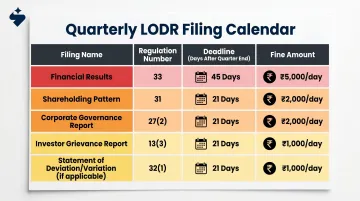
Five core quarterly filings dominate your compliance calendar:
| Filing | Regulation | Deadline | Fine for Delay |
|---|---|---|---|
| Shareholding pattern | Reg 31 | Within 21 days of quarter end | ₹2,000/day |
| Financial results (Q1-Q3) | Reg 33 | Within 45 days of quarter end | ₹5,000/day |
| Corporate governance report | Reg 27(2) | Within 30 days of quarter end | ₹2,000/day |
| Investor grievance statement | Reg 13(3) | Within 30 days of quarter end | ₹1,000/day |
| Share capital reconciliation audit | Reg 76 | Within 30 days of quarter end | Per SOP |
Regulation 30: Material Event Disclosures
Beyond quarterly filings, Regulation 30 imposes real-time disclosure obligations with tight windows:
- Board meeting decisions: within 30 minutes of meeting closure (3 hours if after trading hours)
- Events originating within the company: within 12 hours
- External events: within 24 hours
Material events covered under Regulation 30 include:
- Acquisitions, mergers, and shareholder agreements impacting control
- Board decisions on dividends or buybacks
- Credit rating changes
- Auditor resignations and independent director resignations
- Fraud by promoters or directors
- Insolvency proceedings, cybersecurity incidents, and forensic audits
- Material litigation outcomes
Missing the Regulation 30 window is one of the most common enforcement triggers. Even when the per-day fine is modest, escalation consequences are automatic: promoter shareholding gets frozen on the first violation.
Half-Yearly and Annual Compliance Calendar
Half-Yearly: Related party transaction disclosures under Regulation 23(9) are due within 15 days of publishing standalone and consolidated financial results — twice a year.
Annual Filings:
| Filing | Regulation | Deadline |
|---|---|---|
| Annual audited financial results | Reg 33(3)(d) | Within 60 days of FY end (by May 30) |
| Secretarial Compliance Report | Reg 24A | Within 60 days of FY end (by May 30) |
| Share Transfer Agent certificate | Reg 7(3) | Within 30 days of FY end (by April 30) |
| Annual Report to exchanges | Reg 34(1) | At least 21 days before AGM |
| BRSR filing (top 1,000 entities) | Part of annual report | With annual report |
AGM-Specific Compliance:
AGM must be held within 6 months of financial year end (by September 30). Post-AGM filings include:
- MGT-7 (annual return): within 60 days of AGM
- AOC-4 (financial statements): within 30 days of AGM
- MGT-15 (report on AGM): within 30 days of AGM
- E-voting results to BSE: within 2 working days of AGM
MGT-15 applies to every listed public company under Section 121 of the Companies Act 2013. Penalties for non-filing: ₹1,00,000 initial penalty on the company plus ₹500/day (maximum ₹5,00,000).
Managing these overlapping deadlines requires a structured compliance calendar from day one. S45's post-listing support covers compliance calendar management, quarterly results preparation, materiality determination frameworks, and shareholding pattern filing — so your team stays focused on the business, not the deadline tracker.
Corporate Governance Requirements for BSE-Listed Companies
Board Composition Mandates
SEBI LODR Regulation 17 imposes strict board composition requirements:
| Requirement | Condition | Applicability |
|---|---|---|
| One-third independent directors | If chairperson is non-executive and not a promoter | All listed entities |
| Half (50%) independent directors | If chairperson is executive or promoter-related NED | All listed entities |
| At least one woman director | General requirement | All listed entities |
| At least one independent woman director | Top 1,000 entities by market cap | Top 1,000 only |
| Minimum 6 directors | Top 1,000/2,000 entities | Tiered applicability |
All independent directors must meet SEBI's eligibility criteria and file annual declarations.
Beyond individual director obligations, the board must also constitute four standing committees under SEBI LODR:
| Committee | Regulation | Min Members | Independence | Chair |
|---|---|---|---|---|
| Audit Committee | Reg 18 | 3 directors | 2/3 independent | Independent director |
| Nomination & Remuneration | Reg 19 | 3 directors | All non-executive; 50% independent | Independent director |
| Stakeholders Relationship | Reg 20 | 3 directors | At least 1 independent | Non-executive director |
| Risk Management | Reg 21 | 3 members | At least 1 independent | Board member |
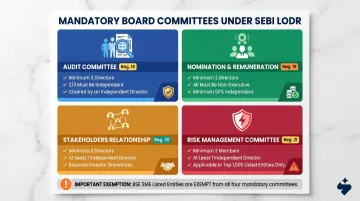
The Risk Management Committee applies only to the top 1,000 listed entities by market cap. BSE SME-listed companies are exempt from all four committee requirements.
Code of Conduct, Insider Trading, and Website Obligations
All board members and senior management must affirm compliance with the company's code of conduct at the first board meeting each financial year under Regulation 26(3). Separately, SEBI's Prohibition of Insider Trading Regulations 2015 require listed companies to maintain a Code of Conduct for Prevention of Insider Trading and enforce trading window closures around material unpublished price-sensitive information.
Website disclosure obligations under Regulation 46 require maintaining a functional website with:
- Basic company information (CIN, registered office, contact details)
- Financial results (quarterly and annual)
- Shareholding patterns
- Corporate governance reports
- Contact details for investor grievances
- Policies on code of conduct, insider trading, RPT
Failure to maintain an updated website is treated as a separate violation under SEBI LODR, attracting its own penalties independent of other reporting lapses.
Penalties for Non-Compliance with BSE Listing Requirements
SEBI's penalty framework for LODR non-compliance operates on two levels: per-day fines and escalating enforcement actions.
Per-Day Fine Schedule (Selected Regulations):
| Regulation | Subject | Fine Amount |
|---|---|---|
| Reg 13(3) | Investor complaints statement | ₹1,000/day |
| Reg 27(2) | Corporate governance report | ₹2,000/day |
| Reg 31 | Shareholding pattern | ₹2,000/day |
| Reg 33 | Financial results | ₹5,000/day |
| Reg 23(9) | Related party transactions | ₹5,000/day |
| Reg 17(2) | Board meeting frequency | ₹10,000/instance |
| Reg 44(5) | AGM timeline | ₹25,000/instance |
Escalation Mechanism (SEBI SOP Master Circular, November 2024)
SEBI Circular SEBI/HO/CFD/PoD2/CIR/P/0155 dated November 11, 2024 prescribes a strict escalation sequence:
- First instance: Freezing of entire promoter shareholding (based on PAN) upon non-submission or non-payment of fine
- Two consecutive quarters: Shifting to Z-category trading, followed by trading suspension
- Six months post-suspension: Initiation of compulsory delisting proceedings
- MPS-specific: Promoters and directors barred from directorships in other listed entities
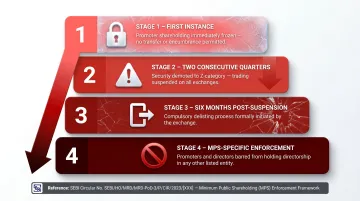
The escalation sequence applies uniformly across all regulations. A ₹1,000/day Regulation 13(3) violation carries identical freeze exposure as a ₹5,000/day Regulation 33 breach — the fine quantum does not determine the severity of enforcement response.
Common Compliance Failures:
BSE action most frequently follows these failures:
- Delayed financial results (highest per-day penalty at ₹5,000)
- Late disclosure of material events under Regulation 30
- Lapses in shareholding pattern filing
- Erroneous shareholding disclosures (the LCC Infotech case drew a ₹1,00,000 penalty for this)
- Governance gaps — missing committees or insufficient independent directors
Most of these failures are preventable with pre-listing groundwork: governance committees seated, disclosure controls mapped, and compliance calendars built before the first DRHP filing date. S45's AI-led readiness scans identify governance and disclosure gaps at the pre-filing stage, so companies are not building compliance infrastructure in parallel with SEBI scrutiny.
Frequently Asked Questions
What are the requirements for BSE listing?
BSE listing requires meeting financial eligibility criteria (Main Board: ₹3 crore net tangible assets, ₹15 crore average operating profit; SME: ₹25 crore capital cap, ₹1 crore EBITDA in 2 of 3 years) and completing documentation including SEBI-approved DRHP, intermediary appointments (merchant banker, RTA, auditor), statutory clearances, and BSE in-principle approval.
What are the compliances for a listed company?
Listed companies must meet SEBI LODR obligations (quarterly filings within 21–45 days, real-time Regulation 30 disclosures, governance committees) alongside Companies Act requirements (board meetings, AGM within 6 months of FY end, MGT-7 and AOC-4 filings). Non-compliance triggers per-day fines and can escalate to trading suspension.
What are post AGM compliances for listed companies?
Post-AGM filings include MGT-7 (annual return) within 60 days, AOC-4 (financial statements) within 30 days, MGT-15 (AGM report) within 30 days—all filed with the Registrar of Companies—plus e-voting results submitted to BSE within 2 working days of the AGM.
What is the difference between BSE Main Board and BSE SME listing compliance requirements?
Both boards share the same LODR quarterly and annual filing timelines. SME companies have lower eligibility thresholds and are exempt from the four mandatory board committees, but must migrate to Main Board once paid-up capital crosses ₹10 crore. Per-day penalties for filing delays apply equally to both.
What are the penalties for non-compliance with BSE LODR obligations?
Delayed filings attract ₹1,000–₹5,000 per day (financial results draw the highest at ₹5,000/day), with promoter shareholding frozen at first default. Continued non-compliance leads to Z-category demotion, trading suspension within two quarters, and compulsory delisting after six months. SEBI adjudication can impose additional penalties of ₹1–10 lakh for willful violations.
How long does it take to get listed on BSE after filing the DRHP?
SEBI typically issues observations within 30 days of a complete DRHP filing, after which companies have 12 months to open the IPO. Listing follows IPO closure by 3 working days (mandatory T+3 timeline). Total time from DRHP to listing is roughly 3–6 months, depending on readiness and market conditions.