For Indian founders, promoters, and business owners, getting this process right is non-negotiable. Procedural errors don't just delay conversion; they can invalidate filings and force a restart. This guide covers what conversion means legally, the eligibility prerequisites, the five-step procedure, post-conversion obligations, and a critical distinction many founders miss: becoming a public company is not the same as getting listed on a stock exchange.
Key Takeaways
- Conversion is governed by Sections 13, 14, and 18 of the Companies Act, 2013 — it requires a board resolution, a special resolution at an EGM, and RoC filings
- Companies with pending annual returns or unpaid matured deposits cannot apply until those defaults are cleared
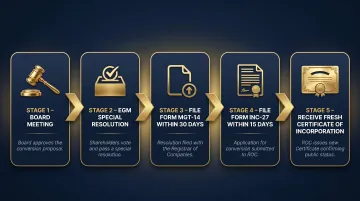
- Five steps to complete conversion: Board Meeting, EGM Special Resolution, Form MGT-14, Form INC-27, then a fresh Certificate of Incorporation
- Post-conversion obligations include a minimum of 3 directors and 7 shareholders, mandatory AGMs, and updated statutory records
- A public company is not a listed company — listing on NSE or BSE requires a separate SEBI-regulated IPO process
What Does Converting a Private Company to a Public Company Mean?
Section 2(68) of the Companies Act, 2013 defines a private company by three specific restrictions its articles must contain:
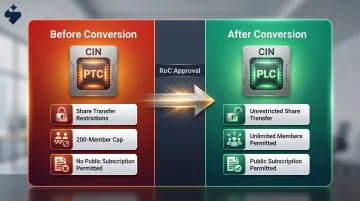
- Share transfer restrictions — shares cannot be freely transferred
- Member cap — membership is limited to 200 (excluding current and former employees who became members during employment)
- No public subscription — the company cannot invite the public to subscribe for its securities
Conversion removes all three. Under Section 14, a company may alter its articles by special resolution to effect this change. When the articles no longer include those private company restrictions, the company legally ceases to be private from the date of alteration.
What Changes Legally
The conversion process alters both the Memorandum of Association (MOA) and Articles of Association (AOA). Specifically:
- The word "Private" is removed from the company's name
- The MOA's name clause is amended under Section 13
- A fresh Certificate of Incorporation is issued by the Registrar of Companies under Section 18
Section 18(3) treats conversion as a continuation of the same entity. Existing debts, liabilities, obligations, and contracts remain enforceable after conversion — only the legal status and name change.
Why Companies Choose to Convert: Benefits and Trade-offs
The Case For Converting
- Unlimited membership — the 200-member cap disappears, enabling broader ownership structures
- Public capital access — the company can invite the public to subscribe for shares
- Unrestricted share transferability improves liquidity for existing shareholders and makes the company more attractive to institutional investors
- Institutional credibility — public company status carries weight with lenders, government bodies, and corporate counterparties
The Trade-offs
Public companies operate under heavier regulatory obligations:
- Mandatory AGMs and quarterly financial filings with the RoC
- Stricter board composition requirements, including independent directors
- Increased scrutiny from regulators and the public
- Potential dilution of promoter control as ownership widens
Many founders convert specifically because listed companies must first be public companies. Conversion is a prerequisite for an exchange listing on NSE or BSE, but it creates neither the obligation nor the automatic right to list. The listing process is a separate regulatory journey with its own eligibility thresholds, SEBI filings, and timelines.
Eligibility Prerequisites Before You Can Convert
The eligibility rules here are statutory — not left to interpretation. Rule 29(1) of the Companies (Incorporation) Rules, 2014 bars conversion if:
- The company has pending annual returns or financial statements not yet filed with the RoC
- The company has failed to repay matured deposits, debentures, or interest thereon
These defaults must be resolved before the conversion process can proceed. The MCA21 portal validates compliance status at the time of e-form filing — if defaults exist, the name change (and Form INC-27) will not go through.
Beyond compliance, your company's composition must also meet minimum structural thresholds before conversion is permitted.
Structural Minimums Post-Conversion
| Requirement | Governing Provision |
|---|---|
| At least 7 shareholders | Section 3(1)(a) |
| At least 3 directors | Section 149(1)(a) |
If your company does not currently meet these thresholds, you must appoint additional members and directors before or at the time of filing. There is no minimum paid-up share capital requirement for public companies under the Companies Act — the Companies (Amendment) Act, 2015 removed the earlier ₹5 lakh threshold.
Step-by-Step Process to Convert a Private Company to a Public Company
The conversion follows five sequential stages. Timeline runs from several weeks to a couple of months, depending on RoC processing speed — and every form is filed digitally on the MCA portal using Digital Signature Certificates (DSCs) of the authorised directors.
Step 1: Convene a Board Meeting
The Board must hold a formal meeting with at least 7 days' advance notice per Section 173 and Secretarial Standard SS-1.
The board resolution must approve:
- The proposed conversion
- Alterations to the MOA and AOA
- The date and agenda for the EGM
- Authorisation of a director or company secretary to file RoC forms
Step 2: Hold the EGM and Pass a Special Resolution
An EGM must be convened with a minimum of 21 clear days' advance notice under Section 101, sent to all directors, shareholders, and auditors.
At the EGM, a special resolution must be passed with at least a 3/4th majority approving:
- The conversion itself
- Removal of "Private" from the company name
- Adoption of the altered MOA and AOA
Shorter notice is permissible with the consent of 95% of members entitled to vote.
Step 3: File Form MGT-14 with the RoC
Within 30 days of passing the special resolution, the company must file Form MGT-14 on the MCA portal under Section 117.
Documents to attach:
- Certified copies of the special resolution and explanatory statement
- Notice of the EGM
- Printed copies of the altered MOA and AOA
Step 4: File Form INC-27 with the RoC
Form INC-27 is the specific conversion application. It must be filed within 15 days of passing the special resolution under Rule 33 of the Companies (Incorporation) Rules, 2014.
Documents to attach:
- Minutes of the EGM
- Certified copy of the special resolution
- Altered MOA and AOA
- Details of directors, promoters, and subscribers
RoC approval triggers an immediate CIN change — from "PTC" (Private Limited Company) to "PLC" (Public Limited Company) — which is the first visible marker of your new status.
Step 5: Receive the Fresh Certificate of Incorporation
With both Form MGT-14 and Form INC-27 approved, the RoC issues a fresh Certificate of Incorporation. This document is your legal proof of conversion — and the trigger date from which compliance obligations under the Companies Act, 2013 shift to the public company framework, including board composition, disclosures, and shareholder rights.
Post-Conversion Compliance Obligations
Conversion triggers an immediate set of ongoing obligations. Meeting them isn't optional — non-compliance carries penalties that can directly affect listing eligibility.
Statutory Records and Branding
Under Section 15(1), every copy of the MOA and AOA must be updated to reflect the alterations. Under Section 12(3), the company must update:
- Registered office signage (name and address, in local language where required)
- Letterheads, billheads, notices, and all official communications to reflect the new public company name and CIN
- Business publications and digital presence
Corporate Governance Upgrades
- Minimum 3 directors are mandatory post-conversion
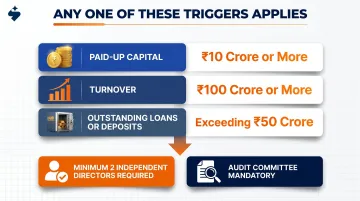
- Independent directors are required under Section 149 — unlisted public companies must appoint at least 2 if they meet any of these thresholds:
- Paid-up capital of ₹10 crore or more
- Turnover of ₹100 crore or more
- Aggregate outstanding loans/deposits exceeding ₹50 crore
- Audit committee constitution is required for companies meeting any of the thresholds listed above, per Section 177 and Rule 6
Ongoing Reporting
- Annual returns (Section 92) and financial statements (Section 137) must be filed with the RoC
- AGMs must be held annually — first AGM within 9 months of the first financial year's close, subsequent AGMs within 6 months, with no more than 15 months between consecutive AGMs
- Statutory registers must be maintained and updated regularly
Non-compliance with annual filing requirements can trigger director disqualification under Section 164(2) if defaults persist across 3 consecutive financial years; this also directly affects future listing eligibility.
Operational Updates
- PAN card re-application in the new company name
- Bank account updates reflecting the new name and status
- Notification to tax authorities (GST, Income Tax), EPF, ESI, and sector-specific regulators
Converting to a Public Company vs. Getting Listed: Why They're Not the Same
This is where many founders get tripped up.
Becoming a public company under the Companies Act, 2013 is a legal status change — it removes the restrictions of private company status. It does not mean your shares are tradable on a stock exchange.
Section 2(52) defines a "listed company" as one that has securities listed on a recognised stock exchange. A company can be a public company without being listed. The two concepts are distinct.
What Listing Actually Requires
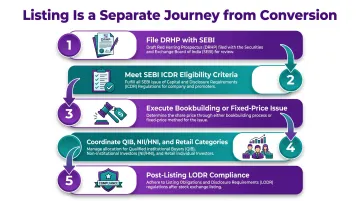
Listing on NSE or BSE requires a separate, SEBI-regulated IPO process under the SEBI (Issue of Capital and Disclosure Requirements) Regulations, 2018, including:
- Filing a Draft Red Herring Prospectus (DRHP) with SEBI
- Meeting SEBI ICDR eligibility criteria on profitability track record, net worth, and financial parameters
- Executing a bookbuilding or fixed-price issue
- Coordinating across QIB, NII/HNI, and retail investor categories
- Post-listing investor relations and compliance under SEBI LODR
Conversion is a necessary first step for founders planning a stock market listing, but the path forward involves far more complexity. Disclosures, pricing, investor relations, and regulatory compliance each require preparation well before a DRHP is filed.
For companies approaching or past the conversion stage, S45's 30-minute AI-powered Readiness Scan can surface eligibility gaps against SEBI ICDR Regulations before formal engagement begins.
Common Mistakes and Misconceptions
Filing Before Clearing Defaults
The most damaging mistake is rushing into the conversion process without resolving compliance defaults. Companies with pending annual return filings or unpaid deposit obligations are statutorily barred under Rule 29(1). Filing Form INC-27 with unresolved defaults leads to outright rejection — and the process must restart from the beginning. Directors of companies with 3 consecutive years of unfiled returns also face personal disqualification under Section 164(2), creating separate complications for any future listing attempt.
Confusing Legal Status with Investor Readiness
Becoming a public company changes your legal structure. It does not substitute for clean financials, organised disclosures, or sound corporate governance. Companies that convert without genuine readiness frequently hit hard stops when they approach institutional investors or initiate the SEBI filing process. The gaps that surface most often:
- Ind-AS restated accounts not prepared or auditor-certified
- Board composition not meeting independent director requirements
- Contingent liabilities unresolved or inadequately disclosed
The legal status change is the easy part. Investor-ready financials, governance, and disclosure are what the process actually demands.
Conclusion
Converting a private company to a public company in India is a five-step legal procedure governed by the Companies Act, 2013, culminating in a fresh Certificate of Incorporation. The steps are structured and achievable — provided the company has cleared its compliance defaults, meets the structural minimums, and executes the filings on time.
For founders whose goal is an actual IPO and stock exchange listing, conversion is the starting point — the SEBI-regulated process that follows demands institutional-grade preparation across disclosures, pricing, investor outreach, and ongoing compliance. Starting that preparation 12 to 18 months before filing gives your team enough runway to close eligibility gaps, strengthen governance, and build an investor narrative before it's tested under scrutiny.
S45's IPO Readiness Scan can surface those gaps in 30 minutes — so you know exactly what needs fixing before the clock starts.
Frequently Asked Questions
What is the process of converting a private company to a public company?
The process involves passing a board resolution, convening an EGM (special resolution requiring a 3/4th majority), filing Form MGT-14 within 30 days and Form INC-27 within 15 days with the RoC, and receiving a fresh Certificate of Incorporation. The procedure is governed by Sections 13, 14, and 18 of the Companies Act, 2013.
Can a private company convert to a public company?
Yes. Any private limited company can convert, provided it has cleared compliance defaults (pending filings, unpaid deposits) and meets the structural minimums of at least 7 shareholders and 3 directors under Rule 29(1) of the Companies Act, 2013.
Does converting to a public company mean the company is listed on a stock exchange?
No. Becoming a public company is a legal status change under the Companies Act. It does not mean your shares are tradable on an exchange. Listing on NSE or BSE requires a separate IPO process regulated by SEBI, including a DRHP filing, bookbuilding, and meeting SEBI ICDR eligibility criteria.
How long does the conversion from private to public company take?
Form INC-27 must be filed within 15 days of the special resolution and Form MGT-14 within 30 days. RoC processing adds additional time on top of that. Depending on prerequisite fulfilment and RoC workload, the end-to-end process takes anywhere from a few weeks to a few months.
What happens to the company's existing contracts and liabilities after conversion?
Conversion does not create a new legal entity. Under Section 18(3), all existing contracts, liabilities, assets, and obligations remain fully intact and enforceable. Only the legal structure and name change, with the CIN updated from "PTC" to "PLC."
What are the mandatory compliance requirements after a company converts to public?
Key post-conversion obligations include:
- Update MOA, AOA, statutory records, letterheads, and signage
- Appoint at least 3 directors (independent directors if thresholds apply)
- Hold annual AGMs and file returns and financial statements with the RoC
- Notify tax authorities, EPF, ESI, and sector-specific regulators of the name and status change