

But record capital raised does not mean smooth outcomes for every issuer. Business Standard reported that 75% of FY26 mainboard IPOs traded below their listing price — a stark reminder that filing a DRHP and executing a successful IPO are two very different things.
Going public is now as much a strategic transition as a financial milestone. The execution partner you choose determines whether you list cleanly or face valuation corrections, delayed timelines, and weak post-listing investor confidence.
This article covers the top IPO readiness firms in India in 2026 — how they were selected, what differentiates each one, and what founders should evaluate before signing a mandate.
Key Takeaways
- IPO readiness requires a partner covering SEBI compliance, DRHP drafting, bookbuilding, pricing, and post-listing IR — end-to-end, not piecemeal
- 75% of FY26 main board IPOs traded below listing price, making execution quality the defining variable
- Track record, sector depth, and execution speed — not brand name — are what separate good outcomes from bad ones
- S45, Equirus Capital, JM Financial, Resurgent India, and IIFL Securities are among the leading IPO readiness firms in India in 2026
- Evaluate any firm — SME or Main Board — on subscription rates, listing pop, and DRHP turnaround time
What Is IPO Readiness and Why It Matters in India
IPO readiness is not a checklist. In the Indian context, it is the structured preparation of a company across financial, legal, governance, and market-positioning dimensions to satisfy SEBI's ICDR Regulations and meet institutional investor expectations before a single page of the DRHP is drafted.
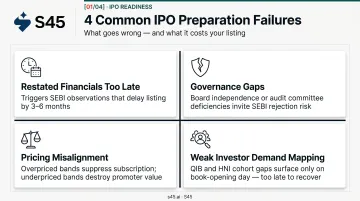
What Goes Wrong Without a Readiness Partner
Companies that approach the IPO process without structured preparation typically encounter:
- Restated financials done too late — Ind-AS restatements that surface mid-drafting delay SEBI filing by months
- Governance gaps — board independence, related-party documentation, and audit committee structure flagged during due diligence
- Pricing misalignment — valuation anchored on promoter expectations rather than institutional demand signals
- Weak investor demand mapping — no clarity on which QIB, NII, or retail cohorts will underwrite the issue
SEBI's own observation process adds further complexity. Standard observation letters are valid for 12 months; pre-filing observations under the UDRHP route extend to 18 months, subject to filing conditions. Any material gap that resurfaces after observation can restart the clock.
What Readiness Looks Like in 2026
The PRIME Database data makes the stakes clear: average listing gains for SME IPOs declined to 11% in FY2025-26, and three-quarters of main board issuers ended the year below their listing price. In this environment, readiness is about more than compliance. It is about pricing discipline, investor fit, and speed of execution.
The firms winning mandates in 2026 deliver eligibility assessment, DRHP drafting, demand mapping, and post-listing IR from a single, accountable process — not fragmented across four advisors and an Excel file. The rest of this guide evaluates which firms in India are actually built to do that.
Top IPO Readiness Firms in India in 2026
Each firm below was evaluated against the criteria founders and CFOs care about most when choosing an IPO advisor:
- SEBI registration and regulatory standing
- Demonstrated track record across Main Board and SME listings
- Sector depth and execution speed
- Quality of investor network across QIB, NII, and retail categories
S45
S45 is India's first AI-native investment bank, founded by operators-turned-bankers who experienced the chaos of the IPO process firsthand — lost version control, unclear pricing, banker disappearance after listing day. The firm was built to fix that. It pairs sector bankers with proprietary analytics across the full IPO lifecycle and applies the same institutional discipline to both Main Board and SME listings.
The platform covers four connected pillars: IPO Readiness, Drafting and Regulatory, Pricing and Distribution, and Post-Listing and Liquidity — with a single, accountable workflow replacing the Outlook-and-Excel stack that most traditional banks still run.
S45 executes IPOs in partnership with Narnolia as Category I SEBI-Registered Merchant Banker. The firm's AI-led readiness scan catches disclosure gaps and governance issues early, and its demand mapping at cohort level — done before mandate signing — gives founders a clear picture of investor appetite before committing to a process.
| Key Specialisation | AI-native end-to-end IPO execution — Main Board and SME — with proprietary readiness, pricing, and bookbuilding analytics |
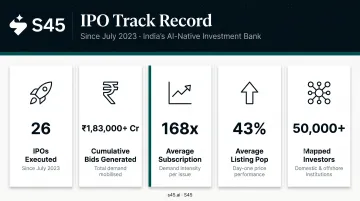
| Track Record | 26 IPOs executed since July 2023; ₹1,83,000+ Cr bids generated; 168x average subscription; 43% average listing pop (47% over the last 12 months) |
| Best Suited For | Founders of high-growth SMEs and mid-sized companies seeking structured, fast, and institutionally rigorous public market access |
Key differentiators:
- Signed mandate typically within 7 days of first call
- DRHP-ready in 30–45 days from clean data room
- 0% upfront fees — milestone-linked model tied to issue execution
- 50,000+ mapped investors across domestic and offshore institutions
- 30-minute AI Readiness Scan covering financial track, free float, board independence, demat readiness, statutory dues, and litigation
Equirus Capital
Equirus Capital is a SEBI-registered Category I Merchant Banker (registration number INM000011286) operating as a mid-market investment bank with a focus on equity capital markets and IPO advisory. The firm provides financial advisory services across IPOs, placements, and structured transactions for growth-stage and mid-sized Indian companies.
Equirus has demonstrated recent Main Board mandate activity — the firm was appointed as BRLM for Online Instruments (India) Limited's DRHP filed with SEBI in May 2026, covering a fresh issue of up to ₹7,500 million alongside an OFS component.
| Key Specialisation | Mid-market Main Board and equity capital markets advisory for growth-stage Indian companies |
| Track Record | Recent BRLM mandate for Online Instruments (India) Limited DRHP (May 2026); active SEBI-registered advisory practice |
| Best Suited For | Mid-market companies seeking an experienced equity capital markets advisor with SEBI Category I registration and institutional distribution access |
JM Financial
JM Financial is one of India's established full-service investment banks, operating as a SEBI-registered Category I Merchant Banker (registration number INM000010361). The firm specialises in lead managing, underwriting, and syndicating IPOs and capital markets transactions across Main Board listings and institutional placements.
JM Financial maintains a public issue track record page per SEBI Circular CIR/MIRSD/1/2012, with recent mandates including Bajaj Housing Finance (₹65,600 MM), BrainBees Solutions/FirstCry (₹41,940 MM), Acme Solar (₹29,000 MM), and HDB Financial Services (OFS up to ₹1,00,000 MM, filed June 2025). The firm's QIB and institutional investor network gives it distribution reach for larger, more complex transactions.
| Key Specialisation | Large-cap and upper-mid-market Main Board IPOs; institutional placements and QIB-heavy transactions |
| Track Record | Recent BRLM roles on Bajaj Housing Finance, FirstCry, HDB Financial Services, and Tata Technologies, among others |
| Best Suited For | Large and upper-mid-market companies with complex transactions requiring deep institutional QIB distribution and full-service investment banking support |
Resurgent India
Resurgent India is a SEBI-registered Category I Merchant Bank established in 2005 (as JMP Associates) with its first owned office opened in Gurgaon in 2012. The firm offers IPO advisory services alongside debt, valuation, and M&A services — covering prospectus preparation, valuation, pricing, and due diligence as part of its IPO consulting scope.
The multi-service model suits founders who need capital markets advisory, valuation, and post-listing compliance support under one engagement — particularly where M&A or debt structuring runs parallel to the listing process.
| Key Specialisation | Full-service merchant banking with IPO advisory, valuation, and capital markets services |
| Track Record | SEBI Category I registration; IPO consulting services covering prospectus preparation, pricing, and due diligence |
| Best Suited For | Companies seeking a merchant banker with multi-service advisory capability — particularly those requiring valuation and M&A advisory alongside IPO preparation |
IIFL Securities (IIFL Capital Services)
IIFL Capital Services Limited (formerly IIFL Securities Limited) is a SEBI-registered Merchant Banker (registration number INM000010940) with equity capital markets services including IPOs and bookrunning. The firm's distribution network spans over 3 million customers with 2,500 points of presence in more than 500 cities — one of the largest retail and institutional footprints among Indian IPO advisors.
Recent BRLM mandates include Smartworks Coworking Spaces (DRHP August 2024), HDB Financial Services (RHP June 2025), Runwal Developers Limited (DRHP September 2025), and Allied Engineering Works Limited (DRHP July 2025). IIFL's institutional relationships span QIBs, FPIs, sovereign wealth funds, and mutual funds — giving it meaningful reach across investor categories.
| Key Specialisation | Broad retail and institutional distribution; bookrunning for Main Board and SME IPOs across diverse sectors |
| Track Record | Recent BRLM roles on HDB Financial Services, Smartworks Coworking Spaces, Runwal Developers, and Allied Engineering Works |
| Best Suited For | Companies seeking wide retail distribution depth combined with institutional QIB and FPI relationships for Main Board listings |
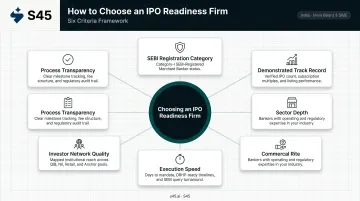
How We Chose These Firms
The selection framework prioritised substance over brand recognition. Each firm was assessed on:
- SEBI registration category — Category I Merchant Banker status is the baseline requirement for lead managing public issues
- Demonstrated track record — number of IPOs executed, subscription rates, and listing performance backed by verifiable data
- Sector depth — whether the firm brings genuine sector knowledge or applies a generic advisory model
- Execution speed — DRHP turnaround timelines and mandate-to-filing pace
- Investor network quality — coverage across QIB, NII, and retail, including domestic and offshore institutional reach
- Process transparency — whether the firm provides clear workflows or operates as a black box
Knowing what to look for is half the equation. The other half is knowing where founders consistently go wrong.
Common Mistakes When Selecting an IPO Readiness Partner
- Choosing on fees alone — the cheapest mandate often reflects a firm without the investor relationships to generate real demand
- Ignoring sector experience — a generalist banker without sector depth cannot credibly represent your business to institutional investors
- Overlooking post-listing IR — firms that disappear after listing day leave you managing institutional relationships and analyst queries without support
- Not meeting the execution team — senior partners pitch, but actual drafting and investor outreach is handled by junior associates; vet both levels
The firms that consistently deliver strong outcomes in 2026 run eligibility, DRHP drafting, pricing, bookbuilding, and aftermarket IR through a single accountable process. When those functions are split across disconnected advisors, accountability gaps are where IPOs quietly stall.
Conclusion
Execution quality in an IPO shows up in subscription rates, listing performance, and long-term investor confidence. The firm you choose needs to own those outcomes — from first readiness assessment through aftermarket — not hand off after DRHP filing.
Before finalising a mandate, evaluate firms on concrete metrics:
- DRHP turnaround time from clean data room
- Average subscription achieved across recent issues
- Listing pop across comparable deals
- Depth of QIB, NII, and retail institutional relationships
Ask to see a live track record, not just a tombstone list.
If those metrics matter to you, the process behind them matters more. S45 runs readiness scans, live demand mapping, SEBI query tracking, and post-listing IR on one connected platform — paired with sector bankers who have lived the founder journey on both sides. Reach out to begin your IPO readiness assessment.
Frequently Asked Questions
Who are the Big 4 auditors in India?
The Big 4 are Deloitte (Deloitte Haskins & Sells), PwC (operating through member firms), EY, and KPMG (operating through B S R & Co. LLP). Under SEBI ICDR regulations, restated financial statements in a DRHP must be audited by statutory auditors holding a valid ICAI Peer Review Board certificate.
What is an IPO readiness assessment and why does it matter?
An IPO readiness assessment is a structured review of a company's financial, governance, legal, and operational gaps relative to SEBI listing requirements. It helps companies identify and fix critical issues 12–18 months before filing, not mid-DRHP when there's no time left to fix them.
What is the difference between an SME IPO and a Main Board IPO in India?
The key distinction is post-issue paid-up capital: SME platforms (NSE Emerge and BSE SME) cap post-issue capital at ₹25 crore, while Main Board listings require at least ₹10 crore in paid-up equity capital with no upper cap. Each pathway carries different SEBI ICDR requirements, disclosure obligations, and market maker rules.
How long does the IPO process take in India from start to listing?
A typical Main Board IPO runs 12–18 months: 6–12 months pre-filing, ~30–45 days for SEBI review, then listing within days under SEBI's T+3 circular. SME IPOs move faster — often 2–3 months from clean mandate to listing.
What financial criteria must a company meet to qualify for a Main Board IPO in India?
Under the profitability route per SEBI ICDR FAQs (May 2025), companies need net tangible assets of ₹3 crore, average pre-tax operating profit of ₹15 crore (any 3 of 5 preceding years), and net worth of ₹1 crore — each sustained for 3 years. Companies that don't meet profitability norms can use the QIB route, where at least 75% of the net offer goes to Qualified Institutional Buyers.
How do I choose the right IPO readiness firm in India?
Evaluate firms on track record (number of IPOs, average subscription, listing pop), SEBI Category I registration, sector expertise, execution speed, and end-to-end coverage from readiness through post-listing IR. Avoid selecting on fees or brand name alone — the execution team and investor network depth matter more than the pitch.