
Applying online takes under 15 minutes once you know what you're doing. But the outcome depends on eligibility, bid strategy, and timing. Get even one step wrong, and your application is dead on arrival.
This guide covers exactly what you need before applying, the precise step-by-step process using ASBA and UPI, what influences allotment, and the mistakes that silently kill bids every subscription cycle.
Key Takeaways
- A valid demat account, KYC compliance, and a UPI ID or ASBA-enabled bank account are mandatory prerequisites
- Applications go through your broker app or bank's net banking portal during the 3-day subscription window
- Retail investors (RII) can bid up to ₹2 lakh; UPI mandate limit is ₹5 lakh per SEBI circular (Apr 2022)
- Oversubscribed retail categories use a computerised lottery; applying at cut-off price with zero errors is your only real lever
- Shares are credited under the T+3 listing timeline; unblocked funds return within T+2 if you're not allotted
What You Need Before Applying for an IPO Online
Preparation determines whether your application is accepted or rejected. Most rejections trace back to missing prerequisites, not intent.
Demat and Trading Account
A demat account linked to your PAN is mandatory — allotted shares are credited there in electronic form. A trading account with a SEBI-registered broker is needed to place bids through broker platforms. These are typically opened together through the same DP (Depository Participant).
Critical: the name on your demat account must match your PAN records exactly. Applications with invalid or mismatched PAN details are rejected outright, per BSE's General FAQs.
UPI ID or ASBA-Enabled Bank Account
Two routes exist for retail IPO applications:
- UPI-based: For retail investors applying up to ₹5 lakh (current SEBI limit), funds are blocked via a UPI mandate (not debited upfront)
- ASBA via net banking: Application Supported by Blocked Amount, routed through a Self Certified Syndicate Bank (SCSB); the bank blocks application money in your account and only debits it if you receive allotment
Your UPI ID must be linked to the bank account where the application funds are available. A third-party UPI ID is invalid and will not be considered for allocation, per NSE's UPI FAQ.
KYC Compliance and PAN Linkage
KYC must be complete with your broker. PAN must be linked to Aadhaar — the government has made this mandatory, with limited exemptions for NRIs, non-citizens, and certain other categories. A frozen demat account or incomplete KYC causes automatic rejection at the registrar level.
Reading the Red Herring Prospectus (RHP)
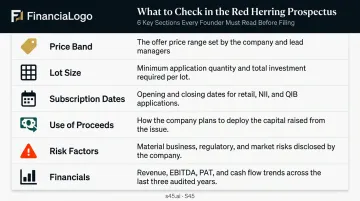
The RHP contains everything a retail investor needs to make an informed decision:
- Price band : the floor and cap for bidding
- Lot size : minimum shares per application
- Subscription dates : open and close
- Use of proceeds : how the capital will be deployed
- Risk factors : company and sector-specific risks
- Financials : three years of audited statements
A well-structured RHP makes this due diligence straightforward. Clear financial disclosures and risk factors written in plain language let retail investors make genuine decisions. Poorly structured prospectuses, where material information is buried or claims are unsubstantiated, are themselves a warning sign about the quality of the offering.
How to Apply for an IPO Online: Step-by-Step
The process is the same whether you use a broker platform (Zerodha, Groww, AngelOne) or your bank's net banking portal. The ASBA/UPI mechanics work the same across platforms.
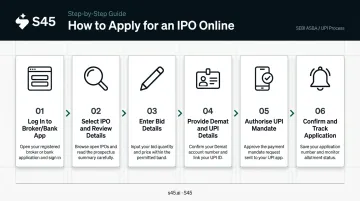
Step 1: Log Into Your Broker App or Bank Portal
Navigate to the dedicated IPO section during the active subscription window — typically three working days. Confirm the IPO is open before entering any details. Check the live subscription status to gauge demand.
Step 2: Select the IPO and Review Key Details
Before placing a bid, verify:
- Price band : floor and cap price
- Lot size : minimum shares per application and total cost
- Closing date : your deadline
- Investor category : Retail Individual Investor (RII) up to ₹2 lakh; S-NII from ₹2 lakh to ₹10 lakh; B-NII above ₹10 lakh
Confirm you fall under the correct category before bidding. Applying in the wrong category triggers reclassification or rejection.
Step 3: Enter Your Bid Details
- Enter the number of lots (must be exact multiples of lot size)
- Select your bid price : either cut-off price or a specific price within the band
Cut-off price means you agree to pay whatever final price SEBI approves within the band. For retail investors, this is almost always the right choice. It maximises allotment eligibility and eliminates the risk of bidding below the final offer price.
Step 4: Provide Demat Account and UPI Details
Enter your 16-digit demat account number (DP ID + Client ID) and your UPI ID. A single transposed digit in either field triggers rejection at the registrar, so verify both carefully before proceeding.
Step 5: Submit and Authorise the UPI Mandate
After submitting, a mandate request is sent to your UPI app (BHIM, GPay, or PhonePe). You must:
- Open your UPI app promptly after submitting
- Locate the pending mandate request
- Approve it before it expires
Per NSE's UPI FAQ, pending mandates that are not acted upon lapse at 12:00 p.m. on T+1 (the day after issue closure). Some offer documents specify 5:00 p.m. on the closing day itself ; check the specific IPO's terms. An unconfirmed mandate invalidates the bid regardless of how it appears on-screen.
The blocked amount remains in your bank account earning interest. It is only debited if you receive allotment.
Step 6: Confirm and Track Your Application
After authorisation, note your application number. Check allotment status after the allotment date using any of these portals:
| Portal | URL |
|---|---|
| BSE | bseindia.com/investors/appli_check.aspx |
| NSE | nseindia.com/invest/check-trades-bids-verify-ipo-bids |
| KFintech | ipostatus.kfintech.com |
| MUFG Intime | in.mpms.mufg.com |
| Bigshare | bigshareonline.com/ipo_allotment.html |
Under the current T+3 framework (mandatory since December 1, 2023), basis of allotment is typically T+1, unblocking by T+2, and listing on T+3.
Key Factors That Affect Your IPO Allotment
Allotment is not purely luck — but for heavily oversubscribed retail categories, the lottery element is real. Here is what actually matters.
How the Retail Lottery Works
Per SEBI's public offer guidelines, when valid retail bids exceed the maximum number of allottable lots, allotment is determined by a computerised draw of lots. Each valid application gets one lot if selected — no application gets preferential treatment based on bid size within the retail category.
This means:
- One application = one lottery ticket, regardless of how many lots you bid for
- Submitting applications across multiple eligible accounts (spouse, parents) is legal and commonly used to improve household probability
- The only way to guarantee eligibility for the draw is a clean, error-free application at cut-off price
What Gets You Rejected Before the Lottery
Applications are screened before the draw runs. Rejected applications don't participate. Common pre-lottery rejection triggers:
- Invalid or missing PAN
- Third-party UPI ID used
- UPI mandate not authorised before deadline
- Incorrect DP ID or Client ID
A clean application doesn't improve your lottery odds — but it ensures you're actually in the draw.
Institutional Demand as a Quality Signal
High QIB (Qualified Institutional Buyer) subscription signals that institutional investors — mutual funds, FPIs, insurance companies — have assessed the business and priced in value. Heavily oversubscribed QIB categories correlate with stronger retail demand and tighter allotment odds, but also tend to indicate stronger post-listing performance.
Watch day-wise subscription data during the subscription window to gauge momentum across categories before the close.
Grey market premium (GMP) is a different matter. SEBI explicitly warns against grey market transactions and does not recognise GMP as an official metric. Treat it as informal market noise, not a reliable demand indicator.
Common Mistakes When Applying for an IPO Online
These errors cause rejection before the lottery even runs. None of them have anything to do with stock selection.
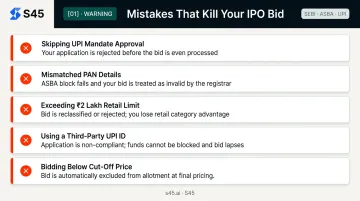
Skipping UPI mandate approval is the single most common rejection reason. The bid looks submitted, but it is invalid without the mandate. Check your UPI app as soon as you submit.
Mismatched PAN details between your application and demat account get flagged by the registrar. Verify your DP account's PAN records before applying.
Exceeding ₹2 lakh as a retail applicant triggers reclassification or rejection. HNI applicants must use ASBA through a bank, since UPI is capped at ₹5 lakh.
Applying with a third-party UPI ID (one not linked to your own bank account) automatically disqualifies the application.
Bidding below the final cut-off price means no allotment. Selecting cut-off price when applying eliminates this risk entirely for retail investors.
Alternatives to the Standard Online IPO Application
Online broker and bank portal applications cover most investors. But two other routes exist.
Offline ASBA Application Through a Branch
Physical ASBA forms can be submitted at designated SCSB branches. The bank blocks funds and submits the form electronically. This route works best for:
- Investors without reliable internet access
- Those more comfortable with in-person banking processes
- Applicants who prefer a branch-verified paper trail
You still need a valid demat account — the offline process only changes how you submit, not what happens afterward.
Applying Through a Registered Financial Intermediary
If offline self-submission isn't practical either, some investors apply through SEBI-registered sub-brokers or financial distributors who handle the application on their behalf. The convenience comes at the cost of handing over your application details to a third party. Before proceeding:
- Verify the intermediary's SEBI registration number on the SEBI website
- Confirm they are authorised to collect ASBA applications
- Never hand over payment or login credentials directly
Unregistered operators have no legal accountability if something goes wrong — so this step is non-negotiable.
Frequently Asked Questions
What is the procedure to apply for an IPO?
In India, investors apply online through their broker's IPO section or bank net banking using UPI or ASBA — entering lot size, bid price, and demat details — then authorising a UPI mandate to block funds until allotment. The subscription window is typically three working days, and allotment follows under the T+3 timeline.
What is the 30-day rule for IPO?
The "30-day rule" applies to anchor investors, not retail applicants. Post-amendment, 50% of anchor allotment is locked for 30 days and the remaining 50% for 90 days from the allotment date. Retail investors can trade freely after listing under normal market rules.
Is IPO allotment luck based?
For heavily oversubscribed retail categories, SEBI mandates a computerised lottery where each valid application gets equal probability for one lot — so yes, luck is involved. But submitting a clean, error-free application at cut-off price is the only way to ensure you're eligible for the draw in the first place.
Can I apply for an IPO without a demat account?
No. A demat account is mandatory in India to receive allotted shares. Without one, the application will be rejected at the registrar level regardless of how or where it was submitted.
What happens if I don't get IPO allotment?
The blocked funds (via ASBA or UPI mandate) are released back to your bank account within T+2 after allotment — approximately one to two business days after the basis of allotment is finalised. No fees are charged and no interest is lost, since the funds were blocked, not debited.
How do I check my IPO allotment status online?
Visit the BSE or NSE website, the registrar's portal (KFintech, MUFG Intime, Bigshare), or your broker app. Enter your PAN or application number after the allotment date — typically T+1 from IPO closure under the current T+3 framework.