
Introduction
Price discovery in an IPO is the process by which a company and its bankers determine the right offer price for shares before public trading begins — anchored in real market demand signals, not guesswork.
For founders and CFOs preparing for an Indian IPO — whether Main Board or SME — getting this right is critical. A mispriced IPO either leaves capital on the table or, worse, results in a broken issue that damages your company's credibility with institutional investors.
Nearly 46% of mainboard IPOs in 2025 ended up trading below their issue price — a direct consequence of poor pricing discipline. What follows breaks down how the process works, what drives pricing decisions, and where founders most commonly go wrong.
TL;DR
- IPO price discovery uses demand signals from roadshows, anchor allocation, and bookbuilding to set an offer price the market will absorb
- SEBI's book-building framework sets a price band; QIBs, NIIs, and retail investors bid to determine the cut-off price
- Pricing inputs span comparable valuations, growth outlook, institutional appetite, and live demand book quality
- Underpricing hands gains to first-day allottees; overpricing creates broken IPOs and lasting reputational damage
- Disciplined pricing tied to real-time demand analysis is what separates clean IPOs from chaotic ones
What Is Price Discovery in an IPO?
Price discovery is the market-driven process of determining the price at which buyers and sellers agree to transact. In an IPO context, where no prior public trading price exists, this means price must be established from scratch using proxies and market signals rather than historical data.
The process aims to find an offer price high enough to maximize proceeds for the issuer and existing shareholders, yet fair enough to attract sustained institutional and retail demand and support post-listing stability. Reaching that balance requires more than a model — it requires the market itself to weigh in.
That's where price discovery parts ways with valuation:
- Valuation — a model-driven estimate of intrinsic worth using DCF, peer multiples, and comparable transactions; theoretical by nature
- Price discovery — the interactive, real-time process where actual bid behaviour during bookbuilding confirms or challenges that estimate; grounded in market demand
Valuation sets the anchor. Price discovery tests whether the market agrees.
Why Price Discovery Matters in an IPO
Price discovery is especially difficult in an IPO compared to secondary market trading. The company has no trading history, significant information asymmetry exists between issuer and institutional investors, and any mispricing is effectively locked in for the first day of trading.
Mainboard IPOs in 2025 delivered an average listing-day gain of 10%, down sharply from 30% in 2024. That compression isn't a sign of tighter pricing discipline.
By late March 2026, only 34 of 108 IPOs (31%) delivered over 10% listing gains, and the average return had fallen to -7%. Retail applications slumped 40% in FY26 — a direct consequence of poor post-listing performance.
What goes wrong without rigorous price discovery:
- Underpricing hands listing-day gains to early allottees rather than the issuer, leaving capital on the table
- Overpricing breaks issue price at listing, triggering negative sentiment and potential SEBI scrutiny
- Poor demand signaling during bookbuilding distorts anchor and QIB allocation, amplifying both risks
Consider Paytm's November 2021 IPO: priced at ₹2,150 per share, it opened at a 9% discount and closed 27% below issue price on listing day. The company faced concerns about its loss-making business model and stretched valuation — a textbook "broken IPO" that damaged credibility for both the issuer and its bankers.
In India, price discovery is not merely best practice but shaped by SEBI's regulatory framework. Regulation 28 of the SEBI ICDR Regulations 2018 mandates the book-building route for most Main Board IPOs, making understanding the process both a compliance requirement and execution imperative.
How Price Discovery Works in an Indian IPO: Step-by-Step
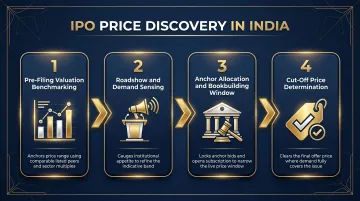
Price discovery in an Indian IPO runs from initial valuation benchmarking (pre-DRHP filing) through the roadshow, anchor investor allocation, the public subscription window, and culminates in the final offer price determination when books close. Each stage feeds information into the next, progressively narrowing the price range.
Pre-Filing: Valuation Benchmarking and Price Band Setting
Before filing the DRHP, the company and its Book Running Lead Manager (BRLM) conduct peer analysis — identifying comparable listed companies, applying relevant multiples (P/E, EV/EBITDA, P/S depending on industry), and accounting for the company's growth trajectory, profitability, and risk profile.
SEBI Regulation 30(3) requires the price band spread to be within 20% of the floor price — meaning the cap price cannot exceed 120% of the floor price. This constraint forces issuers to establish a realistic preliminary valuation range.
Para 9(K) of Schedule VI mandates detailed "Basis for Issue Price" disclosures in the offer document, including:
- Adjusted EPS and Diluted EPS (past 3 years and weighted average)
- P/E ratio relative to issue price
- Industry P/E (High, Low, Average) with source citation
- Return on Net Worth (past 3 years and weighted average)
- Net Asset Value (pre-issue and post-issue)
- Comparison of all ratios with peer companies of comparable size
Roadshow and Demand Sensing
The roadshow serves as the primary channel for gauging real investor appetite before books open. Pre-IPO investor meetings — institutional roadshows with QIBs, analyst presentations, and selective NII outreach — gather feedback on valuation comfort, sector concerns, and pricing sensitivity.
This feedback allows the BRLM and issuer to refine price expectations and finalize the price band that appears in the Red Herring Prospectus (RHP). Where institutional investors signal what they're willing to pay, the roadshow functions as a price discovery mechanism — not a promotional one.
Anchor Allocation and Book Building Window
Once the roadshow closes and demand signals are mapped, anchor allocation translates that intelligence into committed capital. The mechanism is unique to Indian IPOs. Up to 60% of the QIB portion can be allocated to anchor investors one day before the issue opens, at or within the price band. Minimum application size is ₹10 crore.
Anchor allocation shows the market that credible institutional investors have committed capital at a known price. That visible commitment reduces uncertainty for retail and NII applicants entering a live book.
In 2025, anchor investors subscribed to 35% of total public issue amount in mainboard IPOs, with mutual funds accounting for 14.44% (overtaking FPIs for the first time). This distribution reflects the strategic importance of anchor allocation in price discovery.
The subsequent three-day subscription window (QIB, NII, and retail bidding) builds the actual demand book. Key signals that emerge during this window:
- Subscription levels by category — whether QIBs, NIIs, or retail are driving demand
- Bid clustering by price point — where within the band investors are concentrated
- Cut-off price bidding — how many retail applicants opt for cut-off vs. specific prices
These patterns together determine the final cut-off price: the point at which cumulative demand meets the total issue size and books clear.
Key Factors That Influence IPO Price Discovery
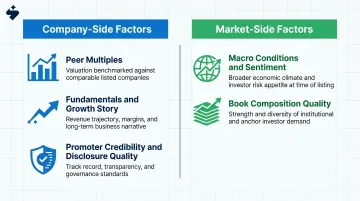
Several factors directly shape how the market responds during price discovery. They fall into two broad groups: company-side inputs that determine what multiple is defensible, and market-side conditions that determine whether investors are willing to pay it.
Company-side factors:
- Peer multiples set the baseline. Investors benchmark the IPO against what listed peers in the same sector already trade at. An unjustified premium — without a clear growth or profitability argument — faces immediate institutional pushback.
- Fundamentals and growth story determine the multiple investors will accept. Revenue trajectory, EBITDA margins, asset-light vs. capital-intensive model, and earnings narrative quality all matter. SEBI introduced stricter profitability requirements for SME IPOs in February 2025: SMEs must demonstrate operating profit (EBITDA) of at least ₹1 crore in two of the preceding three financial years.
- Promoter credibility, use of proceeds, and disclosure quality affect risk premium. Investors scrutinize DRHP disclosures, related-party transactions, and stated use of proceeds. Opaque disclosures or aggressive proceeds claims raise the risk premium and depress the price investors will pay.
SEBI Chairman Tuhin Kanta Pandey stated in March 2026: "Weak or opaque valuations erode confidence. When investee companies move towards public markets, valuation concerns can distort price discovery and weaken trust."
Market-side factors:
- Macro conditions and sentiment shape institutional pricing appetite. Interest rate environment, broader equity market performance, and sector rotation all shift what investors are willing to pay. IPOs in 2024 saw 45x average oversubscription with 30% listing gains; 2025 saw 34x with only 10% gains — a direct measure of how sentiment shifts pricing power.
- Book composition quality matters more than subscription multiples. A book dominated by long-only QIBs signals genuine conviction and supports post-listing stability. A book filled with leveraged HNI applications may reflect subscription-driven demand rather than fundamental appetite, setting up post-listing volatility.
Former SEBI Chairperson Madhabi Puri Buch flagged concerns in March 2024 about inflated IPO applications and mule accounts artificially boosting subscription multiples, particularly in SME IPOs.
Common Mistakes and Best Practices in IPO Price Discovery
Anchoring the Price Band to Promoter Valuation, Not Market Evidence
Many founders approach price discovery with a target valuation already fixed — often derived from the last private funding round — and resist evidence from roadshows or comparable analysis suggesting a lower multiple. This leads to an offer price set at the top of a stretched band, with thin institutional support, resulting in muted listing performance or outright undersubscription.
Best practice: Treat roadshow feedback as data, not noise. Institutional investor signals during pre-IPO soundings (early investor conversations) are market validation, not negotiation positions.
Treating Bookbuilding as a Formality
Some issuers and advisors complete the bookbuilding window without actively analyzing subscription patterns across price points and investor categories. How demand is distributed across the price band — whether concentrated at cut-off (price-sensitive retail) or spread across the range (institutional conviction) — is critical price discovery intelligence.
Best practice: Monitor the book in real time and interpret what the data says about actual pricing power. Key inputs include:
- Daily bidding reports showing subscription velocity
- Bid quality analysis by investor category
- Investor classification reviews to assess institutional concentration
Underestimating Anchor Investors
Some issuers treat anchor allocation as a checkbox. The quality and diversity of anchor investors — marquee domestic mutual funds, FIIs — signals to the broader market what calibre of institutional buyer has validated the price.
Best practice: Build credible anchor investor relationships well before the issue opens. Targeting the right mix of investors creates a foundation for broader demand:
- Long-only funds with sector conviction
- Specialist funds aligned to the issuer's industry
- Insurance companies and domestic institutions seeking duration
Confusing High Subscription Numbers with Successful Price Discovery
A 100x or 200x subscribed IPO is often cited as proof of a well-priced deal, but extremely high subscription can indicate significant underpricing — value transferred from the issuer to first-day allottees.
The distinction matters: a disciplined book at 30-40x with strong institutional participation often reflects better pricing than a 200x retail-driven frenzy. Across 26 IPOs since July 2023, S45 has averaged 168x subscription alongside a 43% listing pop — raising ₹1,180+ crore and generating ₹1.83 lakh crore in bids. That balance between issuer pricing and investor returns comes from structured demand mapping, not aggressive underpricing.

Best practice: Aim for pricing that reflects company fundamentals. High subscription should validate pricing discipline — not substitute for it.
Building a Connected Pricing Process
Each of the mistakes above shares a root cause: treating valuation, roadshow, and bookbuilding as separate events rather than a single connected process. When these phases are linked analytically, pricing decisions are grounded in evidence rather than instinct.
In India's SME and Main Board markets, the BRLM's ability to maintain a live demand picture — tracking subscription velocity, classifying bid quality by investor type, and modeling post-listing scenarios — directly determines pricing quality. Firms that combine sector expertise with real-time analytics can identify concentration risks and retail accessibility gaps as they emerge, adjusting allocation strategies before the window closes rather than after the fact.
Frequently Asked Questions
What is price discovery in an IPO?
Price discovery in an IPO is how the offer price is determined before any public trading exists. The price is derived from real investor demand signals gathered through roadshows, anchor allocation, and the bookbuilding window.
What methods are used for price discovery in an IPO?
Three methods drive IPO price discovery in India:
- Book-building: The SEBI-mandated standard route where investors bid within a price band
- Anchor investor allocation: Early demand signal secured one day before the issue opens
- Comparable company analysis: Peer multiples used to establish the initial price band
Why is price discovery important in an IPO?
Poor price discovery forces issuers into one of two costly outcomes. Underpricing leaves capital on the table, transferring value to early allottees through first-day pops. Overpricing causes a broken IPO, post-listing underperformance, and lasting reputational damage for both the company and its bankers.
What is the IPO listing price, and how does it differ from the offer price?
The offer price is the price set through the bookbuilding process at which shares are allotted to investors before trading begins. The listing price is the price at which the stock first trades on the exchange, determined by market demand on listing day. The two prices frequently differ.
What is an example of price discovery in an IPO?
A company files an RHP with a price band of ₹100–₹120, attracts strong QIB and anchor interest at ₹118–₹120, and closes its books with strong oversubscription at the upper end. The cut-off price is set at ₹120, reflecting where actual market demand cleared.
What is the cost of price discovery in an IPO?
Direct costs include fees paid to BRLMs, legal advisors, and intermediaries involved in roadshow and bookbuilding. BRLM fees in India typically range from 1% to 5% of issue size, with larger deals at 1–1.75% and smaller/tech startup IPOs at 3–4%. Indirect costs are often larger: the value destroyed by underpricing, or the reputational and financial damage from overpricing that triggers post-listing underperformance.