
The results vary significantly based on application size, payment method, allotment mechanics, and timing. Getting even one of these wrong can cost you your entire bid — or get your application rejected outright.
This guide covers who qualifies, what you need before applying, the precise steps to submit via ASBA, what drives allotment probability, and the mistakes that trip up first-time HNI applicants.
Key Takeaways
- Any IPO application of ₹2 lakh or more is automatically categorised as HNI (NII category) — no separate selection needed
- The HNI category splits into sNII (₹2 lakh–₹10 lakh) and bNII (above ₹10 lakh), each with different allotment mechanics
- Applications above ₹5 lakh must use bank ASBA; UPI is only valid up to ₹5 lakh
- HNI applications cannot be withdrawn or reduced after submission; you can only increase the bid amount before the window closes
- Listing on mainboard IPOs now occurs at T+3 from IPO closing, per SEBI's August 2023 circular
What Is the HNI Category in an IPO?
Per SEBI's ICDR Regulations, a retail individual investor is defined as one applying for securities worth no more than ₹2 lakh. Anyone bidding above that threshold — and who isn't a Qualified Institutional Buyer (QIB) — falls into the Non-Institutional Investor (NII) category, also referred to as HNI. Your application value alone determines your classification — no separate wealth threshold applies.
Types of HNI Investors
SEBI's January 2022 ICDR Amendment created two distinct sub-buckets within the NII category:
| Sub-Category | Application Size | Allotment Method |
|---|---|---|
| sNII (Small NII / sHNI) | ₹2 lakh to ₹10 lakh | Lottery-based in most oversubscribed IPOs |
| bNII (Big NII / bHNI) | Above ₹10 lakh | Proportionate (reverts to lottery at high oversubscription) |
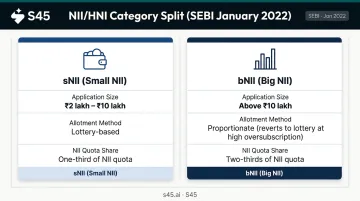
Within the total NII quota, one-third goes to sNII applicants and two-thirds to bNII applicants. If one sub-bucket is undersubscribed, the unallocated portion can be moved to the other.
HNI Quota in an IPO
For mainboard IPOs, SEBI mandates the following allocation framework:
- 35% reserved for retail investors
- 15% reserved for NII/HNI applicants
- 50% (balance) allocated to QIBs
NRIs with NRE/NRO bank accounts can participate in the NII category — and SEBI's investor education material confirms that PIS permission is not required for IPO applications.
HNI Allotment Mechanics
In a mainboard IPO, when the NII category is oversubscribed, allotment works like this:
- The number of allottees is determined first
- Each winner receives a minimum allotment tied to the minimum application size for that sub-category
- Remaining shares are distributed on a pro-rata basis
In heavily oversubscribed mainboard IPOs, even bNII applicants frequently end up with a lottery-like outcome rather than clean proportionate allocation. The sNII vs. bNII distinction matters most at moderate oversubscription levels — not when demand is extreme.
How to Apply for an IPO in the HNI Category
The process follows four steps, each with rules specific to HNI applicants. Get these right before bidding — errors at any stage result in automatic rejection.
Step 1 — Open and Link a Demat Account
A valid demat account linked to a bank account is your starting point. The platform automatically classifies your application as HNI when your bid exceeds ₹2 lakh — there's no separate "HNI" toggle to select.
Confirm your demat account provider supports HNI applications through ASBA before proceeding.
Step 2 — Navigate to the IPO Section and Enter Your Bid
Log into your broker or bank platform, locate the live IPO, and:
- Select the number of lots corresponding to your target investment
- Enter a specific price within the price band — HNI applicants cannot use the cut-off price option
- Bidding at the upper end of the price band (equivalent to cut-off) improves allotment eligibility; bidding below the final issue price results in immediate application rejection
Step 3 — Choose Your Payment Method
SEBI caps UPI-based applications at ₹5 lakh per SEBI Circular SEBI/HO/CFD/DIL2/CIR/P/2022/45 (April 2022):
- Applications up to ₹5 lakh: UPI-based ASBA is permitted
- Applications above ₹5 lakh: Bank ASBA is mandatory — funds are blocked in your bank account but not transferred until allotment
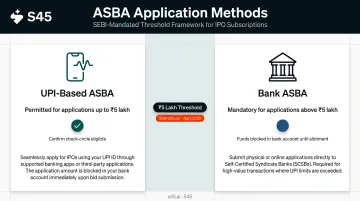
Funds are only debited upon allotment.
Step 4 — Submit and Track Allotment
Submit your application before the bidding window closes on the final day. After submission:
- Track allotment status on the registrar's portal (KFintech, MUFG Intime) or your broker platform
- Allotment is typically finalised at T+3 from IPO closing, with listing on the same day
If you receive an allotment, shares are credited to your demat account on listing day. If not, the blocked funds are released within the same window — no action required on your end.
What You Need Before Applying as an HNI
Preparation determines whether your application clears smoothly. Missing a document or setup step can result in a rejected application or fund-blocking complications.
Documents and Account Requirements
Have these ready before the IPO opens:
- PAN card linked to both demat and bank accounts
- Active demat account with a SEBI-registered depository participant (NSDL or CDSL)
- Bank account linked to the demat account
- For ASBA applications above ₹5 lakh, verify your bank has an active ASBA facility for IPO subscriptions
Note: IPO NII classification is determined by your application value, not wealth documentation. The ₹2 crore income and ₹7.5 crore net worth thresholds cited in some guides relate to SEBI's Accredited Investor framework — they are not a prerequisite for applying in the HNI/NII IPO category.
Capital Planning and Fund Availability
The application amount must be available as unencumbered funds before you submit:
- sNII minimum: ₹2 lakh (minimum application size for the sNII category)
- bNII minimum: above ₹10 lakh
- HNI applications cannot be reduced or cancelled after submission — only increased before the window closes
- IPO margin funding from NBFCs is a common approach to increase application size, but carries leverage risk. Factor in the interest cost over the blocked period (typically 6–7 days) against expected allotment probability.
Compliance and Timing Readiness
With documents and funds in order, timing is the final variable. Get these right:
- Confirm your ASBA mandate is active with your bank before the subscription window opens
- Bids submitted close to the last-day deadline are processed on a best-effort basis by some platforms — apply at least a few hours early to avoid cutoff risk
- Have your broker and bank platform access ready before the IPO opens
Key Factors That Affect HNI IPO Allotment
Applying correctly is necessary but not sufficient. These variables directly influence your allotment probability.
Application Amount vs. Oversubscription Level
In the sNII category, allotment is lottery-based. Each winner receives a minimum allotment regardless of how much they bid — so bidding ₹2.1 lakh gives you the same allotment odds as bidding ₹9.9 lakh in an oversubscribed sNII pool.
In the bNII category, proportionate allotment applies in theory, but at very high oversubscription levels, bNII also effectively reverts to lottery-like outcomes. The difference between the two sub-categories matters most when oversubscription is moderate.
The practical takeaway: in most high-demand mainboard IPOs, the number of applications matters more than the size of any individual bid within the sub-category.
IPO Quality and Lead Manager Discipline
Allotment odds are partly a function of how many serious applicants the IPO attracts — and that depends heavily on how the issue was structured and priced.
IPOs built on disciplined price discovery and transparent bookbuilding attract genuine demand rather than speculative bids. S45, working with Narnolia (Category-I SEBI-Registered Lead Manager), supports this process across QIB, NII, and retail categories. Pre-issue cohort-level demand signals and daily subscription tracking by investor category give informed investors a cleaner read on subscription quality before they commit capital.
Bidding at the Right Price
HNIs must bid within the price band and cannot select cut-off price. Three rules to follow:
- Bid at or near the upper end of the price band to maximise allotment eligibility
- Never bid below the final issue price — the application will be rejected
- Confirm the price band from the Red Herring Prospectus before submitting
Common Mistakes HNI Applicants Make
1. Not reading the offer document
Many HNI applicants bid without reviewing the Red Herring Prospectus (RHP). The RHP contains allotment methodology, lot size, price band, use of proceeds, and risk factors — all of which affect your bid decision. Skipping it often leads to bidding at the wrong price or misunderstanding allotment ratios.
2. Attempting to withdraw or reduce the application
SEBI regulations prohibit HNI applicants from cancelling or reducing their bid once the IPO window closes. You are locked in. The only permitted modification is increasing your bid amount, and this must happen before the closing deadline. Apply only what you're prepared to keep locked for the full window.
3. Applying under multiple demat accounts linked to the same PAN
Applying across multiple accounts under the same PAN (or bidding in both HNI and retail categories with the same PAN) results in rejection of all linked applications. Each PAN can have only one valid application per IPO.
4. Mismanaging ASBA and fund availability
Two common errors here:
- Insufficient funds in the linked bank account to cover the blocked amount, causing silent application failure on some platforms
- Not verifying that the bank's ASBA facility is active before the subscription window opens
For bNII applicants using leveraged margin funding, calculate the interest cost on the blocked period against realistic allotment probability — at high oversubscription levels, the maths rarely works in your favour.
Frequently Asked Questions
Is it better to apply as an HNI in an IPO?
It depends on the amount available and the IPO's oversubscription level. For applicants with ₹2–10 lakh, the sNII competition pool is often smaller than retail, which can improve allotment odds. Multiple retail applications across family members sometimes outperform a single sNII application, though — run the numbers before deciding.
What is the HNI quota in an IPO?
In a mainboard IPO, SEBI reserves 15% of the issue for the NII/HNI category, split one-third for sNII and two-thirds for bNII. SME IPO allocation ratios and allotment methodology differ; check the specific offer document or SEBI's current SME circulars for applicable quotas.
Who qualifies as an HNI in India?
Any IPO applicant bidding ₹2 lakh or more is automatically placed in the HNI/NII category — no separate eligibility process is required. The ₹2 crore income and ₹7.5 crore net worth thresholds belong to SEBI's Accredited Investor framework, not IPO NII classification.
Can I sell HNI IPO shares on the listing day?
Yes. Shares are credited to your demat account before the market opens on listing day, and HNI applicants face no mandatory lock-in. Anchor investors do face lock-in periods under the SEBI ICDR January 2022 amendment; HNI allottees are exempt.
Can I withdraw my HNI IPO application once submitted?
No. SEBI regulations prohibit HNI applicants from cancelling or reducing their bid after submission. The only permitted change is increasing the bid amount, and this must be done before the deadline on the closing day.
What payment method should HNIs use for applications above ₹5 lakh?
Applications above ₹5 lakh must use bank ASBA — funds are blocked in the bank account but not transferred until allotment. UPI-based ASBA is only available for applications up to ₹5 lakh, per SEBI's April 2022 circular.