Introduction
Conversion from a Private Limited Company to a Public Limited Company is a legal prerequisite for any Indian IPO — not the hardest part of going public, but the step that ends the process if it goes wrong or gets skipped.
Under Section 23 of the Companies Act, 2013, only a public company can issue securities to the public through a prospectus. BSE and NSE — whether the Main Board or SME Exchange — require applicants to hold public company status under Indian law. There is no workaround.
What surprises most founders is not the conversion itself (the statutory process takes 30 to 45 days) but what comes after it. Public company compliance obligations activate immediately upon the ROC issuing a fresh Certificate of Incorporation, regardless of whether your shares ever trade on an exchange.
This guide explains the conversion process step by step, what changes (and what does not) after the ROC issues your certificate, and the mistakes founders make when they treat conversion as a checkbox rather than the opening obligation of a public company.
Key Takeaways
- Conversion is governed by Section 18 of the Companies Act, 2013 and requires a Special Resolution (75% majority) passed at an EGM
- Minimum requirements: 7 shareholders, 3 directors (one resident in India), and a mandatory Company Secretary for public companies meeting prescribed thresholds
- Filing involves Form MGT-14 (within 30 days of resolution) and Form INC-27 with altered MOA and AOA
- Conversion preserves the same legal entity — existing contracts, tax history, and carried-forward losses continue unaffected under Section 18(3)
- Conversion enables listing eligibility; SEBI ICDR compliance, DRHP filing, and the full IPO process follow as separate steps
What Is Conversion to a Public Limited Company?
Under Section 2(68) of the Companies Act, 2013, a private company is defined by three specific restrictions written into its Articles of Association:
- Share transfer restrictions (Board approval requirements and pre-emption rights)
- A membership cap of 200
- A prohibition on inviting the public to subscribe to its securities
Conversion removes all three. A Public Limited Company, under Section 2(71), carries none of these constraints: its securities are freely transferable under Section 58(2), and it can issue shares to the public through a prospectus under Section 23.
Section 18 of the Companies Act (full text) is the operative mechanism — it permits any registered company to convert to another class by altering its memorandum and articles. The ROC then issues a fresh Certificate of Incorporation under Section 18(2). What that new certificate doesn't do is wipe your slate clean: existing obligations carry forward in full.
What Stays the Same
Section 18(3) is the provision that matters most for founders anxious about disruption. It states that registration on conversion does not affect debts, liabilities, obligations, or contracts entered into before conversion. In practical terms:
- All existing vendor and customer contracts continue without novation
- Tax history and carried-forward losses are preserved under the same legal entity
- Existing regulatory licenses (FSSAI, RBI, sector-specific registrations) are unaffected
- GST registration and PAN continue under the same CIN — no fresh applications, no gaps in statutory standing
Why Conversion Is Non-Negotiable for an IPO
The Legal Barrier
Section 23 of the Companies Act states unambiguously that a public company may issue securities to the public through a prospectus. A private company cannot, regardless of its financials, market position, or investor interest.
Both BSE and NSE require applicants to hold public company status. The NSE Main Board requires a minimum post-issue paid-up equity capital of ₹10 crore and market capitalisation of ₹25 crore. BSE's IPO listing page sets the same thresholds.
For SME exchanges, NSE Emerge requires post-issue paid-up capital not exceeding ₹25 crore and operating profit of at least ₹1 crore in 2 of the last 3 financial years.
Financial eligibility is a separate question. Conversion is the legal prerequisite: without it, financial eligibility counts for nothing.
Share Transferability
Post-listing, shares must move freely on the exchange without any Board approval or pre-emption mechanism. A private company's AOA is specifically designed to prevent this. Section 58(2) makes securities of a public company freely transferable by statute — a right that cannot be negated by AOA restrictions.
Founders should be clear on what this means in practice after conversion:
- You cannot replicate private company transfer controls in the public company's AOA
- Pre-emption rights and Board approval clauses that existed before conversion become unenforceable
- A separate Shareholders' Agreement (binding only between its parties) can provide some transfer governance, but it cannot override Section 58(2)
This structural shift is permanent. The governance levers that worked as a private company do not carry forward.
Institutional Capital Access
QIBs, FPIs, domestic mutual funds, and insurance companies operate under internal mandates or regulatory frameworks that restrict or prevent investment in unlisted private companies. Conversion — followed by listing — opens the company to this capital pool, which drives IPO subscription depth and post-listing liquidity.
Minimum Requirements Before You Can Convert
Before filing Form INC-27, the company must satisfy these statutory thresholds:
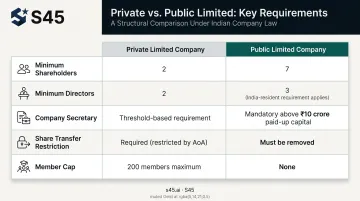
| Requirement | Private Company | Public Company |
|---|---|---|
| Minimum shareholders | 2 | 7 |
| Minimum directors | 2 | 3 (1 must be India-resident) |
| Company Secretary | Threshold-based | Mandatory above ₹10 crore paid-up capital |
| Share transfer restriction | Required in AOA | Must be removed |
| Member cap | 200 | None |
Threshold-Triggered Requirements
Companies crossing any of these thresholds must constitute additional governance structures before or immediately after conversion:
- Paid-up share capital ≥ ₹10 crore, or
- Turnover ≥ ₹100 crore, or
- Outstanding loans/debentures/deposits ≥ ₹50 crore
If any threshold applies, the company needs at least 2 independent directors, an Audit Committee, a Nomination and Remuneration Committee, and a Stakeholders Relationship Committee.
Most companies planning a Main Board IPO will cross one of these thresholds. Map them before conversion — retrofitting governance committees under IPO timeline pressure is one of the more avoidable delays in the process.
AOA Amendments: The Most Overlooked Requirement
Governance structure is only part of the pre-conversion checklist. The AOA itself needs a full overhaul — simply removing "Private" from the company name is not sufficient. The entire AOA must be reviewed and rewritten to:
- Remove share transfer restrictions (including pre-emption rights and Board approval requirements)
- Remove the 200-member cap
- Remove the prohibition on public subscription
- Add governance provisions appropriate for a public company — poll voting procedures, AGM mechanics, board committee clauses
Companies that file INC-27 with partially amended AOAs face ROC objections and delays that push back your IPO timeline by weeks.
How the Conversion Process Works: Step by Step
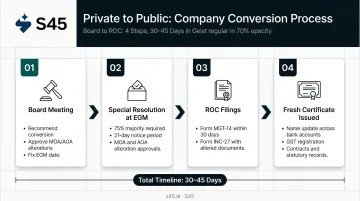
From Board resolution to fresh Certificate of Incorporation, the conversion to a public limited company typically takes 30 to 45 days — provided your company already meets the minimum eligibility requirements before the process begins.
Step 1: Board Meeting
The Board passes resolutions to:
- Recommend conversion to shareholders
- Approve proposed alterations to MOA and AOA
- Fix the EGM date (observing the 21-day notice period)
- Authorise a director or Company Secretary to circulate the EGM notice to all directors, shareholders, and auditors
Step 2: Special Resolution at EGM
The EGM notice must be issued at least 21 clear days before the meeting date. Shorter notice is valid only with written or electronic consent from at least 95% of voting members.
At the EGM, shareholders pass a Special Resolution — under Section 114(2), votes in favour must be at least 3 times votes against (the practical 75% threshold). The resolution covers three approvals simultaneously:
- The conversion itself
- Alteration of the MOA
- Alteration of the AOA
Minutes must capture the vote count, resolution text, and member attendance.
Step 3: ROC Filings
File two forms with the ROC:
- Form MGT-14: Registers the Special Resolution with the ROC. Must be filed within 30 days of the resolution under Section 117(1).
- Form INC-27: The formal application for conversion, filed with the altered MOA and AOA, EGM minutes, and supporting documentation.
If new directors were appointed to meet the minimum-3 director requirement (mandatory for public companies), Form DIR-12 must also be filed.
Step 4: ROC Issues Fresh Certificate
The ROC reviews the application and may raise queries. Once satisfied, it issues an altered Certificate of Incorporation reflecting the new name (dropping "Private") and public company status.
Once the certificate is in hand, your company is legally a public limited company. Update the name immediately across:
- Bank accounts
- GST registration
- Letterheads, website, and contracts
- All sector-specific regulatory registrations
With conversion complete, the company is structurally eligible to proceed with SEBI filing and the formal IPO process.
What Changes After Conversion (and What Doesn't)
Compliance Obligations That Increase Immediately
Public company status triggers a materially higher compliance burden:
- Managerial remuneration caps under Section 197(1): Total remuneration to all directors capped at 11% of net profits; individual MD/WTD capped at 5%
- Secretarial audit applies above ₹50 crore paid-up capital, ₹250 crore turnover, or ₹100 crore bank/PFI borrowings
- Related party transactions: Audit Committee pre-approval is mandatory; shareholder approval required for material RPTs
- Annual return disclosures are more rigorous than for private companies
These costs activate the moment the ROC issues the certificate — not when your shares list.
The Gap Between "Converted" and "Listed"
Many founders lose time here. A converted but unlisted public company:
- Carries all public company compliance costs
- Has no trading liquidity
- Has no access to capital from public markets
- Is not yet subject to SEBI's oversight as a listed entity
Conversion without a concrete, near-term IPO plan creates an extended compliance burden with no corresponding benefit. The timing of conversion should be a deliberate trigger within an active IPO execution plan.
The SEBI Journey That Follows
Once conversion is locked in, the clock starts on execution. After receiving the Certificate of Incorporation, the company must:
- Appoint a SEBI-registered merchant banker (Book Running Lead Manager) to manage the IPO
- Prepare and file a Draft Red Herring Prospectus (DRHP) with SEBI
- Complete full due diligence — financial, legal, and operational
- Meet minimum public shareholding norms (at least 25% post-IPO for Main Board, per SEBI ICDR Regulation 14)
- Comply with SEBI ICDR Regulations throughout the process
SEBI issues its observation letter within 30 days of satisfactory replies to clarifications or stock-exchange in-principle approval, whichever is later. Founders should plan for a total runway of 4 to 6 months from conversion to listing date — longer when DRHP preparation is complex or SEBI raises multiple query cycles.
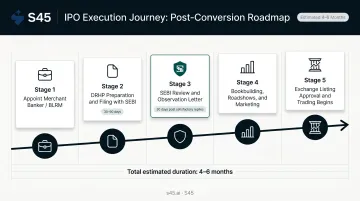
This post-conversion phase — from DRHP drafting through bookbuilding and post-listing IR — is where S45 works with founders as an integrated execution partner, operating alongside Narnolia as the SEBI-registered Category-I Lead Manager. With 26 IPOs executed since July 2023, S45 brings the same process discipline to both Main Board and SME listings.
Common Mistakes Founders Make During Conversion
Converting Too Early
A converted public company that is not listing within 12–18 months carries full public company compliance costs with none of the capital access benefits. These costs add up fast:
- Company Secretary salary and secretarial audit fees
- Board committee setup and ongoing governance overhead
- Stricter RPT (Related Party Transaction) governance requirements
Conversion should be a triggered decision made as part of an active IPO process — not a preparatory step taken years in advance.
Incomplete AOA Amendments
Many companies remove "Private" from the name and adjust the member cap, then file INC-27. The ROC rejects it. The entire AOA must be rewritten to remove all three private company restrictions and add appropriate public company governance clauses. Partial amendments carry no credit. They produce full delays.
Mistaking Conversion for Going Public
The conversion is a corporate law formality — 30 to 45 days, a fresh certificate, a new name on letterheads. The IPO process that follows involves:
- SEBI review (30+ days for observations post satisfactory replies)
- DRHP preparation and filing (30 to 90 days, issuer-dependent)
- Marketing, roadshows, and bookbuilding
- Exchange listing approval
Founders who treat conversion as the endpoint routinely underestimate what follows. Those who arrive at SEBI with gaps in governance, RPT disclosures, or unresolved financial restatements face observation letters, mandatory re-filings, and timelines that stretch well beyond what any board had planned for.
Frequently Asked Questions
How can a private company convert to a public limited company for an IPO?
Pass a Special Resolution at an EGM (75% majority), alter the MOA and AOA to remove all private company restrictions, meet the minimum requirements of 7 shareholders and 3 directors, and file Forms MGT-14 and INC-27 with the ROC. The ROC then issues a fresh Certificate of Incorporation. After that, the company pursues SEBI ICDR compliance — including DRHP filing — to initiate the IPO process.
Can a public limited company go for an IPO?
Yes, but public company status is a prerequisite, not a guarantee. After conversion, the company must appoint a SEBI-registered merchant banker, file a DRHP with SEBI, complete due diligence, and satisfy listing eligibility criteria on BSE or NSE (Main Board or SME Exchange) before it can list shares and raise public capital.
What is the minimum number of shareholders and directors required for conversion?
A Public Limited Company requires at least 7 shareholders and 3 directors, with at least one resident in India. If the converting company falls short, shares must be allotted or transferred and new directors appointed before INC-27 is filed. Filing without meeting these thresholds will result in ROC rejection.
How long does the conversion process take before you can file for an IPO?
The conversion process (Board meeting to fresh Certificate of Incorporation) typically takes 30 to 45 days. DRHP preparation and filing adds another 30 to 90 days depending on the issuer, with SEBI observations issued within 30 days of satisfactory replies — plan for a total runway of at least 4 to 6 months from conversion to listing date.
Does converting to a public limited company mean your shares are automatically listed on BSE or NSE?
No. Conversion and listing are entirely separate processes. Conversion gives the company legal standing to offer shares to the public and apply for listing. Actual listing requires SEBI approval of the DRHP, completion of IPO bookbuilding, and stock exchange approval — after which trading begins. Many converted public companies remain unlisted by choice.
What documents are required to file Form INC-27 for conversion?
The key attachments include the altered MOA and AOA, EGM minutes and the Special Resolution, list of all shareholders and directors, and supporting compliance documentation. Form MGT-14 (for the Special Resolution) must also be filed with the ROC within 30 days of the resolution being passed.
Conclusion
Converting to a Public Limited Company is the essential first step in an IPO journey — it removes the legal barriers to public share issuance, eliminates restrictions on share transferability, and satisfies SEBI's baseline eligibility criteria for listing on BSE or NSE.
The corporate restructuring takes 30 to 45 days. The IPO that follows requires structured execution: DRHP readiness, SEBI compliance, demand mapping, bookbuilding, and post-listing investor relations. Founders who treat the fresh Certificate of Incorporation as the finish line typically find themselves in extended pre-IPO limbo, carrying compliance costs with no capital access to show for it.
Founders who list efficiently treat conversion as one stage in a coordinated IPO plan. Assembling execution partners reactively after conversion — rather than from the outset — adds months and uncertainty to a process that is already demanding.
S45 structures this journey from readiness assessment through to post-listing investor relations, having executed 26 IPOs and generated over ₹1,83,000 crore in bids. The conversion is where the work begins, not where it ends.