

Introduction
The global drone market is undergoing one of its sharpest re-ratings in history. According to The Insight Partners' June 2026 report, the UAV market stood at $40.18 billion in 2025 and is projected to reach $123.01 billion by 2034 at a 13.24% CAGR.
For nearer-term context, MarketsandMarkets projects $40.56 billion by 2030 at a 9.2% CAGR — a more conservative path, but one that still implies near-doubling within five years.
What's driving the acceleration isn't one catalyst — it's three converging at once: active military conflicts pushing urgent procurement, U.S. policy blocking Chinese drone imports, and AI integration lifting software-first valuations across the board. The sector is producing extraordinary returns and sharp corrections, sometimes in the same stock within the same week.
Below: the top drone stocks and IPOs worth tracking in 2026, the structural forces behind the surge, the risks that aren't priced in yet, and the signals that matter most right now.
Key Takeaways
- Swarmer Inc. (SWMR) surged nearly 1,100% in two trading sessions, marking one of the strongest U.S. tech IPO debuts in recent memory
- Defense demand is the primary catalyst — active conflicts have made autonomous drone systems an urgent military priority
- The U.S. ban on DJI and Autel has created a structural supply gap worth billions, benefiting domestic manufacturers
- AI and autonomy software companies command materially higher valuations than pure hardware assemblers
- Post-IPO volatility and contract concentration make speculative pricing a real risk — position sizing matters
Why Drone IPOs Are Dominating 2026 Markets
The $123 billion long-term projection is pulling institutional and retail capital into the sector, but the more immediate signal is ETF inflows. The REX Drone ETF (DRNZ) returned 32.18% year-to-date as of June 2, 2026, with $119 million AUM and $71 million in net inflows between January 1 and May 29. Those numbers reflect sustained institutional positioning, not a short-term retail trade.
Three Mega-Themes in One Sector
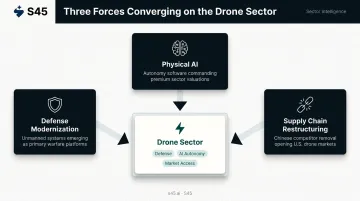
What makes drone stocks unusual is that they occupy three high-conviction investment themes simultaneously:
- Defense modernization — unmanned systems are shifting from supplementary tools to primary platforms in modern warfare
- Physical AI — autonomy software and edge computing are creating premium valuation multiples for software-first drone companies
- Supply chain restructuring — the removal of Chinese competitors from U.S. markets is forcing rapid domestic sourcing across military, commercial, and industrial buyers
Each of these themes carries its own dedicated investor base. When they converge in a single sector, capital concentration follows — and in 2026, drone stocks are drawing defense, AI, and reshoring investors simultaneously. That kind of triple overlap is rare.
Top Drone Stocks and IPOs to Watch in 2026
Swarmer Inc. (SWMR) — The IPO That Rewrote the Record Books
On March 17, 2026, Swarmer priced its IPO at $5 per share and proceeded to do something few public listings have managed: Bloomberg reported it closed up 520% at $31 on debut day, described as the best U.S. stock debut since Newsmax. MarketWatch reported the cumulative gain reached nearly 1,100% across two trading sessions.
What does Swarmer actually do? It builds vendor-agnostic drone autonomy software — a command-and-control platform that allows operators to manage large drone swarms simultaneously. According to the company's SEC Q1 filing, Swarmer has supported over 100,000 combat missions in Ukraine since April 2024, giving it genuine battlefield validation that most defense-tech startups lack.
The market was not pricing Swarmer on current fundamentals. Its SEC 8-K confirms firm commitments plus expected revenue totaling $33.1 million, with approximately 60% expected in 2026. The company's 2025 revenue base was minimal by comparison.
What the volatility signals: This is a textbook low-float IPO in a hot sector. The extreme opening moves reflect human pattern trading as much as fundamental value. Investors who chased the opening surge without understanding the backlog-to-revenue conversion risk learned that lesson quickly as the stock corrected in subsequent weeks.
AeroVironment Inc. (AVAV) — The Pentagon's Most Trusted Drone Supplier
AVAV is the institutional anchor of the drone sector. It may not be the most exciting name in the space, but the contract credibility and backlog quality make it the most defensible position in the group.
Key metrics as of early 2026:
- $1.1 billion funded backlog (per FY2026 Q3 results)
- FY2026 revenue guidance of $1.85B–$1.95B
- $200 million acquisition of ESAero completed March 16, 2026, expanding defense capabilities
- $15 million Dayton-area production expansion announced June 2026, adding capacity and jobs
MarketBeat consensus as of mid-June 2026 shows a price target of $318.78, implying approximately 87% upside from the $170.58 June 12 close. That's a "strong buy" consensus from analysts who see AVAV's backlog quality and contract credibility as underappreciated at current prices.
Ondas Inc. (ONDS) and Red Cat Holdings (RCAT) — The Revenue Momentum Stories
Ondas (ONDS):
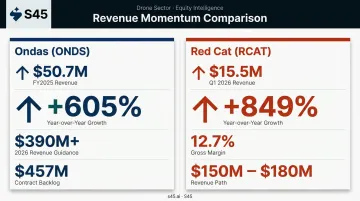
- FY2025 revenue: $50.731 million, up 605.3% from $7.193 million in 2024
- Q1 2026 raised full-year revenue guidance to at least $390 million
- Backlog: $457 million as of Q1 2026
- Roboteam acquisition announced, expanding ground-robotics capabilities
- MarketBeat consensus target implies approximately 85% upside from mid-June trading levels
Red Cat (RCAT):
- Q1 2026 revenue: $15.5 million, up 849% year-over-year
- Gross margin: 12.7% (turned positive and improving)
- Management outlined a path to $150M–$180M in annual revenue
- AI threat-detection partnership announced with Safe Pro Group (September 2025)
- Quaze Technologies acquisition closed May 20, 2026, adding wireless drone power systems
Both companies are proving the hardest thing in defense-tech: converting order books into recognized revenue. That conversion is what separates durable compounders from companies that generate press releases and backlog but struggle to actually ship.
Kratos Defense (KTOS) and Unusual Machines (UMAC) — Defense Backbone and Domestic Beneficiary
Kratos (KTOS):
- Q1 2026 revenue: $371 million, up 22.6%
- Consolidated backlog: $2.010 billion as of March 29, 2026
- Space Systems Command contract: $446.8 million, announced April 2026
- YTD share price: down approximately 24% despite strong fundamentals
- MarketBeat consensus target of $96.28 implies approximately 52% upside
The gap between KTOS's record backlog and its YTD price decline is exactly where valuation resets create entry points — for investors who can stomach procurement timing risk.
Unusual Machines (UMAC):
- Focuses on U.S.-made FPV drone components: Fat Shark goggles, Rotor Riot FPV platforms
- U.S. Army order for 3,500 drone motors with potential scaling to 20,000 components
- Roth Capital Buy rating with a $40 price target as of June 2, 2026
- Shares surged on Pentagon funding news, reflecting the direct policy tailwind from domestic drone procurement mandates
Key Forces Driving the Drone IPO Surge
Military Conflict Tailwind
The cost asymmetry of modern drone warfare is driving procurement urgency at a pace that peacetime budgets never generated. Iran launched 170 drones in the April 2024 Israel attack; CENTCOM confirmed destroying over 80 one-way attack UAVs.
The economics are stark: Shahed-type attack drones cost approximately $35,000 each, while the interceptors used against them — SM-2 missiles at $2.1 million, SM-6 at $3.9 million, PAC-3 at over $3 million — cost orders of magnitude more per shot.
This asymmetry is why militaries are investing urgently in counter-UAS software, low-cost interceptors, and autonomous detection systems rather than continuing to spend $3 million to down a $35,000 drone.
China Supply Chain Disruption
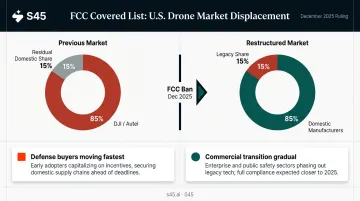
On December 22, 2025, the FCC added DJI and Autel to its Covered List, restricting new covered equipment purchases. The SCSP estimates DJI accounts for 70%–90% of drones across U.S. commercial, government, and consumer applications — including nearly 80% of the commercial market.
This is a market-wide reshuffling of supply relationships, not a niche displacement.
The transition will be gradual — existing fleets are not retroactively banned. But domestic drone companies now carry structural procurement priority that did not exist 18 months ago, and defense buyers are moving faster than commercial ones.
AI Integration as the Valuation Separator
The premium between software-first drone companies and hardware assemblers is widening. Anduril's $87 million counter-drone task order — the first task order under a broader Army contract vehicle described by DefenseScoop as worth up to $20 billion — illustrates where procurement dollars are flowing: toward command-and-control platforms, not airframes.
Swarmer's IPO multiple confirmed the same pattern from the investor side. Markets are awarding scarcity premiums to companies that own the software layer, not the manufactured component.
M&A as a Consolidation Signal
Well-capitalized public drone companies are actively acquiring to expand tech portfolios:
- AeroVironment acquired ESAero for approximately $200 million (March 2026)
- Ondas acquired Roboteam to expand into ground robotics
- Red Cat acquired Quaze Technologies for wireless power capabilities
When incumbents pay acquisition premiums at this pace, it sets a valuation floor for smaller companies building toward exit or listing.
Risks Every Drone IPO Investor Should Know
Low-Float IPO Volatility
Swarmer's first-week trading is the sector's most instructive recent case study. A 520%–1,100% opening move in two sessions is not fundamental price discovery — it is a function of small float, hot sector narrative, and pattern-chasing. These moves can and do reverse sharply. The real discipline is avoiding the first-day frenzy — not avoiding the sector entirely.
Government Contract Dependency
Most drone defense companies derive revenue from lumpy, competitive procurement cycles. A single contract win can send a stock up 80%; losing a renewal bid or facing budget delays can be equally damaging. GAO's 2026 review found that approximately 36 of 74 surveyed acquisition programs reported schedule effects from continuing resolutions. Backlog is real — but that GAO finding is a reminder that recognized revenue timing depends on budget processes that are inherently unpredictable.
Technology Obsolescence
The drone sector evolves fast. Today's leading system can be outperformed within 18–24 months. Two structural pressures compound that risk:
- Domestic-only manufacturing mandates cut off access to low-cost components from global supply chains, creating real sourcing bottlenecks
- Cost structure gaps mean companies that can't scale production domestically will face margin compression — even as they win contracts
Upcoming Drone IPOs and Future Signals to Watch
Skydio: The Most Anticipated U.S. Listing
Skydio remains private but raised a $110 million Series F at a $4.4 billion valuation, with the company stating its core business generates hundreds of millions in annual revenue. No confirmed IPO timeline exists, but when Skydio does list, its pricing will be the clearest indicator of what valuation multiples the public market will accept for a scaled, profitable domestic drone manufacturer.
That pricing will also set a reference point for every other U.S. drone company considering a public listing.
India's Emerging Drone IPO Pipeline
India has built a policy foundation for indigenous drone manufacturing. The PLI scheme allocates ₹120 crore for domestic drone and component producers, and a February 2026 PIB release confirmed 38,500+ registered drones and 39,890 DGCA-certified remote pilots in the country. KPMG projects India's drone services market at $4.9 billion by 2030 at a 44.4% CAGR.
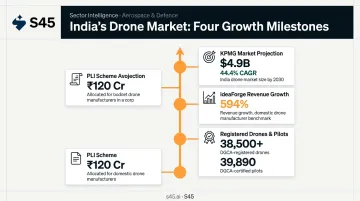
Listed benchmarks like ideaForge — which reported a 594% revenue jump in recent coverage — and funded private companies like Garuda Aerospace (raised ₹100 crore at a $250 million valuation) signal that Indian drone manufacturers are scaling toward public market thresholds.
For Indian drone and defense-adjacent companies, crossing that threshold involves more than growth metrics. The readiness work alone — offset compliance documentation, quality certifications (AS9100, AQAP, CEMILAC), revenue recognition policy for long-cycle contracts, board independence requirements, and SEBI disclosure preparation — typically takes 12–18 months of structured pre-filing preparation.
S45 works with high-growth industrial and defense-adjacent companies at exactly this stage, covering IPO readiness assessment, cohort-level demand mapping, and execution support from first call through post-listing investor relations.
What to Monitor in the Next 12–18 Months
- U.S. defense budget decisions on unmanned systems procurement, particularly how continuing resolutions affect delivery timelines
- Post-IPO lock-up expirations for recent drone listings — insider selling windows can create meaningful price pressure
- BVLOS regulatory developments — Beyond Visual Line of Sight approvals are the gateway to commercial drone scale in logistics and inspection
- Earnings from AVAV, ONDS, and RCAT — as the most liquid sector benchmarks, their quarterly results are the clearest signal of whether drone revenue is converting from backlog to cash
Conclusion
The 2026 drone IPO market combines genuine structural growth — verified military contracts, measurable AI integration gains, and supply chains actively restructuring away from Chinese components — with speculative excess that has already punished investors who chased opening-day prices without understanding the fundamentals beneath them.
The investors best positioned for long-term gains are those who focus on technology depth, verified backlog conversion, domestic eligibility, and disciplined entry — not IPO excitement alone.
The same applies to companies eyeing public listings in this space: the sectors with the strongest narratives attract the sharpest scrutiny. Companies that arrive at market with clean books, auditable order pipelines, and a clear path to profitability tend to hold their listing gains. Those that don't, won't.
Frequently Asked Questions
What was the biggest drone IPO in 2026?
Swarmer Inc. (SWMR) was the standout drone IPO of 2026, pricing at $5 per share on March 17 and surging nearly 1,100% across two trading sessions. Bloomberg described it as the best U.S. stock debut since Newsmax, driven by investor demand for its combat-deployed drone autonomy software.
Is Swarmer (SWMR) a good long-term investment after its IPO pop?
Swarmer had minimal 2025 revenue, but carries a $33.1 million backlog and active deployment in Ukraine with over 100,000 confirmed combat missions. Post-IPO volatility is real — investors should evaluate backlog conversion and execution capability rather than trade purely on opening-day momentum.
What is driving drone stock growth in 2026?
Three forces are driving the sector: active military conflicts creating urgent demand for autonomous systems, the U.S. ban on DJI and Autel opening the domestic market for American manufacturers, and AI integration enabling software-first companies to command premium valuations over hardware assemblers.
How can investors get broad exposure to drone stocks without picking individual IPOs?
The REX Drone ETF (DRNZ) provides diversified drone sector exposure — it returned 32.18% year-to-date through June 2, 2026, with $119 million AUM and $71 million in net inflows.
What are the biggest risks of investing in drone IPO stocks?
The key risks: low-float IPO dynamics create extreme short-term volatility that can reverse just as fast, government contract dependency makes revenue lumpy and tied to unpredictable procurement cycles, and rapid technology evolution can make today's competitive edge obsolete within 18–24 months.
Which upcoming drone IPOs should investors be watching?
For Indian investors, the domestic drone manufacturing ecosystem is the more immediate opportunity — PLI incentives and DGCA certification infrastructure are creating a pipeline of listable companies worth tracking now. Globally, Skydio remains the most anticipated drone IPO, valued at $4.4 billion in its latest funding round, though no listing timeline has been confirmed.