
Introduction
Most private limited company founders in India pay for compliance work they don't legally need to do — because they don't know they qualify as a "small company" under the Companies Act, 2013. The Act creates this distinct classification to unlock meaningful reductions in governance obligations, filing requirements, and penalties.
The primary eligibility filter is the paid-up capital threshold, and the Ministry of Corporate Affairs (MCA) has revised this limit three times since the Act's original enactment. As of December 2025, the threshold has changed again — and many founders are still working with outdated numbers.
If you're running a private limited company and haven't checked your classification recently, the numbers below may change what you owe — and what you don't.
Key Takeaways
- A small company must satisfy both a paid-up capital test and a turnover test simultaneously — not just one.
- The current limits (effective 1 December 2025) are ₹10 crore paid-up capital and ₹100 crore turnover.
- Holding companies, subsidiaries, Section 8 companies, and public companies are excluded from this classification entirely.
- Small company status is re-evaluated every financial year — a company can gain or lose the classification from one year to the next.
- Losing the status means full compliance obligations kick in: four annual board meetings, Form MGT-7, cash flow statements, and a complete directors' report.
What Is a Small Company Under the Companies Act, 2013?
The Statutory Definition
Section 2(85) of the Companies Act, 2013 defines a small company as a company, other than a public company, that satisfies two conditions simultaneously:
- Paid-up share capital does not exceed ₹50 lakh, or such higher amount as prescribed (subject to a statutory ceiling of ₹10 crore).
- Turnover, as per the profit and loss account for the immediately preceding financial year, does not exceed ₹2 crore, or such higher amount as prescribed (subject to a statutory ceiling of ₹100 crore).
The critical point: Section 2(85) of the India Code requires both conditions to be satisfied together. A company that clears the capital test but fails the turnover test does not qualify.
How Small Company Status Works in Practice
A small company is not a separate registration category. Key points founders often miss:
- No separate MCA form to file or certificate to obtain — it is a statutory classification applied to an existing private limited company that meets the prescribed thresholds and is not excluded by the provisos to Section 2(85).
- The classification is assessed annually, using paid-up capital and the turnover figure from the most recently audited profit and loss account.
- A company that qualifies this year may not qualify next year.
What Counts as Paid-Up Share Capital?
"Paid-up share capital" refers to the actual amount received by the company from shareholders in exchange for issued shares, not the authorised capital stated in the Memorandum of Association. Under Section 43 of the Act, share capital includes both equity and preference share capital, so paid-up preference shares are included in the calculation.
If your company has issued convertible preference instruments at scale, verify the treatment with your Company Secretary or statutory auditor before relying on the classification.
Current Paid-Up Capital Threshold: How It Has Evolved
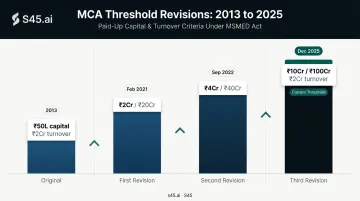
The MCA has progressively raised the thresholds three times since the original Act was notified, each revision aimed at expanding the number of companies that can access compliance relief.
| Period | Paid-Up Capital Limit | Turnover Limit | Basis |
|---|---|---|---|
| Original (Section 2(85) base) | ₹50 lakh | ₹2 crore | Statutory base text |
| 2021 amendment (G.S.R. 92(E), 1 Feb 2021) | ₹2 crore | ₹20 crore | MCA notification |
| 2022 amendment (G.S.R. 700(E), 15 Sep 2022) | ₹4 crore | ₹40 crore | MCA notification / PIB |
| 2025 amendment (G.S.R. 880(E), 1 Dec 2025) | ₹10 crore | ₹100 crore | Official e-Gazette PDF |
The December 2025 Change
The Companies (Specification of Definition Details) Amendment Rules, 2025, notified on 1 December 2025, substituted Rule 2(1)(t) to set the prescribed limits at ₹10 crore paid-up capital and ₹100 crore turnover. The notification states that the rules come into force on the date of publication in the Official Gazette — meaning the revised thresholds are in effect from that date.
If your articles or advisors are still referencing the ₹4 crore limit, they are working with pre-December 2025 figures.
The updated limits significantly expand the universe of qualifying companies. If your paid-up capital sits between ₹4 crore and ₹10 crore, it is worth reviewing whether your company now qualifies — and which compliance exemptions that status unlocks.
Compliance Benefits Available to Small Companies
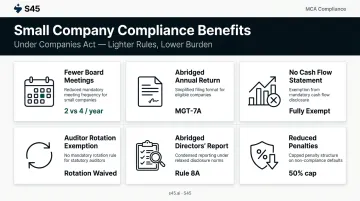
The small company classification unlocks six concrete compliance relaxations under the Companies Act. Here is what each one means in practice:
| Benefit | What It Means |
|---|---|
| Fewer board meetings | 2 per year (vs. 4 for other private companies) |
| Abridged annual return | Form MGT-7A with fewer disclosures |
| No cash flow statement | Excluded from annual financial statements |
| Auditor rotation exemption | No mandatory rotation cycle |
| Abridged directors' report | Shorter board report under Rule 8A |
| Reduced penalties | Capped at 50% of normal, max ₹2 lakh (company) / ₹1 lakh (officer) |
Fewer Board Meetings
Under Section 173(5) of the Companies Act, a small company must hold at least one board meeting in each half of the calendar year, with a gap of not less than 90 days between the two meetings. Other private limited companies must hold a minimum of four board meetings annually, with not more than 120 days between consecutive meetings.
Abridged Annual Return (Form MGT-7A)
Small companies file their annual return using Form MGT-7A, an abridged version of the standard Form MGT-7, applicable from FY 2020-21 onwards. MGT-7A contains fewer disclosure requirements and can be signed by a director or a Company Secretary — the full MGT-7 requires both signatures where a CS is appointed.
No Cash Flow Statement
Section 2(40) of the Companies Act contains a proviso that the financial statement for a small company may not include the cash flow statement. For founders managing accounts without a dedicated finance function, this removes one of the more time-intensive components of annual accounts preparation.
Similarly, the auditor rotation exemption reduces another recurring compliance cost — without the need to re-tender and onboard a new statutory auditor on a fixed cycle.
Auditor Rotation Exemption
Mandatory statutory auditor rotation under Section 139(2) applies to listed companies and certain prescribed classes. Rule 5 of the Companies (Audit and Auditors) Rules, 2014 excludes small companies from those prescribed classes — so there is no obligation to change auditors on a fixed schedule.
Abridged Directors' Report
Small companies prepare an abridged board report under Rule 8A of the Companies (Accounts) Rules, 2014, rather than the full-form report required under Rule 8. This omits several disclosure clauses that apply to larger companies.
Reduced Penalties
Section 446B of the Companies Act caps penalties for small companies at not more than one-half of the normal penalty, subject to a maximum of ₹2 lakh for the company and ₹1 lakh for an officer or other person in default. The cap applies across a wide range of non-compliance scenarios under the Act.
Companies Excluded from Small Company Classification
Section 2(85) contains an explicit proviso that removes certain categories from eligibility regardless of their financial size:
| Excluded Category | Statutory Basis |
|---|---|
| Public companies | Opening words of Section 2(85): "other than a public company" |
| Holding companies | Proviso (A) to Section 2(85) |
| Subsidiary companies | Proviso (A) to Section 2(85) |
| Section 8 companies (not-for-profit) | Proviso (B) to Section 2(85) |
| Companies governed by a special Act | Proviso (C) to Section 2(85) |
A private limited company that is a wholly-owned subsidiary of a larger group entity cannot claim small company benefits, even if its own paid-up capital is well below ₹10 crore and its own turnover is below ₹100 crore. The holding/subsidiary relationship alone disqualifies the entity, regardless of its standalone financials. This catches many promoters off guard during IPO readiness reviews.
Banking companies, insurance companies, and other bodies regulated under their own statutes fall under the special Act exclusion and are similarly ineligible.
What Happens When Your Company Crosses the Threshold?
The Annual Re-Assessment
At the end of each financial year, every company claiming small company status should verify its position:
- Paid-up capital: Check the total paid-up capital as recorded in the share capital account.
- Turnover: Check the turnover figure in the profit and loss account for the immediately preceding financial year.
If either threshold is breached, the company loses its small company status for the following financial year. The classification is binary — there is no partial benefit for companies that satisfy only one of the two tests.
Compliance Implications of Losing Status
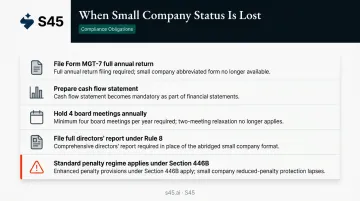
Transitioning out of small company status means a full switch to the standard private limited company compliance framework:
- Annual return: File Form MGT-7 (full-form) instead of MGT-7A.
- Financial statements: Prepare and include a cash flow statement.
- Board meetings: Hold a minimum of four board meetings annually under Section 173.
- Directors' report: File the full-form board report under Rule 8, not the abridged Rule 8A version.
- Penalties: Section 446B's reduced penalty cap no longer applies.
This shift typically adds compliance cost and management time — both in direct professional fees and in the internal effort required to manage more frequent board governance.
The Inflection Point Worth Recognising
Approaching the ₹10 crore paid-up capital threshold often signals that a company is actively raising capital and scaling its equity base. For founders at this stage, the compliance transition is one consideration — but the more significant question is whether the business is building toward a public markets pathway.
S45 works with founders at exactly this stage. For companies beginning to weigh an SME IPO or Main Board listing, S45's IPO Readiness Scan covers financial track record, governance gaps, board independence, and listing route feasibility — in about 30 minutes. Given that most pre-filing engagements run 12-18 months, the conversation about listing readiness should start well before a company formally outgrows its current capital structure.
Frequently Asked Questions
What is the paid-up capital limit for a small company?
The current limit, effective from 1 December 2025, is ₹10 crore paid-up share capital and ₹100 crore turnover (both must be satisfied). The Companies Act permits the government to prescribe limits up to these figures, and the December 2025 amendment has set both at their permitted maximums.
What is the minimum paid-up capital for a Pvt Ltd company?
There is no statutory minimum paid-up capital required to incorporate a private limited company in India — the earlier ₹1 lakh requirement was removed. The ₹10 crore small company threshold is a classification ceiling, not a floor for incorporation.
What is MGT-7A for a small company?
MGT-7A is the abridged annual return form prescribed specifically for small companies and One Person Companies, applicable from FY 2020-21 onwards. It contains fewer disclosure requirements than the standard Form MGT-7, and can be signed by a director or Company Secretary.
Can a subsidiary or holding company be classified as a small company?
No. Holding companies and subsidiary companies are explicitly excluded from the small company definition under the proviso to Section 2(85), regardless of their paid-up capital or turnover.
What happens when a small company exceeds the threshold?
The company loses small company status from the following financial year. It must then comply with standard private limited company requirements: filing Form MGT-7, preparing a cash flow statement, holding four board meetings annually, and submitting a full directors' report.
Is small company status assessed every year?
Yes. Status is re-evaluated at the end of each financial year using paid-up capital and the turnover figure from the most recent profit and loss account. A company can gain or lose the classification from one year to the next.