Introduction
The acronym "FPO" means very different things depending on where you encounter it. Ask a farmer in Maharashtra and they'll describe a collective that helps them buy fertilisers cheaper and sell produce directly to processors. Ask a stock market investor and they'll talk about a listed company raising fresh equity. Ask a food safety officer and they'll reference a government quality certification for packaged juices.
All three are correct, and the confusion between them is common.
This article focuses primarily on the agricultural meaning: Farmer Producer Organizations — what they are, how they work, why India's government has invested heavily in building them, and what benefits they deliver to small and marginal farmers.
Key areas covered:
- Full form disambiguation across agriculture, capital markets, and food safety
- FPO structure and legal forms
- Benefits for farmer-members
- Government schemes and financial support
- Eligibility criteria and the Follow-on Public Offering definition
Key Takeaways
- FPO in agriculture = Farmer Producer Organization — a legally registered farmer collective that improves income and market access
- FPO in finance = Follow-on Public Offer — additional shares issued by an already-listed company after its IPO
- FPO in food safety = Fruit Products Order — a historical quality certification for processed fruit products, now subsumed under FSSAI
- The Government of India's target of 10,000 FPOs through NABARD, SFAC, and NCDC was confirmed as achieved by PIB in February 2025
- Eligible FPOs can access matching equity grants, credit guarantees, and income tax exemptions under central government schemes
FPO Full Form: What Does FPO Stand For?
Three completely different entities share this acronym. Here's the quick reference:
| Full Form | Context | Brief Description |
|---|---|---|
| Farmer Producer Organization | Agriculture | A legally registered collective of farmers — operates as a producer company, cooperative, or society |
| Follow-on Public Offer | Capital Markets | Additional shares issued by an already-listed company to the public |
| Fruit Products Order | Food Safety / Certification | A historical government quality mark for processed fruit and vegetable products in India |
Within Indian agriculture policy, "FPO" almost always means Farmer Producer Organization — a legal entity formed by primary producers under the Companies Act 2013 (as a Producer Company), a State Cooperative Societies Act, or as a registered society or trust. Farmers are shareholders, participate in governance, and share in profits.
The third meaning — Fruit Products Order, 1955 — applies to food safety. It was a mandatory certification for processed fruit and vegetable products, ensuring compliance with quality and hygiene standards. That regime has since been repealed and consolidated into FSSAI's regulatory framework following the full implementation of the Food Safety and Standards Act, 2006 in August 2011 — though older product packaging may still carry the mark.
FPO in Agriculture: Farmer Producer Organizations Explained
A Farmer Producer Organization is a type of Producer Organisation (PO) where all members are farmers — distinct from POs that may include weavers, artisans, or fishermen. Members are shareholders, vote on governance matters, and share in the organization's profits.
The FPO itself is a legal entity that can sign contracts, access credit, and conduct business on behalf of its members.
How an FPO Works
The core problem FPOs solve is scale. An individual smallholder with two acres cannot negotiate bulk input prices from a fertiliser supplier, nor command attention from a large food processor looking for consistent volumes. Alone, they're price-takers at both ends.
By aggregating under an FPO, members gain:
- Collective procurement: bulk purchases of seeds, fertilisers, pesticides, and equipment at lower rates
- Direct market linkages to institutional buyers, exporters, food processors, and retail chains — without multiple intermediary layers
- Formal credit access: the FPO as a registered entity can borrow from banks and pass on credit to members who couldn't qualify individually
- Training in crop management, integrated pest management, post-harvest handling, and export documentation
- Shared machinery and infrastructure pools that reduce capital expenditure for each member
An impact evaluation of 14 NABARD-promoted FPOs in Telangana reported an average income increase of 12.67% among members, attributed to timely input supply, bulk procurement, and market linkages.
Those outcomes, though, depend significantly on how the FPO is structured legally.
Legal Structure of an FPO
FPOs in India can be registered under multiple legal forms. The most common is the Producer Company under the Companies Act 2013 — because it offers greater member-level autonomy, a multi-object scope, and the ability to operate across all of India. Other options include cooperative societies under State or Multi-State Cooperative Societies Acts, or registered societies and trusts.
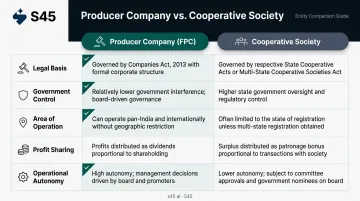
Here's how Producer Companies compare to Cooperative Societies on key parameters:
| Parameter | Producer Company (FPC) | Cooperative Society |
|---|---|---|
| Legal basis | Companies Act 2013 | State/Multi-State Cooperative Societies Act |
| Government control | Minimal — company law governance | Higher — state cooperative law oversight |
| Area of operation | Pan-India | Often restricted to state boundaries |
| Profit sharing | Patronage-linked benefits to members | Cooperative surplus distribution rules |
| Operational autonomy | Higher | Lower |
Key Benefits of Joining an FPO for Farmers
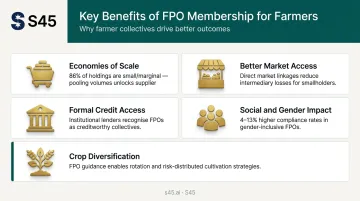
Economies of Scale for Small and Marginal Farmers
India's landholding structure makes collective action urgent. According to the All India Agriculture Census 2015-16, small and marginal holdings below 2 hectares account for 86.08% of all operational holdings — up from 85.01% in 2010-11 — and cover 46.94% of total operated area. These farmers individually lack the volume to negotiate meaningfully with input suppliers or output buyers.
FPOs address this directly by pooling demand and supply, enabling:
- Bulk input procurement at reduced per-unit cost
- Collective selling at prices unavailable to individual farmers
- Shared post-harvest infrastructure — cold storage, sorting, grading, packaging
Better Market Access
FPOs connect farmers directly with institutional buyers, food processors, exporters, and organised retailers — cutting out the chain of commission agents and middlemen that typically erodes farm-gate income. The fewer hands produce passes through before reaching the buyer, the greater the farmer's share of the final price.
Access to Formal Credit
Registered FPOs can access institutional loans that most individual smallholders cannot. Members can receive crop loans, working capital, and infrastructure financing channelled through the FPO, with government-backed credit guarantees reducing lender risk.
Social and Gender Impact
FPOs create structured platforms where women farmers gain decision-making roles that informal agricultural networks rarely provide. Research from the Tata-Cornell Institute found that female-led and mixed-representation FPCs had compliance rates 4-13% higher than male-only organisations — a meaningful governance advantage.
The production benefits are equally clear. A peer-reviewed study published on PMC found that FPO households grew a mean of 4 crops versus 3.5 crops for non-FPO households — a difference that points to stronger nutritional resilience across farming communities.
Government Support and Schemes for FPOs in India
The 10,000 FPO Initiative
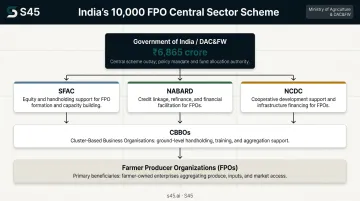
In Union Budget 2019-20, the Government of India announced the formation of 10,000 new FPOs to ensure economies of scale for farmers. The Central Sector Scheme for Formation and Promotion of 10,000 FPOs was launched in 2020 with a total budgetary outlay of ₹6,865 crore. As of February 2025, PIB confirmed that the 10,000 FPO target has been achieved.
Three primary implementing agencies drive this scheme:
- SFAC (Small Farmers' Agribusiness Consortium)
- NABARD (National Bank for Agriculture and Rural Development)
- NCDC (National Cooperative Development Corporation)
State governments may also nominate their own implementing agencies in consultation with the Department of Agriculture, Cooperation & Farmers Welfare.
Financial Support Mechanisms
Two distinct financial support frameworks operate for FPOs, and they apply to different entity types:
SFAC Equity Grant and Credit Guarantee Fund Scheme (for Farmer Producer Companies):
- Matching equity grant of up to ₹10 lakh per registered FPC
- Credit guarantee covering up to 85% of loans not exceeding ₹100 lakh
10,000 FPO Central Sector Scheme:
- Equity grant of up to ₹2,000 per farmer-member, capped at ₹15 lakh per FPO
- Credit guarantee on project loans up to ₹2 crore per FPO
Tax benefit: Section 80PA of the Income Tax Act provides a 100% deduction on eligible profits for Producer Companies with annual turnover below ₹100 crore, applicable from assessment year 2019-20 through 2024-25.
The Role of CBBOs
Implementing agencies engage Cluster-Based Business Organisations (CBBOs) to mobilise farmers at the ground level. CBBOs provide:
- Initial farmer mobilisation and registration support
- Governance training and business planning assistance
- Five years of professional handholding post-formation
- Priority focus on aspirational districts, with at least one FPO per block in these areas
The scheme also uses a produce-cluster approach — aligning FPOs to specific agricultural commodities within geographic clusters to enable better branding, processing, and export potential.
FPO in Finance: Follow-on Public Offer
What It Means
In capital markets, FPO (or Follow-on Public Offer — SEBI's formal term is "further public offer") is when a company already listed on a stock exchange issues additional shares to the public. SEBI's ICDR Regulations 2018 define it as an offer of specified securities by a listed issuer to the public for subscription, and includes offer for sale by existing holders.
Two types exist:
- Fresh issue FPO — new shares are created and issued, increasing total share count. Can be dilutive to existing shareholders' earnings per share
- Offer for sale FPO — existing large shareholders sell their holdings to the public. No new shares are created; generally non-dilutive to EPS
How FPOs Differ from IPOs
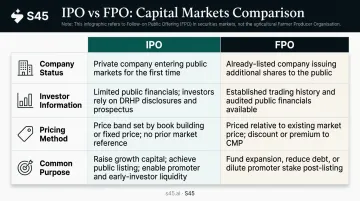
| Parameter | IPO | FPO |
|---|---|---|
| Company status | Unlisted (going public for the first time) | Already listed |
| Investor information | Limited historical data | Public track record available |
| Pricing | Typically set via bookbuilding | Often at or near market price |
| Common purpose | Initial capital raise, promoter dilution | Debt reduction, expansion, government divestment |
A well-known Indian agri/food sector example: Ruchi Soya Industries (now Patanjali Foods) filed a follow-on public offer in 2022, documented with SEBI, partly to address the company's debt position post-resolution.
The Intersection with Agriculture
As Farmer Producer Organizations scale and formalise operations, some may eventually explore listing on public exchanges — a first-time IPO, not an FPO in the financial sense. That path — from readiness assessment through DRHP drafting, pricing, and post-listing investor relations — is a different regulatory and operational exercise entirely. S45, an AI-native investment bank, works specifically with growth-stage Indian companies on first-time listings across Main Board and SME exchanges, including those in the agriculture and food sector.
Who Is Eligible for an FPO?
Membership in an agricultural FPO is open to primary producers — farmers of any scale, including small, marginal, and landless farmers engaged in agricultural activities. Key eligibility parameters under the 10,000 FPO scheme:
- Requires at least 300 farmer-members at formation in plain areas; 100 members in North-Eastern and hilly regions
- Joining is voluntary, with no discrimination based on gender, religion, caste, or political affiliation
- Institutions of primary producers can also become members of a Producer Company
One critical governance principle: ownership and control always rest with farmer-members, not with the promoting agencies or CBBOs that assisted in the FPO's formation. Elected representatives of members manage the FPO, and the promoting organisation's role ends after the handholding period — typically three to five years under the 10,000 FPO scheme.
Frequently Asked Questions
What is FPO and IPO?
An IPO (Initial Public Offering) is a private company's first sale of shares to the public, resulting in a stock exchange listing. An FPO (Follow-on Public Offer) is when that same listed company issues additional shares later. In agriculture, FPO stands for Farmer Producer Organization — a registered collective of smallholder farmers operating outside capital markets entirely.
What is the full form of FPO in food safety?
Fruit Products Order — historically a mandatory government certification for processed fruit and vegetable products in India, ensuring quality and hygiene compliance. The Fruit Products Order, 1955 has since been repealed and replaced under the FSSAI framework following the Food Safety and Standards Act, 2006.
What is the full form of FPO in a salary slip or defence context?
In defence and government postal contexts, FPO stands for Field Post Office — used in the Indian Army's postal system for correspondence and salary communications routed through field units. The term carries no connection to either the agricultural or capital markets definitions.
Who is eligible for an FPO?
Any farmer — small, marginal, or landless — engaged in primary agricultural production is eligible to join an FPO. Forming one requires a minimum of 300 members in plain areas (100 in hilly or North-Eastern regions). Membership is open regardless of gender, religion, or caste.
What is the difference between an FPO and an FPC?
FPC (Farmer Producer Company) is the specific legal form of an FPO registered as a Producer Company under the Companies Act. FPO is the broader umbrella term covering any farmer collective — cooperatives and societies included — regardless of registration type. All FPCs are FPOs, but not all FPOs are registered as companies.
How does the government support FPOs in India?
Government support for FPOs runs across four channels:
- Equity grants: Up to ₹10 lakh (SFAC scheme) or ₹15 lakh (central scheme) in matching grants
- Credit guarantees: Covering up to 85% of eligible loans
- Tax exemption: Five-year income tax relief for qualifying Producer Companies
- Formation programme: 10,000 FPO targets implemented through SFAC, NABARD, and NCDC