 in India](https://file-host.link/website/s45-1upl1t/assets/blog-images/48833bef-3a06-4987-acc9-9bbfcce8edbb/1782810791276213_7deea88e623e404fafdcb98c7bdb2219/360.webp)
For founders preparing to go public, this surge creates an important problem: more options, more noise, and higher stakes in choosing the right partner.
The merchant banker you appoint as Lead Manager will determine your DRHP quality, pricing discipline, investor demand, and ultimately whether your listing day feels like a milestone or a misstep. That single decision shapes everything downstream.
This article covers the top merchant bankers for SME IPOs in India, what distinguishes each firm, and the criteria founders should actually use when making this call.
Key Takeaways
- A SEBI-registered Lead Manager manages your entire SME IPO — from DRHP drafting to post-listing support
- High subscription numbers don't guarantee quality — 85 of 238 SME listings in 2025 saw listing-day losses of up to 45%
- Sector alignment, DRHP quality, and pricing discipline matter more than brand recognition
- Always verify SEBI registration before engaging any merchant banking firm
- The right merchant banker brings sector judgment and investor relationships alongside regulatory compliance
What Does a Merchant Banker Do in an SME IPO?
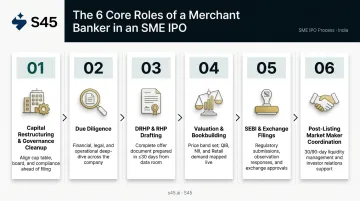
A SEBI-registered Category I merchant banker acts as the lead coordinator for the entire IPO process. Their scope spans every workstream from governance cleanup to post-listing compliance.
Core responsibilities include:
- Capital restructuring and pre-IPO governance cleanup
- Due diligence across financials, operations, legal, and promoter background
- DRHP and RHP drafting, including all SEBI disclosures
- Valuation, pricing band determination, and bookbuilding management
- SEBI and stock exchange filings, observation responses, and approvals
- Post-listing market maker coordination (mandatory for SME platforms)
The Lead Manager vs. Other Intermediaries
Many founders confuse the merchant banker's role with that of the registrar, legal advisor, or market maker. The distinction matters.
The lead merchant banker appoints and coordinates every other intermediary. They hold regulatory accountability for the offer documents and serve as the primary interface with SEBI and the exchange. A weak registrar or slow legal advisor creates friction. A weak merchant banker stops the listing entirely.
Regulatory Requirement Founders Must Know
SEBI mandates that only registered Category I merchant bankers can act as lead managers for SME IPOs. Before engaging any firm:
- Verify their registration status on SEBI's intermediary portal
- Ask directly about their return history — NSE Emerge requires that the lead merchant banker not have had draft offer documents returned by the exchange in the prior six months
Top Merchant Bankers for SME IPOs in India
The firms below were identified based on SME IPO volume, sector coverage, DRHP quality, founder-friendliness, and verified SEBI registration — not registration status alone. When evaluating any merchant banker, ask about their active deal pipeline, sector familiarity with your industry, and post-listing support commitments — not just their credential sheet.
Hem Securities Limited
Hem Securities is one of the most active SME IPO lead managers in India, with a long operating history in capital markets and merchant banking. Their SEBI registration number is INM000010981. They are consistently present on both NSE EMERGE and BSE SME and maintain an established investor distribution network built over many years of high-volume execution.
Their visible transaction footprint spans a wide range of sectors, making them a generalist option for founders across industries.
| Metric | Details |
|---|---|
| SEBI Registration | INM000010981 (verified) |
| Key Sectors | Engineering, IT software, electronics, steel products, pharmaceuticals, plastics, textiles |
| Notable Differentiator | High-volume execution track record; established distribution network across NSE EMERGE and BSE SME |
Pantomath Capital Advisors Private Limited
Pantomath is a well-regarded mid-market investment bank with both SME and mainboard IPO experience. Their SEBI registration is confirmed through their public disclosure; the specific registration number is not independently verified here — check the SEBI IEPF portal directly. Pantomath's website references 150+ ECM transactions across their platform history, covering equity capital markets more broadly than SME alone.
| Metric | Details |
|---|---|
| SEBI Registration | Confirmed (disclosed on pantomathgroup.com; registration number not independently verified — check SEBI IEPF portal) |
| Key Sectors | Telecommunications, steel, civic services, textiles, cables and wires |
| Notable Differentiator | Mid-market ECM advisory breadth; institutional relationships across mainboard and SME issuances |
Aryaman Financial Services Limited
Aryaman Financial Services is a SEBI Category I registered merchant banker with registration number INM000011344, particularly active on BSE SME. They serve smaller and first-time issuers and have established a focused SME practice over several years.
For founders in niche industries or companies listing for the first time, Aryaman's experience with smaller issuers can be a practical fit.
| Metric | Details |
|---|---|
| SEBI Registration | INM000011344 (Category I, verified) |
| Key Sectors | Sector-specific data not available from authoritative public sources; verify directly |
| Notable Differentiator | Focused SME practice; experience with first-time and smaller issuers on BSE SME |
Beeline Capital Advisors Private Limited
Beeline Capital Advisors is a growing SME-focused merchant banker with SEBI Category I registration number INM000012917. Their website references 100+ IPOs across their history, and their AIBI transaction records show activity across a broad range of sectors.
They have presence on both NSE EMERGE and BSE SME, with a pipeline that includes diagnostics, engineering, IT, logistics, media, and energy companies.
| Metric | Details |
|---|---|
| SEBI Registration | INM000012917 (Category I, verified) |
| Key Sectors | Hospitals/diagnostics, engineering, IT software, logistics, petrochemicals, power, trading |
| Notable Differentiator | Active pipeline across both SME platforms; broad sector coverage for growth-stage companies |
S45 — India's First AI-Native Investment Bank
S45 was built by operators-turned-bankers who experienced firsthand what broken IPO workflows cost founders. The founding team brings 22 years of India capital markets experience, IIT Delhi engineering background, and direct experience scaling companies through public market preparation.
Since July 2023, S45 has executed 26 IPOs in partnership with Narnolia (Category-I SEBI-Registered Merchant Banker) as Lead Manager — generating ₹1,83,000+ crore in bids with a 168x average subscription and 43% average listing pop.
What separates S45 is the process architecture. Sector specialists work inside a live, AI-powered data room with evidence-linked DRHP drafting and real-time bookbuilding analytics.
The result: first call to signed mandate in approximately 7 days, DRHP-ready draft in 30–45 days — the same institutional discipline that large mainboard transactions receive, applied to SME listings.
Post-listing, S45 doesn't disappear. They coordinate market maker obligations, run a structured 30/90-day IR program, and prepare earnings materials for ongoing investor engagement.
| Metric | Details |
|---|---|
| IPOs Executed (Since July 2023) | 26 IPOs with ₹1,180+ Cr in capital raised |
| Average Subscription | 168x with ₹1,83,000+ Cr in bids generated |
| Key Differentiator | AI-native process: DRHP-ready in 30–45 days, 50,000+ mapped investors, deep sector expertise across 12 industries, 0% upfront fees |
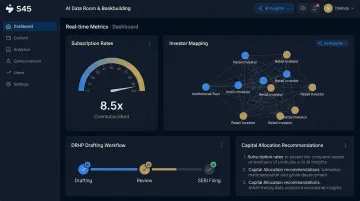
S45 operates as the AI-led advisory and execution layer; Narnolia serves as the SEBI-registered Category I Lead Manager for all regulatory filings.
Note: Definitive cumulative SME IPO counts are not independently verifiable from authoritative exchange or SEBI sources for all firms listed. Verify specific deal history, current registration status, and sector experience directly with each firm before engagement.
How to Choose the Right Merchant Banker for Your SME IPO
The Common Mistake Founders Make
Most founders shortlist merchant bankers on two flawed criteria: lowest fee or most recognizable name. Neither tells you anything about execution quality. A low fee often signals a templated DRHP, generic investor outreach, and a banker optimizing for quick subscription rather than a strong listing outcome.
What Actually Predicts Execution Quality
Ask every prospective merchant banker these questions before signing a mandate:
- How many SME IPOs have you managed in the last 24 months? Mainboard experience doesn't automatically transfer to SME — the investor base, exchange processes, and documentation demands are different.
- What was your average subscription rate and listing day performance? Ask for deal-level data, not aggregate claims.
- Have any of your recent DRHPs been returned by the exchange? NSE EMERGE disqualifies lead managers who had documents returned in the prior six months — that's a concrete, verifiable quality filter.
- Can I see a sample DRHP and your project plan? A well-structured merchant banker will have a clean document and a clear timeline. Vague answers here are a red flag.
Sector Alignment and DRHP Quality
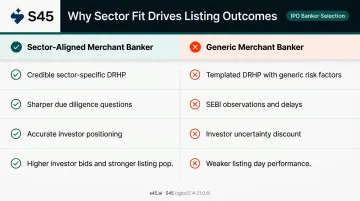
A merchant banker with experience in your sector will build a more credible DRHP, ask sharper due diligence questions, and position your company more accurately with investors. Generic DRHPs that don't reflect industry-specific risk factors attract SEBI observations, slow down the process, and weaken investor confidence.
That gap hits your pricing directly: an investor who understands your sector bids higher, while one who doesn't applies a discount to cover the uncertainty. The difference often shows up in your listing day pop — or the absence of one.
Post-Listing Support Is Not Optional
The mandatory three-year market making period on NSE EMERGE and BSE SME means your relationship with the merchant banker doesn't end at listing day. Ask specifically:
- Who coordinates the market maker, and how?
- What investor relations support do you provide in the 30 and 90 days post-listing?
- How do you handle the transition to ongoing compliance and earnings communication?
Firms that disappear after listing day leave founders managing market maker coordination, SEBI disclosures, and investor queries alone — without anyone who knows the deal history. That pressure accumulates quickly once the stock starts trading.
Conclusion
India's SME IPO market offers direct access to public capital for well-run businesses. But listing quality is only as strong as the execution behind it. The merchant banker you choose determines how your company is presented to investors, how your DRHP holds up under SEBI scrutiny, and whether your listing day builds lasting confidence or erodes it quickly.
Evaluate merchant bankers the way investors evaluate companies — on the same criteria that matter for any high-stakes decision:
- Fundamentals and verifiable execution history
- Track record specific to your sector and issue size
- Alignment between their incentive structure and your listing outcome
- Pricing discipline, not just fee competitiveness
If you've worked through that checklist and want to pressure-test where your company actually stands, S45 runs a structured first conversation covering your readiness gaps, realistic pricing range, and filing timeline. First call to signed mandate: typically 7 days.
Frequently Asked Questions
What is the role of a merchant banker in an SME IPO?
A SEBI-registered Category I merchant banker (Lead Manager) manages the entire SME IPO — from due diligence, valuation, and DRHP preparation to SEBI filings, bookbuilding, allotment coordination, and post-listing market maker oversight. They carry full regulatory accountability for all offer documents and are the primary point of contact with SEBI and the exchange.
How is a merchant banker different from other SME IPO intermediaries?
Other intermediaries — registrar, legal advisor, market maker, banker to the issue — each handle a defined function. The merchant banker coordinates all of them, and unlike the others, cannot be replaced mid-process without SEBI notification. That structural accountability is the key distinction.
How much does a merchant banker charge for an SME IPO?
No authoritative SEBI or exchange source publishes a standardised fee range. Fees vary based on issue size, complexity, and the firm's positioning — structures typically combine a retainer for drafting and filing work with a success fee tied to issue execution milestones. Request itemised quotes from each firm rather than relying on market estimates.
How many merchant bankers are needed for an SME IPO?
SEBI ICDR 2018 requires at least one lead manager for any public issue. SME IPOs typically proceed with a single lead manager given their issue size. Co-managers may be engaged for larger or more complex issues, but this is not the norm for standard SME listings.
What is the difference between NSE EMERGE and BSE SME for choosing a merchant banker?
Both platforms have similar eligibility thresholds — post-issue paid-up capital not exceeding ₹25 crore — but differ in fee structures, investor bases, and exchange processes. Some merchant bankers have stronger relationships or a deeper transaction history on one platform. Ask each prospective banker which platform they file on most frequently and why — the answer reveals where their institutional relationships actually sit.
How long does the SME IPO process take from merchant banker appointment to listing?
A well-prepared SME IPO typically takes 2–3 months from mandate signing to listing. The timeline depends heavily on documentation quality, audit readiness, and the merchant banker's process discipline. DRHP drafting, SEBI filing, observation responses, exchange approval, and the subscription window each add time — delays in any stage compound across the rest.