
Introduction
India's IPO market had a record-breaking FY25. According to PRIME Database data reported by Business Standard, 78 mainboard companies raised ₹1.62 trillion — more than double the ₹61,922 crore raised in FY24. The average deal size jumped from ₹815 crore to ₹2,082 crore in a single year.
That momentum reflects real appetite. But it also creates a risk: founders watching peers list can mistake market enthusiasm for a green light, skipping the harder question of whether their own company is ready.
An IPO is one of the most consequential decisions a founder will make. Done well, it unlocks capital, credibility, and future flexibility. Done poorly, it destroys morale, drains management bandwidth, and hands competitors a window of distraction while the company recovers.
This guide covers the full picture — the advantages and disadvantages of an IPO for companies, and the benefits and risks for investors — so founders and investors alike can weigh the decision on the merits.
Key Takeaways
- An IPO provides large-scale equity capital with no repayment obligation, plus brand visibility and M&A optionality.
- Surrendering some control is part of the deal: SEBI-mandated disclosures, quarterly reporting cycles, and public scrutiny come with the listing.
- Investors get early access to growth-stage companies and potential listing gains, though limited pre-issue data and valuation risk remain genuine concerns.
- Execution quality matters as much as the decision itself: poor pricing or weak book-building amplifies every downside.
- Governance readiness and market timing matter as much as capital need — get either wrong and even a solid company pays for it.
Advantages of an IPO for Companies
Raising Large-Scale Capital Without Debt
The most obvious benefit: an IPO lets a company raise substantial capital from public markets without taking on loans. No interest burden, no repayment deadlines, and no covenant restrictions.
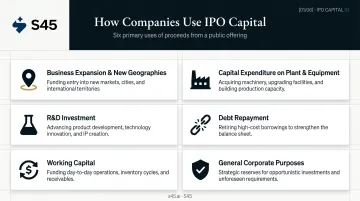
Consider a mid-sized Indian manufacturer. Expanding capacity through bank debt adds interest costs and restricts financial flexibility. Raising the same capital through an IPO dilutes ownership but leaves cash flow intact for operations and growth. The funds can be deployed across multiple priorities simultaneously:
- Business expansion and new geographies
- Capital expenditure on plant and equipment
- R&D investment
- Debt repayment or prepayment
- Working capital requirements
Unlike private equity, where a single large institutional investor often receives board seats and protective rights in exchange for capital, a public issue distributes ownership across thousands of shareholders. No single investor holds disproportionate control. For founders, that structural difference matters.
Enhanced Brand Credibility and Market Visibility
Listing on BSE or NSE subjects a company to mandatory SEBI disclosures — quarterly financials, material event announcements, related party transaction approvals. That transparency, while demanding, builds trust. NSE explicitly notes that visibility from listing improves customer and client credibility, with corporate announcements disseminated through the exchange network to investors and analysts.
The IPO process itself — DRHP filing, roadshow, listing event — generates media coverage that private fundraising rarely replicates. For B2B companies in particular, appearing on a national exchange changes how customers, suppliers, and prospective employees perceive the business.
Exit Route for Founders and Early Investors
An IPO creates a liquid, structured exit for founders, angel investors, venture capital funds, and key employees holding ESOPs. Shares can be offered via Offer for Sale (OFS) during the IPO itself, or sold in the secondary market after the applicable lock-in periods expire.
Moneycontrol reported that the OFS share of IPO value rose to 38% in 2024, up sharply from 9% the prior year — a clear signal that PE and VC investors are actively monetising through public markets. For Indian businesses backed by institutional capital, an IPO exit frequently delivers higher valuations than a strategic sale to a competitor.
Attracting and Retaining Talent with ESOPs
As a listed company, ESOPs become genuinely compelling. Employees can see the real-time market value of their options and sell shares on an exchange — something a private company promise cannot offer. NSE confirms ESOPs become an effective talent tool post-listing.
For founders competing with large MNCs or well-funded startups for senior hires, this is a meaningful structural advantage.
Using Listed Shares as M&A Currency
Once listed, a company's shares carry a market-determined valuation. That makes stock-based acquisitions viable, and often preferable, to cash deals. Zomato's acquisition of Blinkit is the clearest recent example: a ₹4,447 crore all-stock deal that let Zomato grow inorganically without depleting working capital. HDFC's reverse merger into HDFC Bank, structured as a share exchange, illustrates the same principle at larger scale.
Each of these advantages compounds the others — but they come with real trade-offs. The next section covers what founders and boards need to weigh on the other side of the ledger.
Disadvantages of an IPO for Companies
High Costs and Significant Time Commitment
An IPO is expensive, and the costs extend well beyond the listing date. The expense categories for an Indian IPO include:
- Merchant banker and underwriter fees
- Legal and due diligence fees
- SEBI filing fees
- DRHP drafting and audit fees
- Registrar and transfer agent fees
- Ongoing investor relations and compliance costs post-listing
No single authoritative all-in percentage range for Indian IPO costs has been publicly verified — offer documents include expense sections, but precise totals vary widely by issue size and complexity. What is clear: the cost burden is real and ongoing.
The time commitment is just as disruptive to operations. A typical mainboard IPO takes 9 to 18 months from preparation through listing. That timeline pulls the management team — especially the CFO and CEO — away from operations. For founder-led businesses with lean teams, that opportunity cost is substantial.
S45 addresses this directly: DRHP-ready drafts in 30 days from a clean data room, built on structured workflows that cut the version-control chaos and last-minute rewrites common in traditional banker relationships.
Loss of Operational Control and Founder Autonomy
Once listed, a company is accountable to a diverse shareholder base, a board with fiduciary duties to public investors, and stock exchange regulations. Strategic decisions that were previously made in a management meeting now require board approval, public disclosure, or shareholder votes.
The psychological shift catches many founders off guard. Activist shareholders can agitate for changes in capital allocation or management. Institutional investors apply pressure around margins or growth targets. Market sentiment starts shaping decisions: a founder may forgo a bold but expensive strategic move simply because of how it reads in a quarterly filing.
Private company autonomy is real, and founders routinely underestimate how much they will miss it.
Continuous Compliance and Disclosure Obligations
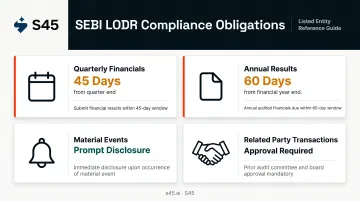
SEBI's Listing Obligations and Disclosure Requirements (LODR) cover four primary obligation categories:
- Quarterly financials must be submitted within 45 days of each quarter end
- Annual results must be filed within 60 days of the financial year end
- Material events require prompt stock exchange disclosure under Regulations 30 and 30A
- Related party transactions must be approved per Regulation 23
Delays carry financial consequences. SEBI's SOP specifies fines of ₹5,000 per day for delayed quarterly financial results, with additional daily fines for other governance defaults.
These obligations require dedicated internal teams — a qualified Company Secretary, compliance officer, investor relations function — and sustained engagement with external auditors and legal counsel. That's an overhead cost that doesn't exist for private companies.
There's a strategic cost too: financials, management compensation, and business strategy become public. Competitors can read your margins. Vendors know your cash position. Prospective acquirers see your valuation constraints.
Short-Term Market Pressure Overriding Long-Term Strategy
Public company CEOs and CFOs operate under constant pressure to meet quarterly earnings estimates. Missing analyst projections triggers immediate consequences. Max Healthcare shares fell up to 7.31% after Q4 FY26 results missed estimates; Nestle India dropped nearly 3% after a single quarter of below-expectation numbers.
That pressure is structural — and it distorts decision-making. Management tilts toward decisions that defend the near-term P&L: forgoing investment, deferring hiring, pulling back on R&D that won't show results for 18 months. The long-term competitive position takes the hit. Boards of private companies can absorb that kind of patient capital allocation without a stock price reaction.
Risk of Weak Listing or Failed IPO Execution
A poorly priced, under-subscribed, or weakly listed IPO causes lasting damage:
- Employee morale suffers when shares trade below issue price
- Retail investors who applied at issue price face immediate losses
- The company's ability to raise capital through future FPOs or institutional placements is weakened
- Management attention diverts to damage control
Execution quality — pricing discipline, demand mapping, book quality — directly determines listing outcomes. FY25 data shows that while 55 of 78 mainboard IPOs delivered listing gains above 10%, only 46 of 78 were trading above issue price at a later date. The gap between listing-day performance and sustained value creation is real — and it starts with how the book is built.
Benefits of an IPO for Investors
Retail and institutional investors who apply in an IPO gain access to a company's shares at the primary issue price — before the broader market re-rates the stock.
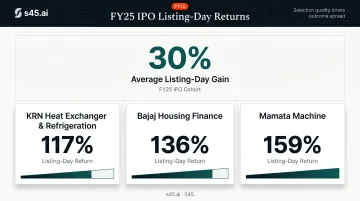
The data from FY25 is compelling: the average listing-day gain was 30%, with standout performers including Mamata Machine (159%), Bajaj Housing Finance (136%), and KRN Heat Exchanger & Refrigeration (117%). That spread matters — the gap between top performers and flat listings is wide, which makes IPO selection as important as IPO access.
Listing-day returns, though, are only part of the picture. IPOs open up sectors and business models that simply aren't available in the secondary market — giving investors a way to build exposure to growth-stage companies before they become household names on the exchange.
Post-listing benefits include:
- Earn dividend income once declared by the company
- Participate in future rights issues as an existing shareholder
- Trade freely on the exchange with full secondary market liquidity
Risks of Investing in an IPO
The same FY25 data that shows strong average gains also reveals the other side: 32 of 78 mainboard IPOs were not trading above issue price at a later measurement date. IPO investing is not low-risk.
Three specific risks deserve attention:
Information asymmetry. An IPO company has limited public financial history. Investors rely on the DRHP, which includes management-selected disclosures and forward-looking projections. Due diligence is harder than with listed peers — companies with years of BSE/NSE filings, analyst coverage, and audited quarterly results offer far more reference points than a first-time issuer's DRHP alone.
Post-listing volatility. IPO stocks frequently experience sharp price swings in the first weeks of trading — driven by sentiment, anchor investor activity, and lock-in expiry dynamics. Under SEBI rules revised in 2022, 50% of anchor investor allocations are locked for 30 days and the remaining 50% for 90 days. When those lock-ins expire, supply increases, which can pressure prices.
Valuation risk. Companies sometimes price IPOs aggressively to maximise proceeds, leaving limited room for upside. A broader market downturn post-listing can depress a stock well below its issue price regardless of business quality — retail investors who applied at issue price bear that loss in full, with no averaging-down mechanism available before listing.
Should Your Company Consider an IPO?
Assessing Internal Readiness
Before pursuing an IPO, a company must honestly evaluate several factors:
- Audited financials: At least 2–3 years of clean, SEBI-compliant financials
- Business model: Scalable and profitable, or a clear, credible path to profitability
- Management team: Credible, stable leadership that can hold up to institutional investor scrutiny
- Governance: Clean board structure, no complicated legacy investor arrangements, related party transactions within LODR norms
- SEBI eligibility: Meeting the profitability route thresholds under ICDR Regulation 6 (net tangible assets of ₹3 crore, average operating profit of ₹15 crore, net worth of ₹1 crore over three preceding full years) — or qualifying under the alternative QIB route, or via the SME pathway if post-issue paid-up capital is within ₹25 crore
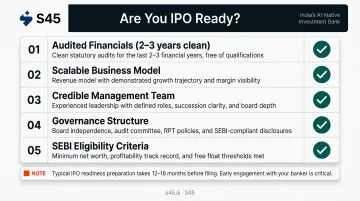
None of these are binary pass/fail checks. Companies often need 12 to 18 months of preparatory work — governance restructuring, accounting policy alignment, cap table cleanup — before they are genuinely DRHP-ready.
Timing the Market
A company can be fundamentally ready but still list into a poor window. Sector-specific sentiment, broader index levels, and institutional appetite for your business category all influence listing outcomes. Listing during a market downturn or a period of negative sector sentiment compresses valuations regardless of company quality.
Founders should assess IPO timing alongside readiness — not treat them as separate questions.
Working with the Right Advisor
The IPO process is regulated, high-stakes, and full of sequencing traps that informal advisors miss. An experienced advisor maps readiness gaps early, prices the business correctly, and builds a clean institutional book — reducing the risk of weak subscription and poor listing.
S45, India's AI-native investment bank, works with founders across the full lifecycle on both Main Board and SME listings. Engagements typically cover:
- IPO Readiness Scan — a 30-minute AI-powered check flagging eligibility gaps in governance, financials, and compliance
- DRHP drafting and SEBI query management — structured, evidence-linked, tracked to closure
- Pricing and bookbuilding — live pricing band with real-time demand mapping across QIB, NII, and retail
- Post-listing investor relations — 30/90-day IR, earnings materials, and analyst coverage coordination
For companies 12 to 18 months from a potential filing, the readiness phase is where eligibility gaps get closed and listing outcomes get protected.
Frequently Asked Questions
Is an IPO a good investment?
IPOs can deliver strong returns when the underlying company has solid fundamentals and the issue is fairly priced. However, limited public financial history, valuation uncertainty, and post-listing volatility create real risks. Investors should read the DRHP carefully and assess business quality, not just listing-day demand.
How do you earn profit from an IPO?
Two routes: sell on listing day to capture any listing pop, or hold shares and benefit from long-term capital appreciation as the company grows. The second path requires evaluating the business itself — not just GMP or subscription numbers.
Can you sell IPO shares immediately?
Retail investors can sell their allotted shares as soon as the stock begins trading on listing day. Promoters, anchor investors, and other major pre-IPO shareholders are subject to lock-up periods — typically 90 to 180 days post-listing — during which they cannot sell.
Do you get IPO money back if not allotted?
Yes. If your application is not allotted shares — due to oversubscription or partial allotment — the unallotted amount is refunded directly to the bank account linked to your UPI or ASBA application, typically within a few days of allotment finalization.
What is the main disadvantage of going public?
Loss of control and continuous compliance obligations. Founders must answer to public shareholders, meet ongoing SEBI disclosure requirements, and manage quarterly market expectations that can conflict with long-term business strategy.
How long does the IPO process take in India?
A typical mainboard IPO takes 9 to 18 months from preparation to listing. SME IPOs can be completed faster. The timeline depends on the company's readiness, SEBI review cycles, and how clean the data room is at mandate signing.