
For a founder standing at that inflection point, the advisory firm you choose is not a vendor decision. It determines whether your listing is structured, credible, and well-subscribed — or whether you spend 14 months in documentation chaos, only to see a tepid listing day.
This article covers India's top IPO advisory firms, explains what they actually do, and gives founders a framework to evaluate the right partner for their stage and ambition.
Key Takeaways
- IPO advisory firms guide companies through readiness, DRHP drafting, SEBI compliance, bookbuilding, and post-listing investor relations.
- Firm selection should be based on verified execution track record, sector expertise, SEBI registration, and institutional investor network quality.
- The leading firms in India — S45, JM Financial, Axis Capital, Resurgent India, and MUDS Management — each serve different company stages and listing goals.
- S45 pairs AI-led demand mapping with ≤30-day DRHP drafting, 0% upfront fees, and end-to-end execution for growth-stage companies listing on Main Board or SME exchanges.
What Do IPO Advisory Firms Do in India?
The End-to-End Scope
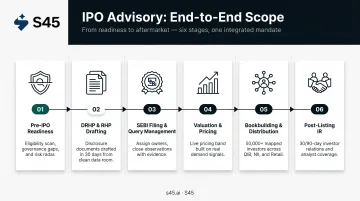
IPO advisory firms help private companies navigate the full public listing journey. That scope covers:
- Pre-IPO readiness — governance audit, financial restatement, board composition, related-party cleanup
- DRHP and RHP drafting — disclosure preparation, data room management, evidence-linked documentation
- SEBI filing and query management — regulatory submissions, observation responses, exchange approvals
- Valuation and pricing — comparable benchmarking, price band determination, anchor investor outreach
- Bookbuilding and distribution — QIB, NII, HNI, and retail demand generation
- Post-listing investor relations — 30/90-day IR, earnings materials, analyst coverage coordination
Advisor vs. Merchant Banker — A Critical Distinction
These roles are related but not identical. A SEBI-registered Category I Merchant Banker (also called a Book Running Lead Manager or BRLM) is the legally accountable entity under SEBI's Merchant Bankers Regulations, 1992. They sign the due diligence certificate, manage the regulatory interface with SEBI and the exchanges, and formally run the bookbuilding process.
An IPO advisory firm provides strategic, documentation, and execution support across that same journey. The best firms either hold their own merchant banking licence or operate through a deep partnership with a licensed BRLM.
| Role | Who They Are | What They Own |
|---|---|---|
| BRLM (Merchant Banker) | SEBI-registered; legally accountable | Due diligence certificate, SEBI interface, bookbuilding |
| IPO Advisory Firm | Strategic and execution partner | Readiness, documentation, pricing support, IR |
For founders evaluating options, this structure — advisory firm paired with a licensed BRLM — is what determines whether you get genuine end-to-end ownership or just a filing service.
Main Board vs. SME: Why It Changes Everything
India has two primary listing pathways:
| Feature | Main Board (NSE/BSE) | SME Board (NSE Emerge/BSE SME) |
|---|---|---|
| Issue size | Larger; broader institutional distribution | Smaller; post-issue paid-up capital ≤ ₹25 crore |
| Eligibility | Stricter profit, net worth, EBITDA thresholds | NSE Emerge requires ₹1 crore EBITDA for 2 of 3 years |
| Market making | Not required | Mandatory for 3 years post-listing |
| Typical timeline | 12–18 months readiness-to-listing | 6–9 months with structured advisory |
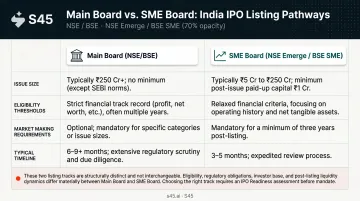
The advisory requirements, investor profiles, and execution complexity differ between these tracks. A Main Board mandate demands institutional-grade documentation, broader QIB distribution, and a longer regulatory runway. An SME mandate requires market maker coordination from day one and a leaner, faster execution model. The two are not interchangeable — and the firm you choose should have a clear track record on the path you're taking.
Top IPO Advisory Firms in India
The firms below were evaluated on execution track record, regulatory standing, range of services, sector expertise, institutional investor network, and verified outcomes for clients.
S45
S45 is India's first AI-native investment bank, built by operators-turned-bankers who set out to fix the chaotic, disconnected IPO process that still defines most advisory engagements in India.
The founding team combines 14+ years of investment banking and operating experience (Deepank Bhandari, formerly BNP Paribas, Blinkit, 1mg), 22 years in capital markets including 16+ Main Board IPOs (Pankaj Harlalka, formerly Microsec India), and an IIT Delhi entrepreneurial and SaaS background (Aman Singh, founder of SayF, formerly Khosla Ventures-backed).
The firm operates as a pure-play IPO bank — no M&A, no debt syndication, no FPOs for already-listed companies. It executes in partnership with Narnolia, a Category-I SEBI-Registered Merchant Banker, which serves as the regulatory Lead Manager. S45 runs the AI-led readiness, demand mapping, pricing analytics, and post-listing IR layer.
What separates S45 operationally:
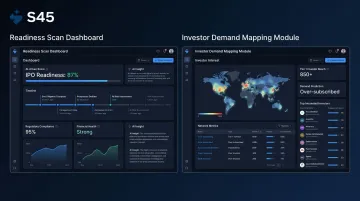
- Cohort-level investor demand mapping completed before mandate signing — founders know institutional appetite before the clock starts
- 30-minute AI Readiness Scan covering financials, governance, litigation, demat readiness, and free float
- DRHP-ready in 30–45 days from data-room handoff, with evidence-linked drafting and a live SEBI Query Board for observation tracking
- 50,000+ mapped investors across QIB, NII, HNI, and retail — domestic and offshore
- Post-listing IR covering 30/90-day investor relations, earnings materials, analyst coverage, and SME market maker coordination
- 0% upfront fees — milestone-linked fee model tied to execution outcomes
| Metric | S45 Track Record (Since July 2023) |
|---|---|
| IPOs Executed | 26 |
| Capital Raised | ₹1,180+ Crore |
| Average Subscription | 168x |
| Average Listing Pop | 43% |
| Total Bids Generated | ₹1,83,000+ Crore |
| Listing Focus | Main Board and SME across 12 industry sectors |
JM Financial
JM Financial is one of India's most established full-service investment banks and a SEBI-registered Category I Merchant Banker. The firm has a long track record managing large Main Board IPOs across financial services, manufacturing, and consumer businesses, and maintains a publicly accessible Public Issue of Equity track record page listing recent mandates including Capillary Technologies, Aequs, and Corona Remedies.
Its institutional investor relationships and equity research capabilities make it a credible co-BRLM or lead manager for companies targeting large-scale Main Board listings with significant QIB participation.
| Feature | Detail |
|---|---|
| Listing Focus | Primarily large-cap and mid-cap Main Board IPOs on BSE and NSE |
| Key Differentiator | Deep institutional investor relationships; equity research coverage post-listing |
| SEBI Standing | SEBI-registered Category I Merchant Banker and BRLM |
Axis Capital
Axis Capital is the investment banking arm of Axis Bank and one of India's most active equity capital markets advisors for mid-to-large cap Main Board listings. The firm claims relationships with 500+ leading institutional investors across domestic and global markets, and has acted as lead manager on high-profile listings including LG Electronics India (₹1,16,407 million), Waaree Energies (₹43,210 million), and Groww (₹66,323 million).
Its ability to mobilise both domestic mutual funds and foreign institutional investors makes it a strong choice for companies targeting premium Main Board valuations with anchor investor participation.
| Feature | Detail |
|---|---|
| Listing Focus | Mid-to-large cap Main Board IPOs with strong institutional investor mobilisation |
| Key Differentiator | Backed by Axis Bank's balance sheet; 500+ institutional investor relationships; strong anchor placement |
| SEBI Standing | SEBI-registered Category I Merchant Banker (Reg. No. INM000012029) |
Resurgent India
Resurgent India is a SEBI-registered Category I Merchant Bank offering integrated advisory across DRHP preparation, valuation, due diligence, underwriting, debt syndication, ESG advisory, and post-IPO compliance. The firm claims 1,000+ transactions and USD 3 billion+ in advised value across its broader practice, though it hasn't published specific IPO mandate counts.
It covers pre-IPO restructuring through to listing — a practical fit for mid-sized companies that need governance strengthening, Ind-AS restatement, or related-party cleanup before filing.
| Feature | Detail |
|---|---|
| Listing Focus | Mid-cap and SME companies; Main Board and SME IPO listings |
| Key Differentiator | Integrated advisory covering pre-IPO restructuring, valuation, due diligence, and post-listing compliance |
| SEBI Standing | SEBI-registered Category I Merchant Banker; ISO 9001:2015 certified |
MUDS Management
MUDS Management is an SME IPO consulting firm focused on guiding small and medium enterprises through the full listing process on BSE SME and NSE Emerge. Its service scope includes DRHP documentation, SEBI filings, registrar coordination, market maker arrangements, and post-listing compliance — with an educational approach designed to keep founders informed through each stage.
The firm is a practical choice for SME-stage companies that need dedicated, process-oriented support through exchange-specific requirements without the overhead of a full-service investment bank.
| Feature | Detail |
|---|---|
| Listing Focus | SME-focused: BSE SME and NSE Emerge platform listings |
| Key Differentiator | End-to-end SME IPO process management including regulatory coordination with SEBI and stock exchanges |
| Notable Feature | Ongoing post-listing compliance support and investor relations management for newly listed SMEs |
How We Chose the Best IPO Advisory Firms
The Evaluation Framework
The IPO advisory space in India includes hundreds of firms, from boutique consultants to full-service investment banks. Most founders make the mistake of choosing based on brand recognition or headline fee — without examining execution quality, sector fit, or what the firm actually does after the DRHP is filed.
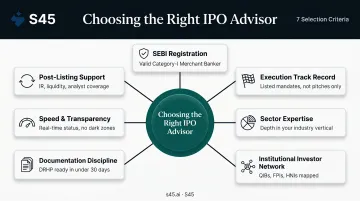
We assessed each firm across these criteria:
- SEBI merchant banking registration — Category I registration or a verified, operational BRLM partnership
- Verifiable execution track record — subscription rates, listing gains, post-IPO performance, and named mandates
- Sector expertise — depth in the issuer's specific industry, not generic advisory capability
- Institutional investor network — quality and breadth of QIB, NII, HNI, and anchor relationships
- Documentation and compliance discipline — DRHP quality, SEBI observation handling, audit readiness
- Speed and process transparency — clear timelines, milestones, and execution accountability
- Post-listing support — investor relations, earnings materials, market maker coordination for SME issues
These criteria tell you what a firm can do. The red flags below tell you when to walk away.
Red Flags to Watch For
Before signing any mandate, founders should be alert to these warning signs:
- Guaranteed valuation or subscription promises — SEBI prohibits these, and any advisor offering them is either uninformed or misleading you
- No verifiable track record — ask for named IPOs, subscription data, and listing performance, not just total "transactions advised"
- Unusually low fees without explanation — ask for a line-item breakdown; retainer scope, DRHP drafting, roadshow support, and post-listing IR are commonly excluded from headline quotes
- Junior execution teams — a mandate sold by a senior partner but executed by a junior team is one of the most common complaints in the advisory market
- No defined post-listing scope — an advisor who disappears after listing day has misaligned incentives with your long-term public market performance
Ask any shortlisted firm to walk you through their last three mandates: what happened between DRHP filing and listing day, how they handled SEBI observations, and who managed the book. The answers tell you more than any credential page.
Conclusion
Choosing an IPO advisory firm is a strategic decision, not a procurement exercise. The firm you pick shapes whether your company enters public markets with clean books, credible disclosures, and investors who were mapped before the roadshow began.
Go beyond brand recognition. Evaluate advisors on their actual execution process, sector depth, regulatory relationships, and what happens after listing day. The founders who do this consistently end up with stronger subscriptions, tighter disclosures, and listing pops that reflect genuine investor conviction — not just retail momentum that fades in two weeks.
For founders who want structured, AI-native IPO execution — from a 30-minute eligibility scan to a signed mandate in 7 days to a DRHP-ready draft in under 30 days — S45 has built the process and the platform for that. Reach out to the S45 team at +91 95879 52454 or visit their office at Cessna Business Park, Bengaluru to run your IPO Readiness Scan.
Frequently Asked Questions
What are IPO advisory services?
IPO advisory services help private companies navigate the end-to-end process of listing on a public stock exchange. This covers IPO readiness assessment, DRHP preparation, SEBI regulatory filings, investor marketing, bookbuilding, and post-listing investor relations support.
What is the difference between an IPO advisor and a merchant banker in India?
A SEBI-registered merchant banker (BRLM) is the legally accountable entity — responsible for due diligence certification and the regulatory interface with SEBI and exchanges. An IPO advisor provides strategic, documentation, and execution support, either as a combined function or in partnership with a licensed BRLM.
How do I choose the right IPO advisory firm for my company?
Evaluate firms on their verified IPO track record, sector-specific expertise, SEBI registration or BRLM partnership quality, institutional investor network depth, and process transparency. Fees and brand name are secondary to execution capability and sector fit.
How long does the IPO process take in India?
A typical Main Board IPO takes 12–18 months from readiness to listing; SME IPOs can be completed in 6–9 months. With a clean data room and completed audits, DRHP preparation can begin within 30–45 days of mandate signing.
What is the difference between an SME IPO and a Main Board IPO in India?
SME IPOs list on BSE SME or NSE Emerge, with lower eligibility thresholds — NSE Emerge requires post-issue paid-up capital not exceeding ₹25 crore and ₹1 crore EBITDA for 2 of 3 prior financial years. Main Board IPOs require larger issue sizes and more stringent SEBI compliance. SME listings also require mandatory market making for three years post-listing.
How much does IPO advisory cost in India?
IPO advisory fees typically include a retainer for readiness and filing work, a milestone-linked success fee as a percentage of issue size, and out-of-pocket costs for regulatory filings, roadshows, and marketing. Request an itemised fee breakdown upfront and tie payments to specific execution milestones — this structure protects you and aligns the advisor's incentives with your listing outcome.