But listing a company is not the same as completing an exit. Many promoters and PE funds discover this late. An IPO usually delivers staged liquidity, often through an offer for sale (OFS), and rarely transfers control or clears a full stake on day one.
In calendar 2025, Main Board IPOs in India carried Rs111,495 crore of OFS against Rs64,406 crore of fresh issuance, according to PRIME Database. This guide explains how the exit works, when it fits, and what it costs.
Key Takeaways
- An IPO is an exit route, but rarely an immediate or complete one.
- Fresh-issue money goes to the company; OFS money goes to selling shareholders.
- Suitability turns on market readiness, governance, valuation and the need for growth capital.
- Plan promoter and PE liquidity together with post-listing governance and disclosure.
How an IPO Creates Liquidity for Promoters and PE Investors
What an IPO exit strategy means
An exit strategy is a planned route for founders, promoters, funds or other shareholders to realise value from their investment. It also decides what happens to the business afterwards.
Unlike a trade sale, an IPO usually leaves the company independent and listed. Individual shareholders can then sell at different stages. This article focuses on promoter and PE liquidity, not retail investors deciding whether to sell on listing day.
Fresh issue versus offer for sale
A fresh issue creates new shares. The company receives the money and spends it on disclosed purposes such as expansion, working capital, debt reduction or acquisitions.
An OFS transfers existing shares. The selling shareholder, whether promoter or PE fund, receives the proceeds directly.
One IPO can combine both. In its November 2024 prospectus, Swiggy's IPO had a fresh issue of ₹4,499 crore and an OFS of ₹6,828 crore. The first funded the company. The second paid existing shareholders.

Main Board OFS shares must generally be fully paid and held by the seller for at least one year before the DRHP is filed, with specified exceptions.
How promoters use an IPO
Promoters rarely sell out entirely. Common aims include:
- Selling a slice to diversify personal wealth
- Bringing institutional shareholders onto the register
- Supporting succession planning
- Funding the next growth phase while keeping leadership
The rules shape what is possible:
- Minimum promoter contribution is generally 20% of post-issue capital on the Main Board.
- That contribution is locked in for 18 months, or 3 years under the capex condition.
- Promoter holding above the minimum is generally locked in for 6 months, or 1 year under the same condition.
- Promoter trades are subject to insider-trading and takeover disclosure rules.
Rules change often. Confirm the current ICDR text with your advisers before fixing a plan.
How PE investors realise returns
PE funds typically sell some shares in the IPO, sell later once lock-ins end, or combine both in a staged sell-down.
- The general non-promoter lock-in is 6 months from allotment.
- Category I/II AIFs, VCFs and FVCIs have a specified exception requiring one year from purchase. FPIs are not in that exception.
- A shareholder holding over 20% may offer at most 50% of its pre-issue holding in certain Regulation 6(2) issues.
Fund life, return targets, portfolio concentration and market depth all affect timing. EY and IVCA recorded 42 PE/VC IPO exits worth US$3,894 million in 2025. Listing opens a liquidity pathway. It does not guarantee valuation, volume or return.
Main Board and SME considerations
The right route depends on scale, eligibility, governance maturity and ambition. SME exits are tighter.
- SME OFS is capped at 20% of issue size, and each seller may sell at most 50% of its holding.
- SME minimum promoter contribution is locked in for 3 years.
- NSE Emerge and BSE SME require post-issue capital up to ₹25 crore.
- Migration to the Main Board is not automatic. It needs shareholder approval and Main Board eligibility.
Check the latest eligibility, trading and shareholder-sale rules with SEBI and the exchange before deciding.
When Is an IPO the Right Exit Route?
Objectives of the company and its shareholders
An IPO suits a company that wants growth capital, public visibility, institutional ownership and operational independence. Frame the decision around the company's next phase, not exit alone.
If promoters or PE investors mainly want a fast, complete sale, a strategic acquisition or secondary transaction usually serves them better.
Public-market readiness
A strong private valuation does not make a company IPO-ready. Investors and regulators look at:
- Revenue quality and cash flows
- Profitability or a credible path to it
- Customer or business concentration
- Competitive position and scalability
- Quality of financial reporting
The case must rest on consistent, verifiable information.
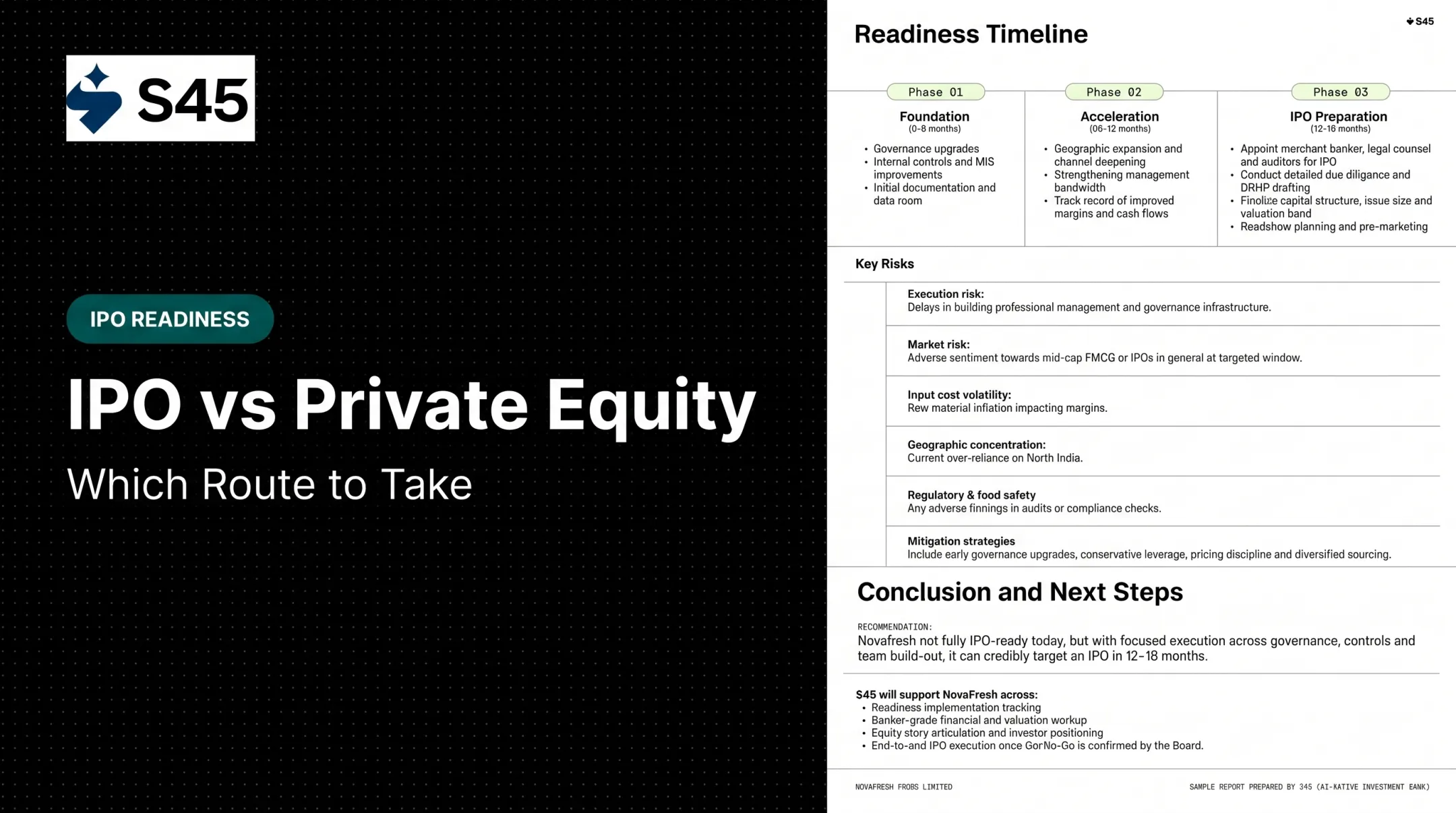
S45's sample readiness report for a fictional food company, NovaFresh, illustrates this: a score of 73/100, a "Partially IPO-Ready" label and a 12 to 18 month gap-closing timeline, driven by working-capital intensity and limited regional depth.
Promoter and PE alignment
Promoters often prioritise control and long-term value. PE investors prioritise fund timelines and realisation. These goals can collide.
Review shareholder agreements early, including exit rights, preference terms, drag-along and tag-along clauses and transfer restrictions. Then agree who sells, how much, when, and whether the IPO favours primary capital, secondary liquidity or both.
Market timing, valuation and demand
Sentiment, sector performance, listed comparables, interest rates and the IPO pipeline all affect pricing. Valuation expectations are not the same as achievable pricing.
Issues can be delayed, resized, repriced or withdrawn. In April 2025, Reuters reported that Ather Energy cut both its fresh issue and OFS amid market volatility.
IPO versus alternatives
| Route | Liquidity | Control | Capital raised | Confidentiality |
|---|---|---|---|---|
| IPO | Staged | Often retained | Yes, via fresh issue | Low |
| Strategic sale | Often full | Usually transferred | To sellers | Higher |
| PE secondary | Full or partial | Varies | To sellers | Higher |
| Company buyback | Limited, rule-bound | Retained | None | Moderate |

Routes can be sequential. A private secondary may give interim liquidity, and an acquisition may later seed a listing.
The deciding question: does the company need public capital and independence, or do shareholders mainly need negotiated liquidity and a transfer of control?
IPO Readiness and Execution Roadmap in India
Set strategy and test eligibility
Start with a readiness diagnostic: listing route, primary and OFS mix, who sells and why, capital needs, shareholder structure and likely investor base. Design the structure early so dilution, promoter ownership, PE liquidity and post-listing control are weighed together.
Have qualified advisers verify current ICDR, Companies Act, exchange and accounting requirements.
Build clean financial, legal and operational foundations
Gaps found during diligence cause delays and valuation questions. Clean up:
- Audited financials and any restatements
- Tax matters and contingent liabilities
- Related-party transactions
- Material contracts, licences and litigation
- IP ownership, subsidiaries and debt arrangements
Keep a data room with source-linked evidence so management, auditors and counsel work from one verified set of facts.
Strengthen governance
Promoter and PE-backed companies must show that controls survive continuing public scrutiny, not just a one-time review. Under LODR, the independent-director requirement is generally one-third with a qualifying non-executive chair, and one-half in other specified cases. The audit committee needs at least three directors, two-thirds independent.
Prepare management for quarterly results (generally within 45 days), event disclosures and analyst interactions.
Prepare the DRHP and diligence
The company, merchant banker, auditors, legal counsel and registrar each own part of the DRHP. The public-comment period is 21 days, and SEBI's 30-day observation clock runs from the latest applicable trigger. It is not a guaranteed 30-day timetable.

Draft business, risks, use of proceeds, promoter background, PE ownership and financial history from evidence. Avoid unsupported projections and promotional language.
Build demand, price and allocation discipline
Price discovery comes from investor education, management presentations, anchor engagement and bookbuilding feedback. Demand signals are not binding commitments.
Main Board allocation rules:
- Regulation 6(1) route: up to 50% QIB, at least 15% NII and at least 35% retail
- Regulation 6(2) route: QIBs take at least 75%
- Cap price: 105% to 120% of the floor
- Listing timeline: T+3 basis

Pricing must balance shareholder liquidity against sustainable aftermarket performance.
Manage listing and the post-IPO sell-down
After listing, promoters and PE investors need written selling principles: staged sales, compliance windows, communication and the effect on market confidence. Promoters and directors must disclose trades above ₹10 lakh in a quarter within two trading days.
S45, an AI-enabled investment bank, works with Narnolia as Category-I merchant banker and Lead Manager. S45 runs readiness assessment, demand mapping, pricing support and 30/90-day post-listing investor relations. It does not guarantee pricing, allotment or timelines.
Risks and Trade-offs of Using an IPO as an Exit Strategy
Market, valuation and execution risk
Volatility, weak demand, regulatory observations or open diligence points can delay, resize or kill an issue. Ather Energy's reduced offer size is a recent example.
Historical returns do not predict the future. A SEBI study found only 26 of 144 Main Board IPOs (April 2021 to December 2023) gained over 50% on listing day. Locked-in holders could not sell at those prices anyway.

Liquidity, lock-in, dilution and control
- Promoters or PE funds may be unable to sell their full intended stake at listing.
- Fresh issuance dilutes existing holders.
- A large OFS can signal reduced commitment if the rationale is unclear.
Judge the post-IPO ownership and voting structure, not just headline issue size or implied valuation.
Ongoing public-company obligations
Public listing brings lasting obligations beyond the exit event:
- Recurring disclosures and statutory audits
- Related-party transaction scrutiny
- Share-price volatility and pressure to explain short-term results
Get tax, securities-law and transaction advice from qualified Indian legal, tax and capital-markets professionals.
Practical Checklist for Promoters and PE Before Choosing an IPO Exit
- Clarify the outcome. Is the goal growth capital, partial promoter liquidity, PE realisation, a full exit or continued independence? Fix selling shareholders, percentage ranges, control goals and timing before appointing advisers.
- Test readiness and alignment. Review the cap table, investor rights, preference terms, transfer restrictions, financial records, legal risks, governance and IP. If a PE fund's horizon clashes with the growth timetable, consider a private secondary as interim relief.
- Compare routes. Weigh IPO, strategic sale and secondary against capital raised, liquidity, control, confidentiality, complexity and ongoing obligations.
- Build a phased plan. Cover readiness work, adviser selection, diligence, DRHP, investor engagement, pricing, listing and post-listing investor relations.
Treat an IPO as a long-term capital-markets strategy, not a one-day chance to sell shares.
Frequently Asked Questions
Is an IPO an exit strategy?
Yes, partly. An IPO can give promoters and PE investors liquidity through an OFS or later market sales, but it does not automatically create an immediate or complete exit.
When can you exit after an IPO?
Timing depends on lock-ins, disclosure rules, market conditions, valuation and whether you prefer a staged sell-down. Confirm current SEBI lock-in rules and take professional advice before you sell.
What is an exit strategy?
It is a plan for owners or shareholders to realise value through an IPO, sale, secondary transaction, buyback or another liquidity route.
How do promoters exit through an IPO?
Promoters can sell in an OFS and, where permitted, in the market after lock-ins end. Many choose a partial exit and keep a meaningful stake.
Can private equity investors exit during an IPO?
Often yes, through an OFS or later sell-down. It depends on issue structure, lock-ins, fund documents, disclosure rules and investor demand.
Is an IPO better than an acquisition for a promoter or PE investor?
An IPO may preserve independence and raise public capital. An acquisition may offer a more complete, negotiated transfer. The better choice depends on control, timing, valuation and capital needs.