Introduction: Why Pro Forma Financial Statements Matter in an IPO
An IPO asks more than "what did you earn last year?" Founders and investors also want to know how the fresh issue, debt repayment, issue costs and capex plans change the balance sheet and earnings.
Pro forma financial statements answer that. They take a clean historical base, apply stated adjustments, and show an illustrative result. They are not audited accounts, and they are not restated financials.
Under ICAI's SAE 3420, pro forma information shows a specified transaction as if it had occurred at an earlier date. Confusing it with projections or restatements is one of the most common mistakes in IPO preparation.
This article covers the three core statements, the preparation workflow, Indian disclosure considerations, and how pro forma financials differ from projections and a pro forma cap table.
Key Takeaways
- Pro forma statements show the illustrative effect of a defined transaction, such as an IPO.
- A usable IPO model links the P&L, balance sheet, cash flow, share capital, proceeds and issue expenses.
- Restated figures describe the past; pro forma figures describe a defined scenario.
- Every assumption needs evidence, documentation and a check against current ICDR requirements.
What Does Pro Forma Mean in an IPO?
A pro forma financial statement shows what a company's position or performance could look like after a specified event. In an IPO, that event is usually the issue itself and what the money is meant to do.
IPO events a model can capture
- Fresh issue of shares and the resulting change in share count
- Repayment of borrowings from proceeds
- Capex or capacity expansion funded by the issue
- Issue expenses and intermediary fees
- The effect on equity and earnings per share
How it differs from related terms
| Term | What it shows |
|---|---|
| Historical statements | Actual past transactions under the applicable framework |
| Restated financials | Historical figures adjusted for consistent policies, presentation and corrections |
| Management projections | Expected future performance driven by operating assumptions |
| Pro forma cap table | Ownership and dilution only, not a full set of statements |
The distinction matters because investors must know which numbers are history, which are adjusted for a transaction, and which depend on future assumptions.
A simple example: take a company's pre-issue balance sheet. Add fresh capital to cash and equity, deduct issue costs, reduce debt by the planned repayment, and show the rest of the proceeds as awaiting deployment. That is a pro forma balance sheet, with no forecast of future profit involved.
Treat these statements as decision-support tools. They guarantee nothing about post-listing performance.
What Should IPO Pro Forma Financial Statements Include?
SAE 3420's illustrative report identifies a pro forma balance sheet, statement of profit and loss, cash flow statement and related notes. It also allows individual or condensed statements, so a full set is not always required.
Pro forma income statement
The income statement shows how proposed changes affect revenue, COGS, employee costs, selling and administrative expenses, depreciation, finance costs, tax, profit, margins and EPS. Lower finance costs after debt repayment is the classic IPO adjustment.
Pro forma balance sheet
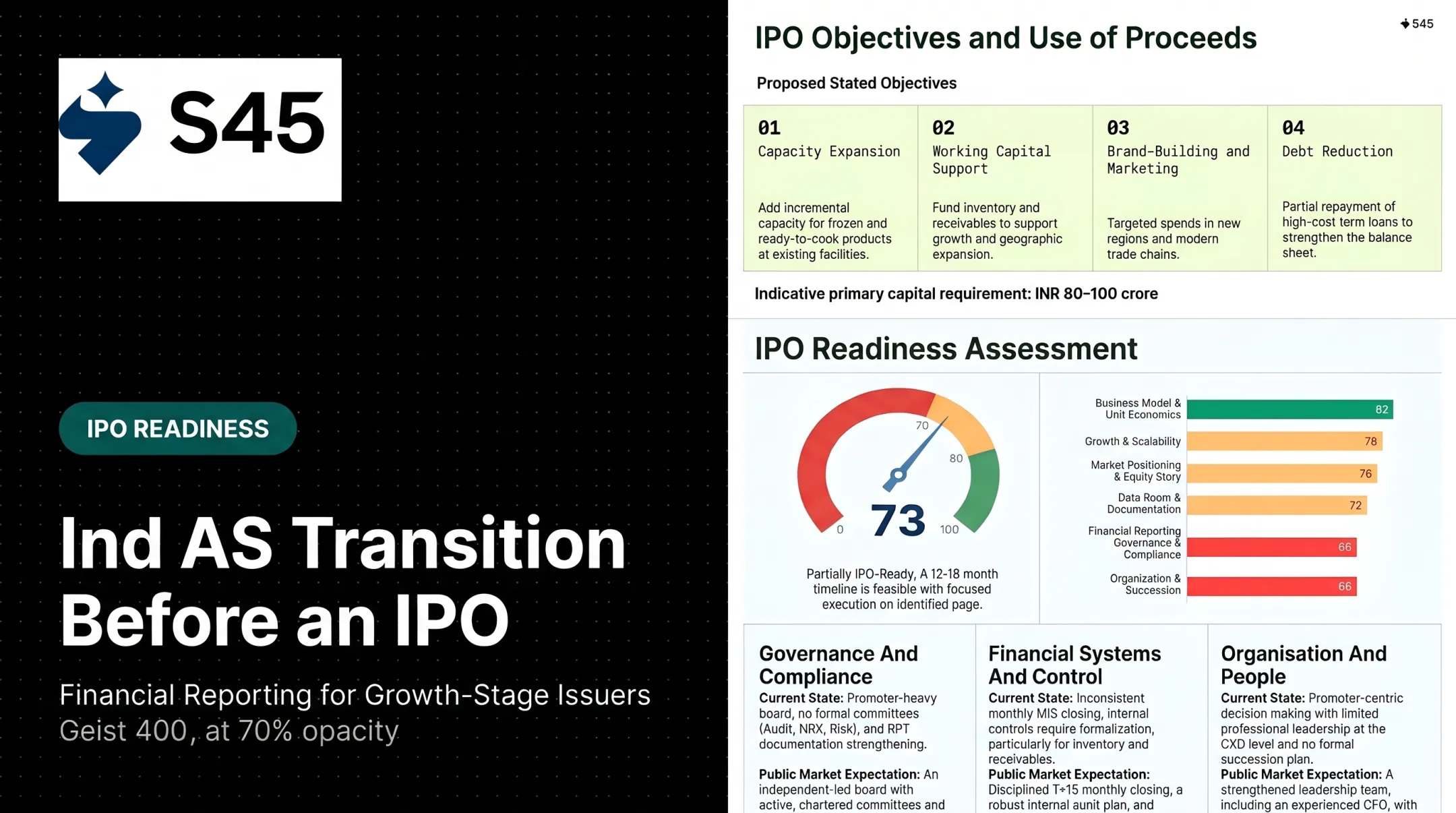
The balance sheet captures effects on cash, fixed assets, working capital, debt, other liabilities, share capital, securities premium, retained earnings and net worth. For a company like the sample issuer NovaFresh, with an indicative ₹80–100 crore requirement, this is where capacity expansion and debt reduction become visible.
Pro forma cash flow statement
Cash flow links operating cash generation to investing uses (capex) and financing flows (IPO proceeds, repayments, issue costs). Working capital often decides whether the cash picture holds up.
Supporting schedules
- Pre-issue and post-issue share count and dilution
- Use-of-proceeds schedule with timing and financial impact
- Debt, working capital, capex, depreciation, tax and issue-expense schedules
- Sector KPIs such as capacity, utilisation, retention, margins or receivable days
Adjustment rules are strict:
- Must be directly attributable to the transaction and factually supportable
- Future actions after completion are not automatically valid adjustments
- Each material adjustment needs a bridge back to restated historical information
- Tag every number as sourced, estimated or scenario-dependent
An illustrative layout:
| Line item | Restated (pre-issue) | Adjustment | Pro forma |
|---|---|---|---|
| Cash | Sourced | + Net proceeds, − repayment | Derived |
| Borrowings | Sourced | − Repayment | Derived |
| Net worth | Sourced | + Net fresh issue | Derived |
How to Prepare Pro Forma Financial Statements for an IPO
- Define the purpose. Is it readiness, issue-size analysis, use-of-proceeds planning or debt reduction? The purpose sets the transaction perimeter.
- Build the historical base. Use audited or restated financials, management accounts, ledgers, debt schedules, fixed-asset registers, cap-table records and KPIs. SEBI's framework looks for three years plus a stub period where applicable.
- Write explicit assumptions. Cover fresh issue size, treatment of any offer for sale, issue expenses, timing of proceeds, capex, repayments and tax effects.
- Integrate the three statements. Operating assumptions flow to profit, profit flows to equity, working capital hits cash, and financing actions update the balance sheet.
- Run scenarios. Build a base and a downside case. Add an upside only if operating evidence supports it. Test revenue growth, margins, collection periods, capex delays and proceeds timing.
- Reconcile to offer documents. Figures, share counts, proceeds and use-of-funds language must not contradict the DRHP narrative.

Where an adviser helps
Statutory responsibility stays with the issuer, auditors and the merchant banker. S45 supports the surrounding work:
- IPO readiness scans
- Evidence-linked financial analysis in a versioned data room
- Coordination of auditors, counsel and Narnolia (its Category-I merchant banker partner)
- Pricing sensitivities on growth, margin and working capital
S45 does not guarantee timelines, pricing or allotment.
IPO Disclosure, Review, and Risk Considerations
What the regulations require
Under SEBI's ICDR Regulations, material disclosures must be true and adequate. Mandatory pro forma applies only in a narrow case: material businesses or subsidiaries acquired or divested after the latest disclosed period, where materiality is 20% or more of turnover, net worth or profit before tax.

ICDR does not impose a universal pro forma three-statement mandate for every Main Board or SME IPO. Confirm current requirements with your merchant banker and counsel.
ICDR separately requires a capitalisation statement (borrowings and equity before and after the issue), plus pre-issue and post-issue EPS and NAV disclosures. These are narrower than a full pro forma set.
Disclosure controls
- Label historical, restated, pro forma and projected figures separately
- Explain assumptions and adjustment mechanics
- State the source and period of each data set
- Disclose material limitations
- Obtain appropriate professional review
Common errors
- Overly optimistic assumptions
- Leaving out recurring costs
- Double-counting proceeds
- Treating offer-for-sale money as company cash
- Omitting issue expenses
- Using inconsistent post-issue share counts
- Letting stale model versions circulate
Proceeds disclosure carries real enforcement risk. In a 2025 SEBI confirmatory order, INR 19 crore of a INR 54.04 crore SME issue was allegedly paid to three entities, against INR 80 lakh of issue expenses disclosed. SEBI called its findings prima facie.

Reading the model
Compare assumptions with historical trends, sector evidence, capacity and cash needs. Look at the downside case before the headline profit figure.
Frequently Asked Questions
What is a pro forma financial statement?
It is financial information adjusted to illustrate a specified transaction as if it had occurred at an earlier date, based on stated assumptions. It differs from audited or restated historical financials.
What are examples of pro forma financial statements?
A pro forma income statement, balance sheet and cash flow statement. In an IPO, they reflect issue proceeds, debt repayment, capex and post-issue equity.
Is a pro forma financial statement the same as a profit and loss (P&L) statement?
No. A pro forma P&L is one type. A complete set may also include the balance sheet, cash flow statement and supporting schedules.
How are pro forma financial statements used in an IPO in India?
They support use-of-proceeds analysis, capital structure, dilution and liquidity planning, and investor evaluation. Required disclosures vary, so verify current ICDR requirements for your route.
What is the difference between pro forma and restated financial statements in an IPO?
Restated statements present historical performance with consistent policies and corrections. Pro forma statements model a defined hypothetical or post-transaction scenario.