Each label answers a different question: who receives the money, how the price is found, what ownership changes, and who can apply. SEBI's annual report records 366 newly listed companies, 109 on the Main Board and 257 on SME platforms, so the choice of structure is a live decision for many founders.
This guide covers the main classifications, how the Indian IPO process runs, the IPO versus public issue distinction, and what founders and investors should check first.
Key Takeaways
- An IPO is a first public offer; "public issue" covers IPOs and FPOs.
- Classifications overlap: pricing, source of shares, listing segment, issuer stage.
- Fixed-price issues state the price upfront; book-built issues discover it within a band.
- Fresh issues fund the company; an OFS pays selling shareholders.
- Choose a structure based on capital need, dilution, readiness and compliance capacity.
What Is an IPO and Public Issue in India?
An initial public offer is the first offer of securities by an unlisted issuer to the public, followed by listing on a recognised stock exchange. Under the current ICDR definition, a public issue is an IPO or a further public offer (FPO) by an already listed company. A rights issue sits in a separate chapter of the regulations.
Public issues also sit across two markets. In the primary market, the issuer or selling shareholders offer securities for the first time. In the secondary market, later investors trade listed shares among themselves.
Why does the classification matter?
One offering can carry several labels at once, for example, a book-built SME IPO with a fresh issue and an OFS. Each label describes a different dimension:
- IPO or FPO: the issuer's listing status
- Fixed-price or book-built: the pricing method
- Fresh issue or OFS: who gets the proceeds
- Main Board or SME: the listing segment
The structure alone does not say whether an issue is attractive. Investors still need the prospectus, valuation, risks, use of proceeds and promoter holdings.
Types of IPO and Public Issues in India
IPO and public issues in India are classified along several dimensions at once. The same offer can be book-built and a fresh issue, or Main Board and an OFS, so these labels are not mutually exclusive.
Pricing-based issues
In a fixed-price issue, the price is disclosed in the offer document before applications open. In a book-built issue, investors bid within a price band and the final price is discovered from demand.
Key mechanics for book-built Main Board issues:
- The cap price must be 105% to 120% of the floor price.
- The band is announced at least two working days before an IPO opens, if not already in the RHP.
- Retail investors may bid at cut-off, accepting whatever price is discovered.
- A band revision extends bidding by three days, within a 10 working day maximum.
- SME issues opening from 1 July 2025 do not allow cut-off bidding or cancellation.

Confirm the latest position in current SEBI and exchange circulars, because bidding rules change.
Funding and ownership-based issues
- Fresh issue: new shares; proceeds go to the company for its disclosed objects.
- Offer for sale (OFS): existing holders sell; proceeds go to them, not the company.
- Combined issue: both, with company objects and seller proceeds kept distinct.
The split decides dilution and who exits. NTPC Green Energy's 2024 prospectus is a fresh-only example: a ₹10,000 crore fresh issue with no OFS. Never assume an issue's purpose; read the objects section of the prospectus.
Main Board general corporate purposes are capped at 25% of the amount raised by the issuer. Selling shareholders generally must have held shares for at least one year before the DRHP.
Main Board vs SME
| Aspect | Main Board | SME (NSE Emerge, BSE SME) |
|---|---|---|
| Post-issue paid-up capital | At least ₹10 crore | Up to ₹25 crore |
| Typical track record | Three years of profits and net worth tests | Three years; EBITDA of ₹1 crore in two of three years |
| Minimum application | Retail up to ₹2 lakh | Two lots above ₹2 lakh (from 1 July 2025) |
| Market making | Not required | At least three years |
| OFS limit | Route-specific | 20% of issue size |

SME general corporate purposes are capped at the lower of 15% of the amount raised or ₹10 crore. Lock-ins also differ: Main Board excess promoter holding is released after six months in the ordinary case, while SME releases happen in stages.
Always verify thresholds against the latest SEBI, NSE or BSE material.
IPO, FPO and rights issue
An IPO is the first public offer by an unlisted company seeking a listing. An FPO is a later public offer by a company that is already listed. A rights issue is offered only to existing shareholders as of a record date, and falls outside the ICDR definition of a public issue.
Both FPOs and rights issues can raise further capital, but pricing, eligibility and timelines depend on the offer document.
How Does an IPO Work in India?
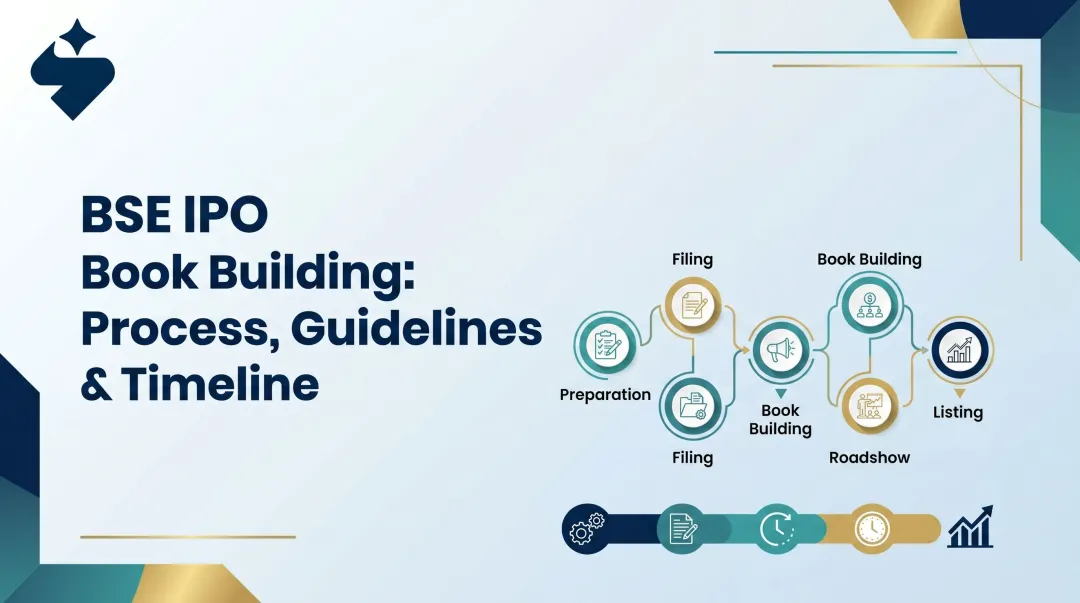
- Preparation. The company tests readiness, appoints a merchant banker and advisers, cleans up financial reporting and governance, and picks an issue structure.
- DRHP. The draft is filed with SEBI and made public for comment for at least 21 days. It covers the business, three years of audited financials, risks, litigation, promoters, related-party transactions and objects of the issue.
- RHP. After SEBI observations are closed, the RHP is filed with the RoC at least three days before opening.
- Pricing. Fixed-price issues set the price upfront. Book-built issues rely on valuation work, comparables, roadshows and bidding demand. Grey market premium is not an official mechanism; SEBI has called it unofficial and unregulated.
- Bidding. Investors apply through ASBA or UPI. Money stays blocked in the bank account, and only the amount for allotted shares is debited.
- Allotment and listing. The timeline runs T+1 for the basis of allotment, T+2 for unblocking and demat credit, and T+3 for listing.

Investor categories
Once bidding closes, allotment follows SEBI’s category-wise split. For Main Board book-built issues under the common route (Regulation 6(1)):
- QIBs: not more than 50%
- NIIs: at least 15%
- Retail: at least 35%
Under Regulation 6(2), QIBs get at least 75%. Retail means applications up to ₹2 lakh. Up to 60% of the QIB portion can go to anchor investors, with lock-ins of 30 and 90 days.

Applying never guarantees allotment. Shares allotted at the offer price differ from shares bought later on the exchange.
How to Choose the Right IPO or Public Issue Structure
The right structure depends on objective, readiness, investor base and long-term obligations, not on what is most popular.
Factors to consider
- Purpose: growth capital, expansion, debt repayment, working capital, shareholder exit, or a mix
- Scale and fit: sector, financial history, governance, dilution tolerance, and whether Main Board or SME is realistic
- Pricing: certainty of a fixed price against market-based discovery
- Capacity: cost, documentation, compliance team and post-listing investor relations
What to check before finalising
- Latest SEBI and exchange requirements
- Objects of the issue and the fresh issue versus OFS split
- Related-party transactions, litigation and promoter transactions
- Valuation assumptions, lock-ins and risk factors
Do not choose a route because it is popular or because headline subscriptions look impressive. Fit, transparency and the ability to run a listed company matter more. Listing also brings ongoing LODR duties covering results, shareholding patterns and material events.

When to involve an IPO adviser
Founders often bring in help during the readiness phase. Many companies begin that work 12 to 18 months before filing.
S45, working with Narnolia as the Category-I Lead Manager, supports:
- Readiness scans and evidence-linked DRHP drafting
- Pricing and demand analysis
- Main Board or SME execution
- 30/90-day investor relations It does not guarantee pricing, allotment, listing performance or returns; outcomes depend on SEBI review and market conditions.
Conclusion
Indian IPOs and public issues differ along four dimensions: pricing method, source of shares, listing segment and issuer stage. Separating an IPO from the broader public issue, and reading the offer document closely, helps founders choose a suitable route and investors weigh risk.
Frequently Asked Questions
What are the investor types in an IPO?
The main categories are QIBs (institutions), NIIs or HNIs (above ₹2 lakh) and retail individual investors (up to ₹2 lakh on the Main Board). Allocation depends on the issue route, so check the offer document.
What are class A, class B, and class C shares?
They are not a standard IPO classification in India. The relevant concept is superior-rights equity shares, with voting ratios from 2:1 to 10:1. The offer document sets out any differences in rights.
How does an IPO work?
The company files a DRHP, closes SEBI observations, files an RHP, prices the issue and takes bids. Shares are then allotted, credited to demat accounts and listed. Applying does not guarantee allotment.
What is the difference between IPO and public issue?
An IPO is the first public offer by an unlisted company. A public issue is broader and includes IPOs and FPOs. A rights issue is a separate route for existing shareholders.